The Inevitable Turning Point
Technology moves fast, and society shifts unevenly beneath its weight. In times like these, chasing every new headline is a distraction. What matters is understanding the structural forces quietly at work underneath.
This report looks at signals observed in day-to-day software development, recurring notes and working logs, and broader movements in global industry and geopolitics. It is not a news roundup. It is an effort to trace the trajectories already set in motion, helping us see where we are heading and where our attention belongs.
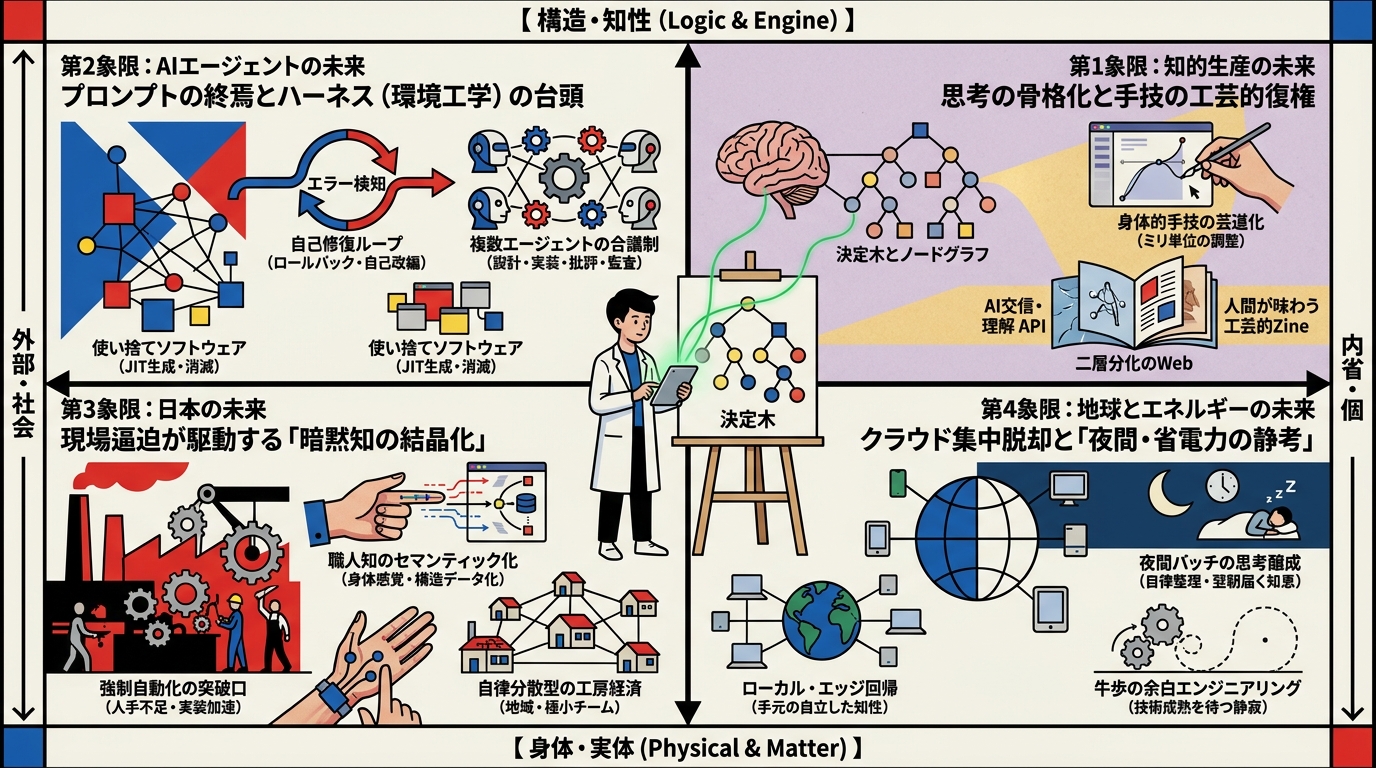
4 Domains: Structural Projections & Strategic Leverage Matrix
The Future of Kamos & Intellectual Production
Leading Signals LEADING SIGNALS
The landscape of the internet is changing quietly but fundamentally. Web analytics reveal that non-human traffic—AI agents, scrapers, and automated crawlers—now accounts for a majority of visits. As a result, the visual veneer of conventional websites is giving way to semantic structures, clean data trees, and node graphs optimized for machine comprehension.
At the same time, creators and engineers are rediscovering design as a disciplined craft. Because generative models can produce polished images and interfaces in seconds, purely automated output has become a cheap commodity. In response, value is shifting back to deliberate physical work: adjusting a bezier curve millimeter by millimeter, honoring the embodied discipline of traditional arts, and engaging in a patient back-and-forth dialogue between rough machine sketches and meticulous human editing.
There is also a growing pushback against the latency and energy costs of continuous, real-time AI requests. Instead, workflows are returning to quiet batch processing: letting autonomous agents organize information overnight and deliver finished digests, notes, or printable zines by the following morning.
Underlying Mechanism UNDERLYING MECHANISM
When the marginal cost of producing digital content falls toward zero, the location of scarcity flips.
Until recently, generating a finished output—whether prose, design, or working code—carried inherent value. In an era of infinite, instant generation, finished products become cheap. Value moves upstream and downstream: upstream to defining clear intent and building structured decision trees, and downstream to the physical context and accountability that only a human being can provide.
While machine-facing interfaces strip away decoration in favor of raw semantic protocols, human-facing interfaces are moving in the opposite direction. They are becoming tactile and intentional, offering the calm, spacious feel of turning the pages of an independent magazine. The relationship between human and computer is shifting from a crude master-servant dynamic into a balanced partnership between a craftsman and a trusted tool.
Future Projections FUTURE PROJECTIONS
- Short term (1–3 months): Decision trees and matrices become the default scaffold for thought. Linear chat logs are quickly losing their appeal. Intellectual workers are turning to structured tools—two-axis matrices and branching decision trees—that break complex problems down into clear, orthogonal choices. Capturing thought as structured, reusable data is replacing disposable conversational history.
- Mid term (6–12 months): The web splits into an Agent Web (A2A) and a Craft Web for humans. Websites will divide into two distinct layers. On the front end, humans will find spacious, quiet, editorial layouts designed for deep reflection. Underneath, machines will trade structured data across clean JSON and API pipelines in milliseconds. Human interfaces will be treated like handcrafted print work: valued for their pacing, texture, and ability to foster deliberate thinking.
- Long term (Multi-year): The emergence of personal "Intellectual Operating Systems." Relying entirely on centralized cloud platforms carries obvious risks. Independent thinkers will increasingly adopt local, personal operating systems that securely store their notes, tastes, and working habits. Rather than relying on an omniscient, distant cloud, people will favor a modest, reliable intellectual partner that runs quietly in the background and helps mature their thoughts overnight.
Focus on two things: the design of underlying data structures (node graphs and decision trees) and the cultivation of manual craft.
The Frontier of AI & Agentic Systems
Leading Signals LEADING SIGNALS
Prompt engineering has run its course. As reasoning models improve and context windows expand, focus has shifted from finding clever phrasing to building the broader runtime environment—the "harness"—in which models operate.
In software engineering, line-by-line coding by humans is rapidly declining. Instead, pipelines of specialized agents take a specification, draft code, run automated tests, and fix bugs autonomously. Meanwhile, mounting copyright disputes and intellectual property concerns are driving a clear division of labor between massive, proprietary cloud models and specialized open-weight models that can run locally.
Underlying Mechanism UNDERLYING MECHANISM
We have moved past prompt engineering into agent harness engineering.
Raw intelligence is useless without eyes to observe the environment, hands to run tools, and persistent memory to track past mistakes. Because intelligence itself is turning into a utility—like running water or electricity—competitive advantage now comes from the harness: the external framework of rules, safeguards, state management, and feedback loops that allows an agent to operate safely on its own.
This changes how software is built. Instead of spending months building permanent, rigid applications, we are entering the era of Just-in-Time Software: code generated on the fly to solve an immediate problem, which can be discarded when the job is done or continuously rewritten by background agents.
[Traditional Software Development]
Specification ──► Manual Coding ──► Build & Test ──► Permanent Maintenance

[Agent Harness Era]
Intent ──► Multi-Agent Deliberation ──► Auto-Generation & Verification ──► Just-in-Time Execution
Future Projections FUTURE PROJECTIONS
- Short term (1–3 months): Prompting yields entirely to environment design. Interfaces that rely on users typing clever instructions will fall out of favor. Systems will instead provide pre-configured context, verified tool access, and safety guardrails. Users simply supply their broad intent, and the harness handles multi-step reasoning behind the scenes.
- Mid term (6–12 months): Deliberative agent teams and persistent memory become standard. Working with a single chatbot will be replaced by small, automated teams: planner, builder, reviewer, and security auditor agents debating among themselves before asking for human approval. Databases will connect directly to long-term memory harnesses, ensuring that project context survives cleanly across work sessions.
- Long term (Multi-year): Intelligence leaves the screen and enters the physical world. The autonomous patterns refined in software will migrate to local hardware, microcontrollers, and robotics. Massive cloud models will still set high-level strategy, but compact, power-efficient local models will handle real-time perception and physical action with near-zero latency.
Build reliable self-healing loops.
Japan’s Structural Shift & Strategic Leverage
Leading Signals LEADING SIGNALS
Across domestic business in Japan, the early enthusiasm for exploratory AI proofs-of-concept (PoCs) is fading into sober disillusionment. Companies find that simple chatbots go unused and fail to move the needle on productivity. Meanwhile, the working-age population is shrinking rapidly.
Logistics, local transit, infrastructure maintenance, elderly care, and small manufacturing shops are hitting a hard wall: job listings go completely unanswered. The traditional corporate approach—gathering everyone in a room to build slow, step-by-step consensus—is breaking down because the bodies simply are not there.
Underlying Mechanism UNDERLYING MECHANISM
This is not merely a slow pace of digital adoption. It is a collision between exhausted consensus-building habits and an unavoidable, forced transition.
For decades, Japanese organizations avoided radical automation out of risk aversion and a desire to preserve existing relationships. But demographic decline has removed the luxury of endless deliberation. When there is no one left to do the physical work, keeping the old habits alive becomes impossible.
To survive, organizations will skip the debate and move directly into wholesale automation, handing operational workflows over to autonomous agents. This is not an ideological embrace of technology; it is basic environmental adaptation.
[Limits of Consensus] Precedent & Endless Meetings ──► Severe Labor Depletion
 │
 ▼ (Physical Limits Hit)
[Forced Transition] Operational Breakdown ──────────► Direct Hand-off to Autonomous Agents
Future Projections FUTURE PROJECTIONS
- Short term (1–3 months): The death of superficial PoCs; focus shifts to survival tools. Vague internal AI trials will lose their funding. The only tools that survive will be lean, single-purpose agents that remove manual hours immediately—processing invoices, routing customer inquiries, and generating standardized documentation.
- Mid term (6–12 months): Forced automation in back-office work, logistics, and maintenance. Sectors facing acute staffing shortages will adopt workflows where human intervention is reserved strictly for exceptions. Data reconciliation, vendor communications, and route optimization will run autonomously in the background without needing routine approvals.
- Long term (Multi-year): A renaissance of tacit physical knowledge through edge AI. As pure software markets saturate worldwide, Japan’s deep reserves of physical know-how—precision engineering, hands-on craft, and subtle, context-aware service—will become globally valuable when paired with local models and robotics. True competitive advantage will belong to those who can connect machine intelligence to the physical world.
Translate unwritten, hands-on workplace knowledge into structured causal models that machines can run.
The Future of Earth, Global Economy & Humanity
Leading Signals LEADING SIGNALS
Looking at global infrastructure, technical ambitions are running straight into the hard physical limits of our planet. New hyperscale data centers require electricity on the scale of mid-sized nations. This has triggered a race to restart nuclear reactors, build small modular reactors (SMRs), and secure scarce grid capacity.
At the same time, geopolitical tensions around semiconductor manufacturing equipment and advanced chips have permanently disrupted open global supply chains. As trust in major currencies wavers, capital is flowing into physical assets like gold and decentralized networks. Securing reliable access to electricity and natural gas has once again become a core pillar of state sovereignty.
Underlying Mechanism UNDERLYING MECHANISM
Compute has become an instrument of state power, and intelligence is physically bound to energy and natural resources.
Software was once thought of as frictionless, weightless, and universally accessible. In reality, state-of-the-art intelligence requires staggering amounts of power, massive volumes of cooling water, rare minerals, and fragile global supply chains.
The limits of intelligence are no longer determined primarily by code, but by who controls the power grid, who has access to cooling water, and who guards the physical trade routes. The dream of a seamless, global internet is giving way to a fractured network divided into regional energy and compute blocs.
[Physical Resource Limits]
Power Grids, Water, and Land ──► Strict Ceilings on Data Center Growth
 │
 ▼
[Sovereignty & Compute Converge]
Computing Equals National Power ──► Resource Securitization and Protectionism
 │
 ▼
[A Fragmented World Order]
Regional Energy & Compute Blocs ──► The Urgent Need for Low-Power, Local Systems
Future Projections FUTURE PROJECTIONS
- Short term (1–3 months): Growth stalls against physical grid bottlenecks. Major cities worldwide will pause or reject new data center projects due to overloaded substations. This friction will generate sharp criticism of energy-wasteful, oversized models, accelerating research into efficient edge deployment and low-power inference.
- Mid term (6–12 months): Compute migrates toward energy-rich regions, altering regional wealth. Infrastructure will concentrate wherever clean, cheap power is abundant—whether through geothermal, hydro, or nuclear energy (such as parts of Northern Europe, the Middle East, and resource-rich mountain regions). Economic advantage will hinge on the pairing of energy sovereignty and computational capacity.
- Long term (Multi-year): Global compute rationing and a focus on civilizational resilience. Faced with energy limits and climate instability, societies will have to decide where their computational resources belong. Power wasted on automated clickbait and hyper-targeted advertising will face strict limits. Computing power will be prioritized for collective survival: climate modeling, drug discovery, energy efficiency, and resilient food production.
Build asymmetric, low-power systems that yield high intellectual output.
Propositions from the Future Researcher
The future ahead is neither a tragedy of lost humanity nor an unavoidable story of decline.
When machine systems take over surface decoration and brute-force scaling hits the wall of physical reality, we are brought back to a fundamental question: Why do we think, and what is truly worth making?
There is no need to rush. We can step back from the endless consumption of instant, push-button content. We can pick up two-axis matrices to untangle complicated realities, sketch our own decision trees, and make conscious choices about where to go. We can let our ideas sit quietly overnight, waking with a clear head to speak honestly with the people around us.
Once the obsession with raw speed burns itself out, a quiet, spacious landscape opens up. That quiet space is where genuine human creativity has always lived. Keep your tools sharp, take pride in your craft, and take the next step with quiet confidence.
PAST ISSUES // BACK NUMBERS
 VOL. 01
CURRENT // VIEWING
VOL. 01
CURRENT // VIEWING