The Inevitable Turning Point
We stand at a quiet but decisive inflection point in technological history. The automated generation of text, images, and program code by artificial intelligence has settled into daily routine. Work that was once celebrated as the pinnacle of high-order intellectual labor can now be produced in seconds at virtually zero marginal cost.
Yet, this vanishing barrier to creation has triggered an unexpected paradox. As the world becomes saturated with "plausible outputs" conjured on screens, the true focus of human desire and trust is shifting elsewhere—toward domains far removed from the digital canvas.
Drawing on daily engineering experiments, grounded intellectual logs, and macroeconomic signals, this report examines the structural shifts set to unfold across our work, our daily lives, and our broader social fabric over the coming months and years. It is designed as a calm, steady compass—a tool to help you see past fleeting trends and discern the deep currents reshaping our world.
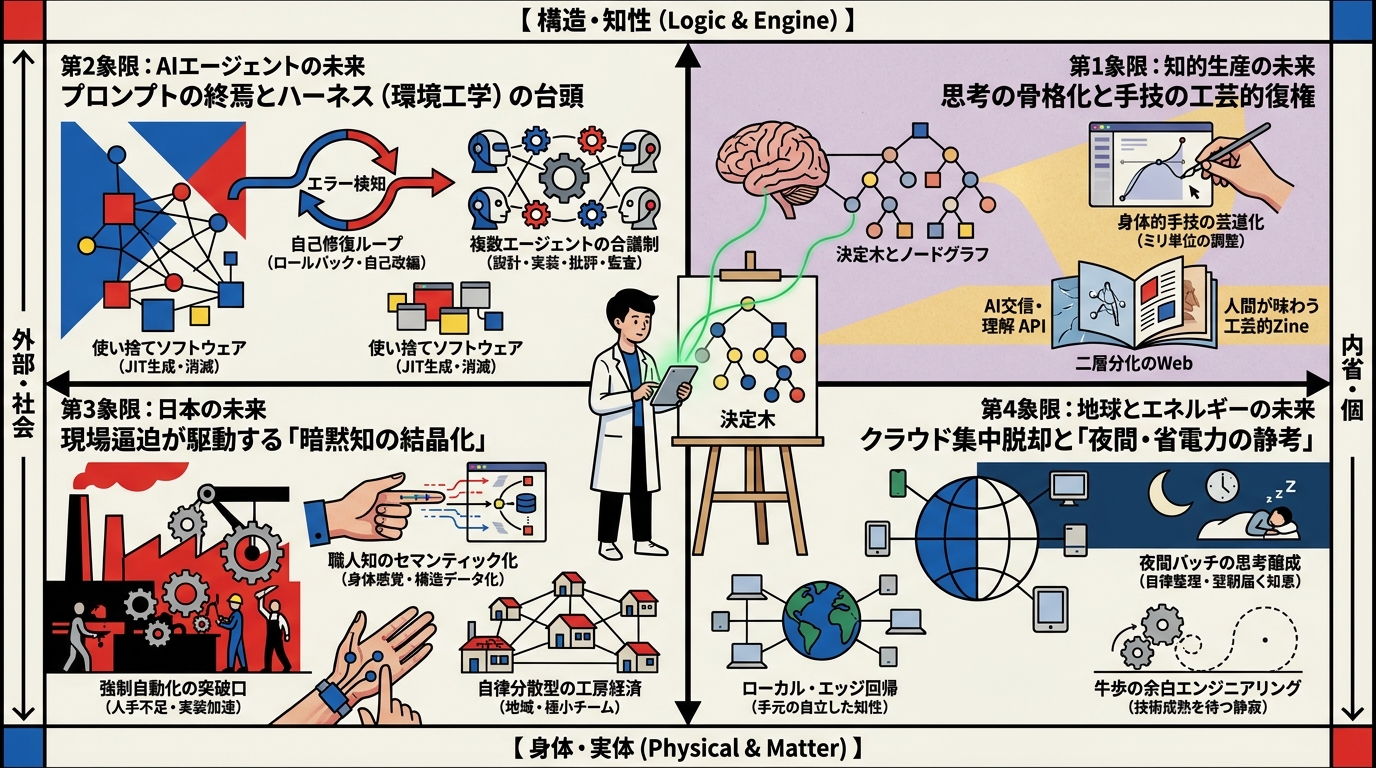
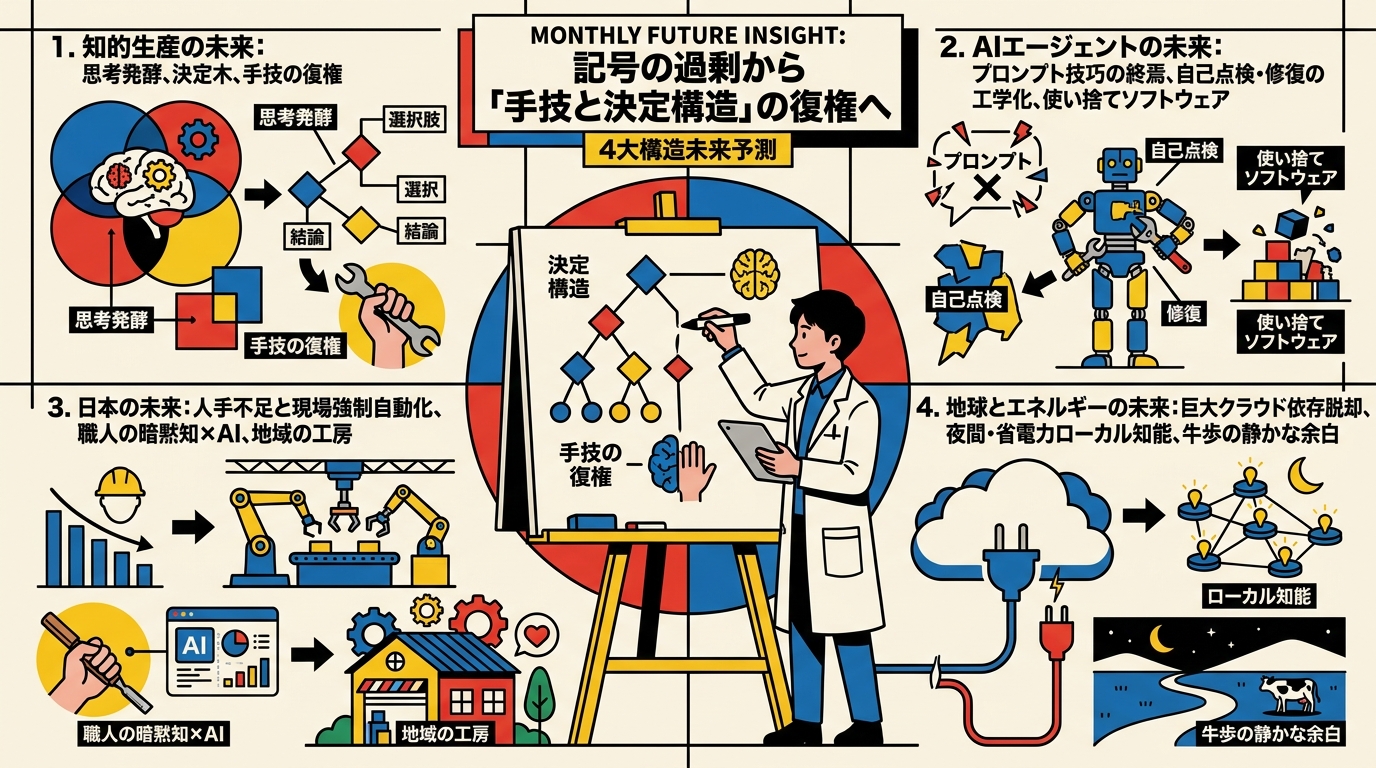
4 Domains: Structural Projections & Strategic Leverage Matrix
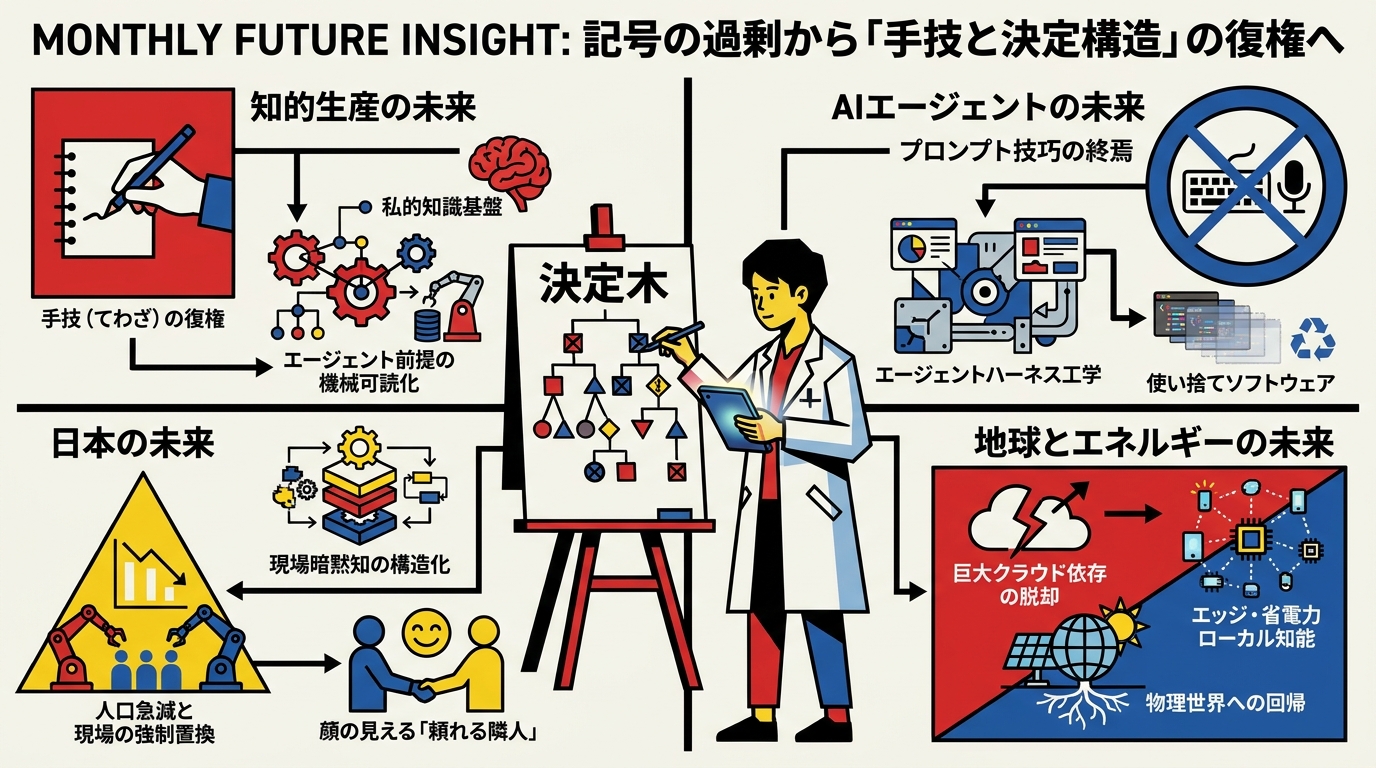
The Future of Kamos & Intellectual Production
Leading Signals LEADING SIGNALS
Inside day-to-day creative work and software development, clear signs show that the foundations of intellectual production are shifting:
- A Return to Analogue Inception: A growing practice involves capturing subtle intuitive frictions and raw ideas by hand in paper notebooks before feeding them into digital intelligence layers for synthesis and archiving. Before touching a keyboard or prompting a machine, creators are rediscovering the vital necessity of using hands and paper to give thought its initial contour.
- The Inversion of the Web’s Audience: Web traffic is increasingly dominated by AI crawlers and autonomous agents rather than human visitors. In response, designers are paring back excessive visual ornamentation, prioritizing clean semantic structures and machine-readable data files that machines can interpret without ambiguity.
- Local, Cloud-Independent Context: Practitioners are building lightweight, local environments capable of scanning thousands of personal thought logs and conversational archives directly on the device. By decoupling context retrieval from centralized cloud platforms, thinkers can ground their work entirely within their own immediate reach.
Underlying Mechanism UNDERLYING MECHANISM
Why this return to handwritten notes, deliberate craft, and minimalist data architectures? The answer lies in the value inversion caused by zero-cost generation.
When anyone can generate a polished layout or fluent essay in an instant, the scarcity—and therefore the intrinsic value—of the surface output drops toward zero. Value migrates to the depth of context: Why was this specific decision made? It settles into the tangible conviction that only physical, embodied labor can cultivate—what in Japanese is called tewaza (手技, "hand-craft" or embodied technique). Much like the traditional arts of Noh or the tea ceremony, where tools are handled with deliberate care and every superfluous gesture is stripped away, this patient attitude forms an unshakeable boundary between human creation and mechanical generation.
Furthermore, relying uncritically on third-party code and borrowed data has become an acute security and intellectual liability. Keeping one’s personal thought ecosystem compact, transparent, and physically accessible—moving fluidly between manual craft and machine generation—is proving to be the most rational, sustainable mode of knowledge work.
Future Projections FUTURE PROJECTIONS
[Short-Term: 1–3 Months] [Mid-Term: 6–12 Months] [Long-Term: Multi-Year]
Decline of cosmetic work -> Bifurcation of the web -> Digital craft as "Geido"
Shift to local knowledge Agent-first data backends High-trust local alliances
- Short-Term (1–3 Months): Demand for outsourced work focused purely on superficial visual polish contracts sharply. Creators and small teams redirect their energy toward building private, local knowledge repositories that AI can safely reference without leaking data.
- Mid-Term (6 Months–1 Year): The separation between human-facing websites and machine-to-machine data endpoints becomes formalized. Human interfaces turn quiet and concise, while structured data graphs collaborate behind the scenes across an agent-centric web.
- Long-Term (Several Years): Digital craftsmanship ascends from disposable utility to a disciplined practice akin to a traditional art form (geido). Autonomous agents will assemble structural baselines in seconds, leaving human practitioners to apply the final, decisive calibration of aesthetic judgment and physical intuition. Sustainable livelihoods will rest on serving as a trusted, accessible neighbor rather than broadcasting mass-produced assets to an indifferent crowd.
Establish a compact, sovereign thought pipeline that anchors human tacit knowledge (writing on paper, handling tools, direct conversation) and converts it into structured explicit formats ready for machine synthesis.
The Frontier of AI & Agentic Systems
Leading Signals LEADING SIGNALS
In applied artificial intelligence, the early obsession with "prompt engineering" is fading into memory.
The frontier has moved from optimizing the raw intelligence of standalone models to engineering the environments that direct them: the agent harness. Practical systems now focus on equipping models with specific tools—such as search engines, live weather feeds, and internal databases—and orchestrating how the system decides which tool to deploy under shifting conditions.
Alongside this, observability has become essential. Production environments now incorporate live tracing to monitor the reasoning paths models use before calling external tools, requiring explicit human approval for irreversible actions, while automated scanners continuously patch dependencies against emerging vulnerabilities.
Underlying Mechanism UNDERLYING MECHANISM
This transition reflects a fundamental identity shift: AI is changing from a conversational advisor into an operational task force.
No large language model, however sophisticated, can maintain a reliable grasp of the physical world on its own. To navigate real-world variance and self-correct when assumptions fail, a model requires an external harness. This scaffolding manages state persistence, limits tool privileges, and injects runtime context. Only within such a framework can a model perform reliable work.
Consequently, the traditional view of software as an artifact built for multi-year maintenance is eroding. Code is increasingly generated on the fly for immediate contextual needs and discarded once the task is complete. Software development is migrating from writing static code to engineering the boundaries within which code can be safely written, executed, and torn down.
Future Projections FUTURE PROJECTIONS
[Short-Term: 1–3 Months] [Mid-Term: 6–12 Months] [Long-Term: Multi-Year]
Prompt tricks lose value -> Multi-agent consensus dev -> Intelligence enters physical realm
Focus on harness design Architecture replaces coding Edge AI controls physical tools
- Short-Term (1–3 Months): Prompt-crafting guides lose their market value. Engineering attention pivots entirely to agent harness standards: robust interface protocols, automated retries, and containment boundaries that block anomalous behavior.
- Mid-Term (6 Months–1 Year): Collaborative development setups gain traction, with specialized agents auditing one another’s work, detecting defects, and deploying repairs autonomously. The developer's primary job ceases to be implementation; it becomes the definition of system roles, boundaries, and authority.
- Long-Term (Several Years): As screen-based automation approaches saturation, the intelligence frontier pours into physical space. Edge intelligence wired directly to cameras, environmental sensors, and localized hardware will orchestrate real-world machinery and robotics, dissolving the wall between digital computation and physical action.
Rather than waiting for ever-larger foundation models, focus on mastering harness engineering: design unambiguous input/output contracts for tools and build fail-safe operational guardrails.
Japan’s Structural Shift & Strategic Leverage
Leading Signals LEADING SIGNALS
Across Japan’s corporate and social landscape, a quiet structural reckoning is underway.
Many enterprise AI initiatives and proofs of concept (PoCs) have stalled, failing to produce measurable business returns. Meanwhile, front-line realities offer no breathing room. Essential sectors—logistics, infrastructure maintenance, disaster response, precision manufacturing, and eldercare—face severe labor shortages driven by demographic decline.
Concurrently, independent professionals and small studios are seeing their traditional business pipelines narrow. Prospective clients increasingly use AI for preliminary scoping and requirements drafting, bypassing the initial exploratory meetings that used to serve as the gateway to consultative work.
Underlying Mechanism UNDERLYING MECHANISM
The traditional practices of Japanese business—deliberate consensus-building (nemawashi) and risk-averse, incremental adjustments—were luxuries afforded by a stable, predictable population.
Rapid depopulation renders these methods unsustainable. In sectors where business continuity is threatened by sheer lack of personnel, the adoption of autonomous agents will not wait for unanimous internal consensus. It will take the form of Forced Transition: automation deployed simply to prevent operations from halting tomorrow.
Herein lies an overlooked opportunity. Japan’s enduring strength resides in its vast reserve of embodied, tacit knowledge—field-tested craftsmanship, unwritten situational awareness (me-kubari), and anticipatory care (ki-kubari). These nuanced practices cannot be duplicated by organizations that rely solely on surface manuals. If this tactile field wisdom can be translated via sensors and direct interfaces into data structures that autonomous agents can interpret, Japan can establish uniquely resilient social systems.
Future Projections FUTURE PROJECTIONS
[Short-Term: 1–3 Months] [Mid-Term: 6–12 Months] [Long-Term: Multi-Year]
PoC cancellations mount -> Forced agent substitution -> Hyper-lean societal models
Budgets focus on survival Autonomous field operations Exportable depopulation blueprints
- Short-Term (1–3 Months): Superfluous corporate AI pilot projects are canceled as budgets tighten. Capital consolidates around systems addressing immediate, concrete deficits, such as automated disaster communications and automated operations for field teams.
- Mid-Term (6 Months–1 Year): Autonomous systems take root out of necessity across regional logistics, routine back-office processing, and basic facility monitoring—making operational decisions without waiting for human sign-off.
- Long-Term (Several Years): By turning demographic decline into an engineering constraint, Japan pioneers an ultra-lean operational model that marries front-line tacit insight with autonomous execution. Retaining human aesthetic sensibility while running infrastructure with minimal staffing, the country becomes a case study for regions facing similar demographic trajectories.
Move beyond boardroom debates and abstract manual-writing. Focus directly on extracting the physical instincts and unwritten decision heuristics of experienced practitioners, encoding them into rules that autonomous systems can execute.
The Future of Earth, Global Economy & Humanity
Leading Signals LEADING SIGNALS
While the digital realm suggests limitless expansion, hard physical boundaries are exerting heavy pressure on global civilization.
Persistent energy costs and currency volatility continue to burden nations reliant on imported fuel. Simultaneously, the power demands of expanding data centers are growing exponentially, straining legacy power grids and generating friction with local communities over freshwater consumption for cooling.
Geopolitical restrictions around advanced semiconductor supply chains, compounded by climate-driven disasters, are exposing the fragile physical foundations that support our digital architectures.
Underlying Mechanism UNDERLYING MECHANISM
Civilization has entered an era where compute capacity correlates directly with geopolitical influence. Yet, the most advanced neural network cannot run for a single second without electricity and cooling water.
The expansion of digital intelligence has revived a classic civilizational struggle: the contest for primary energy. Regions with secure access to domestic nuclear power or stable renewables are accumulating computational infrastructure. Conversely, regions dependent on imported energy confront rising compute costs alongside structural inflation.
In a fragmented world subject to ecological volatility, systems designed under the assumption of uninterrupted cloud connectivity and boundless power are fundamentally fragile. Human institutions will increasingly be judged by their physical resilience: their capacity to distribute scarce energy thoughtfully and sustain operations when networks fail.
Future Projections FUTURE PROJECTIONS
[Short-Term: 1–3 Months] [Mid-Term: 6–12 Months] [Long-Term: Multi-Year]
Grid bottlenecks bite -> Geopolitical energy divides -> Resilient, dynamic grids
Shift to off-peak batches Compute costs track power Decoupled edge-native survival
- Short-Term (1–3 Months): Electrical grid bottlenecks and rising power tariffs slow new hyperscale data center construction globally. Inefficient real-time streaming architectures are re-evaluated, encouraging a return to off-peak batch processing and aggressive data compression.
- Mid-Term (6 Months–1 Year): The cost of running AI systems diverges sharply between energy-independent regions and energy-importing regions. Energy security and sovereign AI policy fuse into a single geopolitical priority, driving international negotiations and trade frictions.
- Long-Term (Several Years): Planetary compute workloads adapt dynamically to weather patterns and power availability, throttling workloads autonomously. Concurrently, offline-first edge infrastructure capable of operating through grid collapses becomes a recognized baseline for societal resilience.
Reject the assumption of continuous cloud connectivity and cheap power. Design distributed architectures that process workloads during low-cost energy windows and run critical operations entirely on local hardware.
Propositions from the Future Researcher
In an era when machines can handle intellectual generation on demand, our goal cannot be to race them in raw processing speed.
No matter how immense the models operating behind the screen become, the world remains anchored by human experience: the intuitive unease that prompts a new direction, the physical feel of a pen shaping thoughts on paper, and the quiet trust forged between people standing in the same room.
Step back from passing industry clamor. Cultivate your own embodied skill, build clean and simple structures, and care for the work happening directly before you. This unhurried, grounded commitment is the most resilient foundation for the years ahead.
PAST ISSUES // BACK NUMBERS
 VOL. 02
CURRENT // VIEWING
How the Commoditization of Intelligence Reshapes Work, Society, and Human Touch
 VOL. 01
Technology, Civilizational Shifts, and the Return to Human Craft
 VOL. 01