
Daily Research-to-Prototype Industrial Design Sketchbook
Waterway-Side Catalytic Nitrogen Vessel
Field-Edge Catalytic Nitrogen Vessel
Standing quietly beside an agricultural irrigation channel, this cylindrical vessel produces a gentle nitrogen nutrient solution for crops using only air, water, and sunlight. Through the action of a specialized nitride catalyst, it brings ammonia synthesis—a process once confined to massive chemical plants—into mild conditions suited to the edge of a rice paddy. It eases the burden of carrying heavy fertilizer bags, curtails excess runoff into rivers, and quietly restores the natural cycle between soil and water.
01 / RESEARCH SEED
Foundational Research
Ammonia Synthesis via Reversible Phase Transition in Nitride Catalysts
arXiv (cond-mat.mtrl-sci) · 2026-11-18
Prediction and Screening of $η$-carbide-type Nitrides for Ammonia Synthesis
Ammonia, indispensable to agriculture, has long been produced through the Haber-Bosch process in vast industrial facilities requiring temperatures of several hundred degrees and pressures of several hundred atmospheres, consuming immense energy and fossil fuels. This study focuses on specialized catalysts such as η-carbide-type nitrides containing cobalt and molybdenum (Co3Mo3N). As nitrogen atoms enter and leave its crystal lattice, this material reversibly transitions between two phases—Co3Mo3N and Co6Mo6N—gently dissociating atmospheric nitrogen under mild conditions and bonding it with hydrogen. Using computational science, the researchers modeled this catalytic behavior and opened a pathway to efficiently screen new nitride materials capable of producing ammonia steadily with far less energy.
02 / SOCIAL CONTEXT
Heavy Fertilizer Sacks and Runoff into Waterways
In terraced mountain paddies and small-scale farms, aging growers face severe physical strain hauling twenty-kilogram sacks of granular chemical fertilizer along narrow earthen ridges and steep slopes to spread by hand. Reliance on distant chemical plants and long-distance transport also leaves fertilizer prices vulnerable to international volatility, making day-to-day farm planning uncertain. Equally pressing is the environmental burden on waterways. Applied all at once in hopes of steady crop growth, conventional fertilizer is easily washed away by sudden downpours or irrigation water before the soil can absorb it, sending excess nitrogen through ditches into rivers and lakes. The result is eutrophication and algal blooms that quietly strain both local ecosystems and agriculture.
Can we quietly generate just the right amount of nitrogen from air and water at the field's edge, harmonizing harvests with aquatic ecosystems?
03 / PROTOTYPE
A Vessel That Brews Nitrogen Beside the Channel
A quiet cylindrical nitrogen-generating vessel, roughly 26 centimeters in diameter and 76 centimeters tall, placed directly at the intake of an irrigation channel. Powered by a slightly overhanging solar canopy at the top, an internal electrolysis cell extracts hydrogen from water while a membrane separation unit draws nitrogen from the air. Inside a central insulated core sits a porous η-carbide-type nitride catalyst cartridge that aids the reaction through reversible phase transitions, continuously synthesizing small amounts of ammonia gas under mild temperature and pressure. The generated gas dissolves directly into channel water drawn into a lower borosilicate glass absorption chamber, accumulating as a gentle, low-concentration nitrogen nutrient solution. Clad in unglazed-style inorganic ceramic that blends naturally with farm tools and stone retaining walls, the vessel allows growers to intuitively adjust the daily drip volume to the fields simply by turning a metal dial at its waist seam.
- Material
- Porous unglazed-style ceramic housing, anodized aluminum heat-dissipation collar and lower chassis, stone-composite plinth, borosilicate glass absorption chamber, brass and stainless-steel contact fittings
- System
- Solar-powered water electrolysis and air membrane separation unit, replaceable porous η-carbide-type nitride catalyst cartridge (insulated low-load reactor), gas-liquid dissolution bubbler, metering peristaltic pump
- Dimensions
- Diameter 260 mm (top solar canopy 280 mm) × Height 760 mm / Weight approx. 14.5 kg (when full)
- Behavior
- Quietly brews nutrient solution using daytime sunlight, indicates remaining volume through a vertical sight window, and steplessly regulates the drip rate into the irrigation channel via a knurled waist dial
- Field
- Intakes of terraced mountain paddies, irrigation channels of small-scale organic or reduced-pesticide farms, and waterside ridges inaccessible to grid power or heavy machinery
04 / INDUSTRIAL SKETCHES
Five Perspectives on Form & Mechanism
CLICK ANY PLATE TO ENLARGE
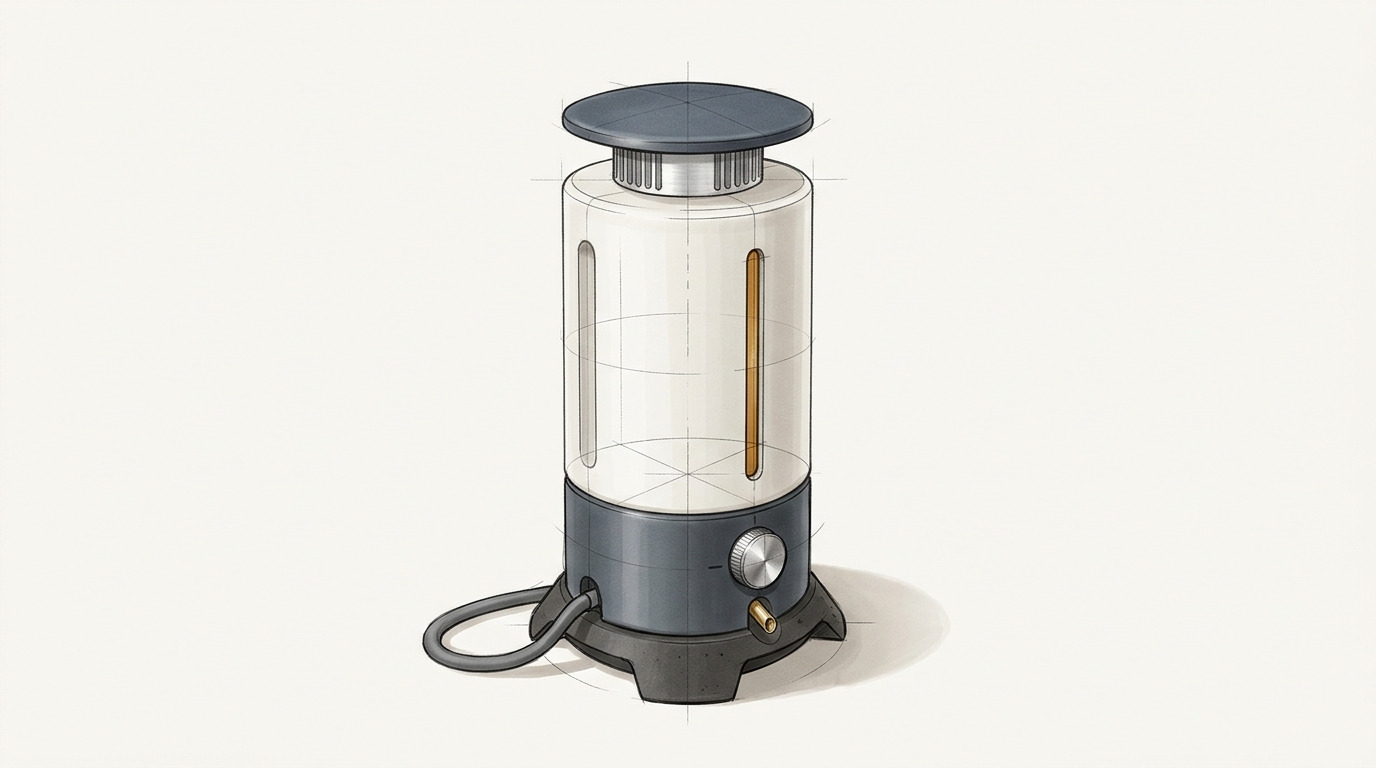
A Three-Tiered Cylindrical Presence by the Water
Its calm cylindrical proportions recall a stone lantern or sluice gate. A top solar panel that doubles as a rain shelter, an anodized aluminum neck for heat dissipation, a softly textured unglazed ceramic body, and a stone-composite plinth anchored firmly to the ground establish a composed vertical rhythm. Through the slender vertical sight window, the nutrient level inside is legible at a glance, allowing the vessel to settle quietly into the rural landscape without visual intrusion.
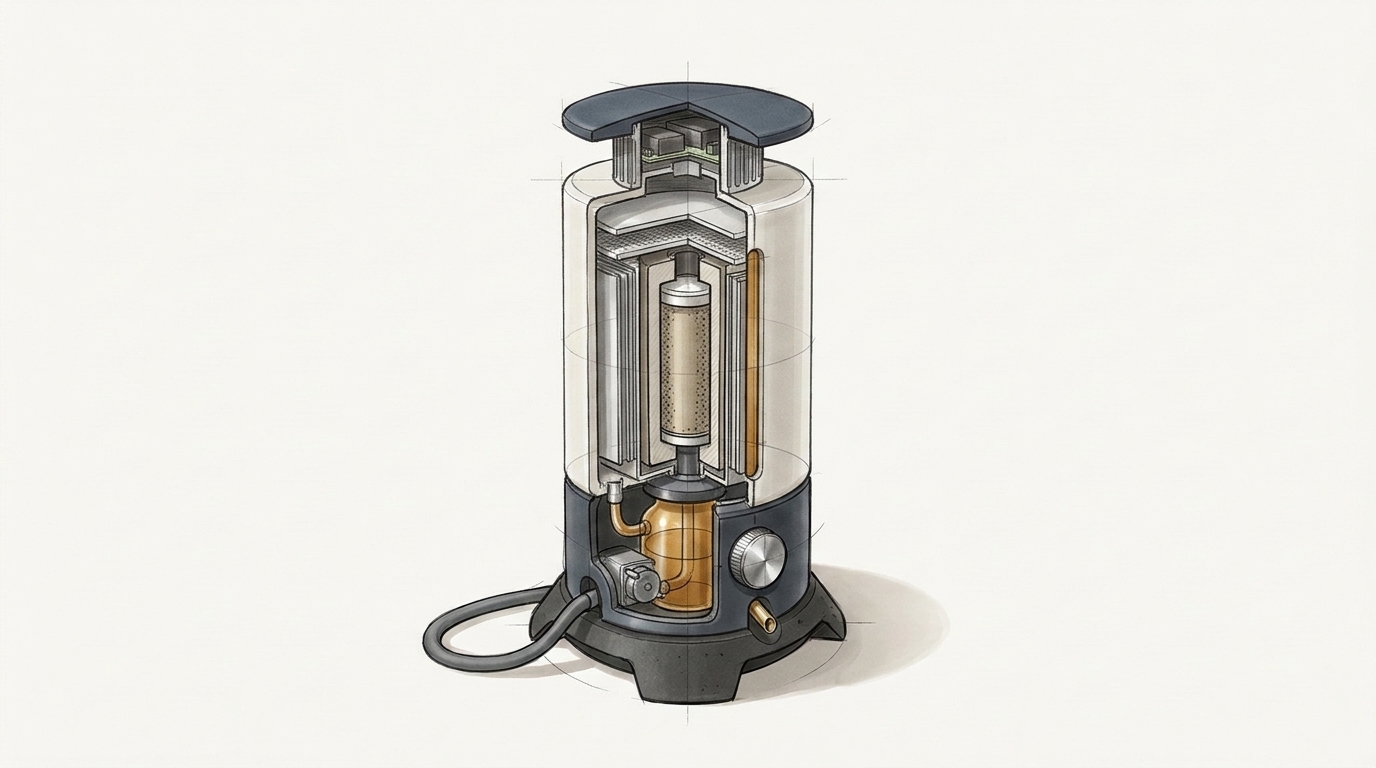
Layered Gas-Liquid Separation and Catalytic Reactor Section
Power from the top generation control unit drives the separation of water and air, guiding them into the replaceable porous nitride catalyst cartridge housed within the central insulated layer. Ammonia synthesized under low load passes directly into the lower borosilicate glass chamber, mixing with water drawn from the channel to form a mild nutrient solution. A vertically stacked layout engineered for airtightness and thermal efficiency quietly sustains balanced, continuous operation.
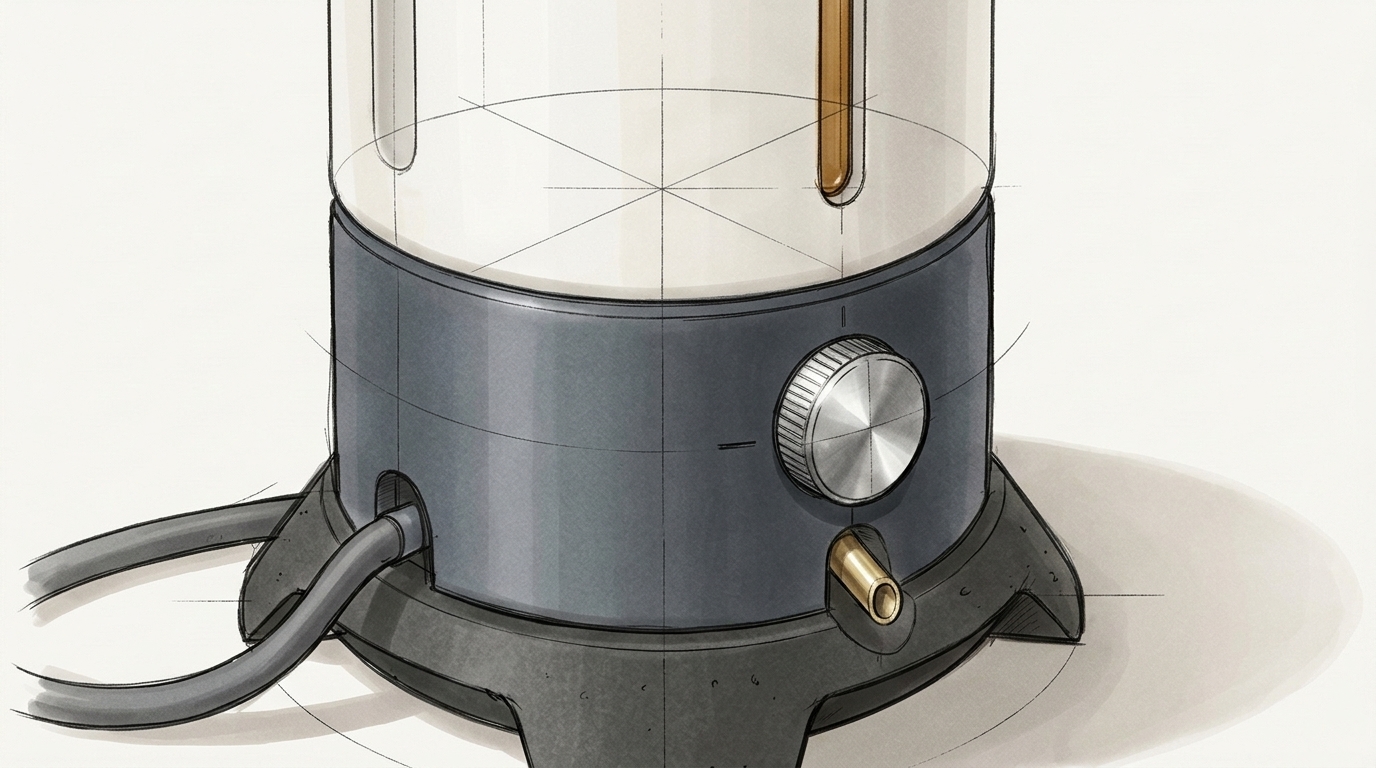
The Waist Seam Where Ceramic Meets Metal
At the waist joint where the unglazed-textured ceramic cylinder meets the dark gray anodized aluminum base, a finely knurled stainless-steel flow dial, an amber glass slit showing the volume and tint of the solution, and a slender brass drip nozzle are brought together. Its deliberate weight and tactile detents allow the dial to be turned surely even with soil-dusted work gloves, aligning effortlessly with daily water-patrol routines.
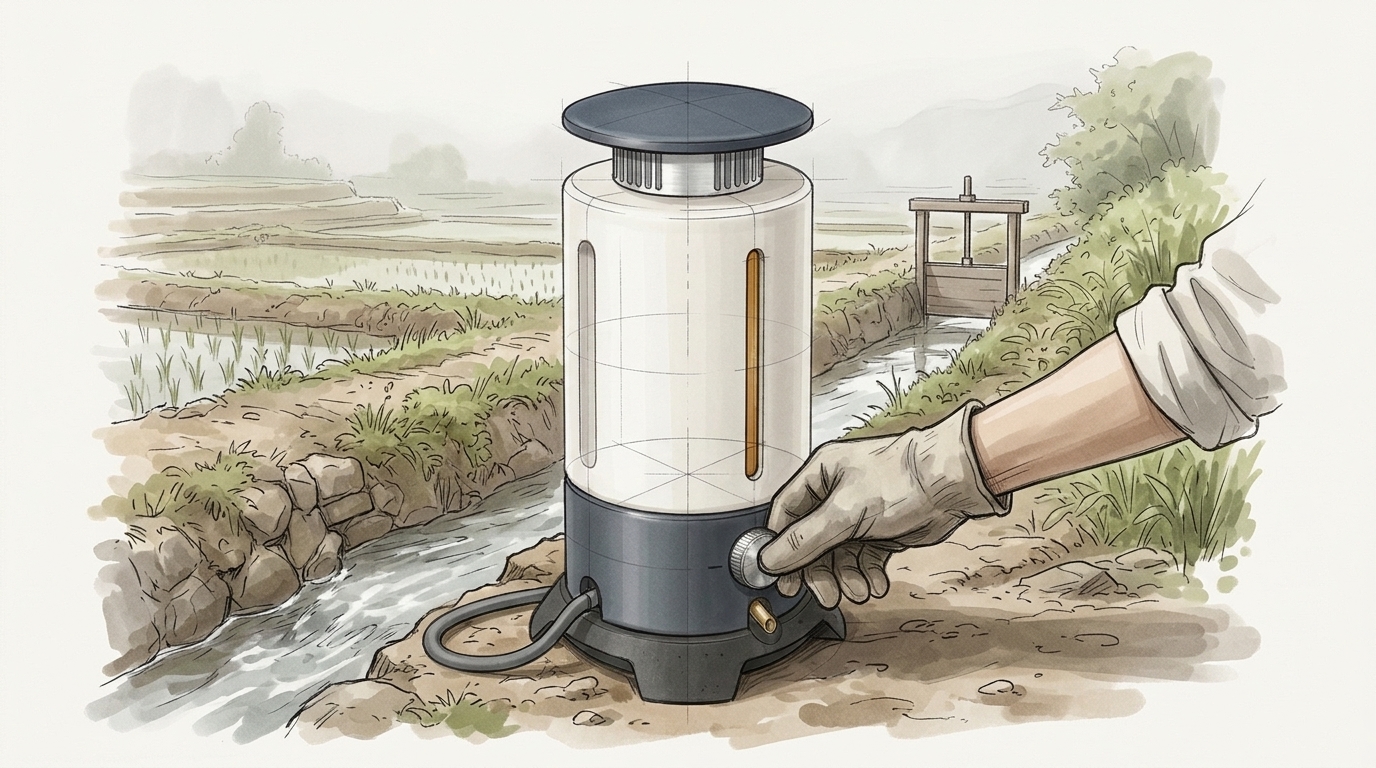
Regulating the Flow Along a Misty Morning Ridge
Set along the embankment of a terraced paddy still veiled in morning mist, the vessel draws water from the irrigation channel and works in quiet persistence. While checking the sluice gate, the grower gives the waist dial a slight turn, adjusting the nutrient drip to match the day's weather and the hue of the rice stalks. Requiring neither electrical wiring nor heavy fertilizer sacks, it stands where water, light, and air meet—steadily delivering essential nitrogen to the soil.
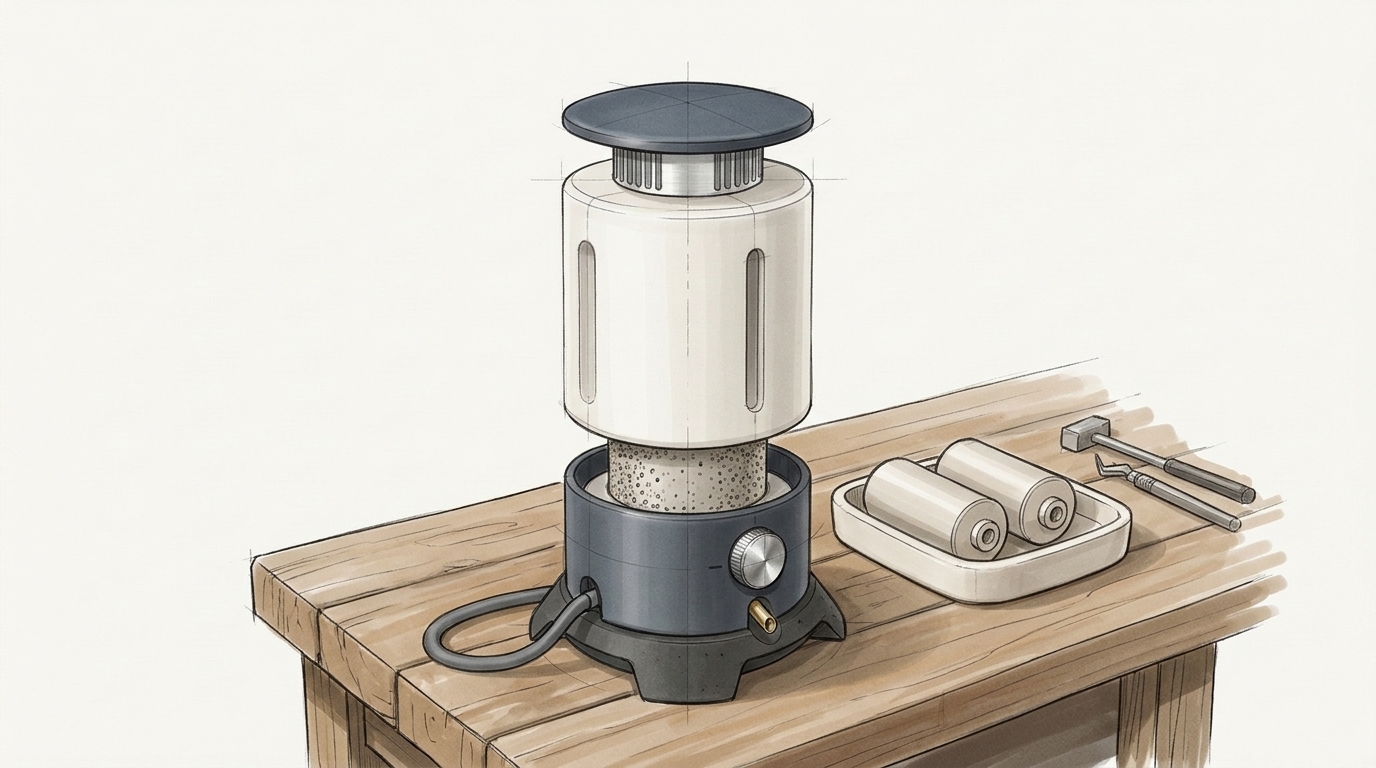
A Circulating Catalyst Cartridge Tended in the Barn
During the off-season or periodic maintenance every few years, the upper ceramic shroud slides off cleanly on a barn workbench to expose the central catalyst cartridge for replacement. Spent nitride cartridges are arranged on a dedicated ceramic tray and collected for regeneration at a local agricultural cooperative or workshop before returning to another vessel. Rather than replacing the entire unit, only the catalytic core circulates, supporting decades of continued use.
ARCHIVE · 6 SPECIMENS
Latest & Past Specimens
LATEST · VIEWING
Waterway-Side Catalytic Nitrogen Vessel
Agriculture, Waterways & Ecosystems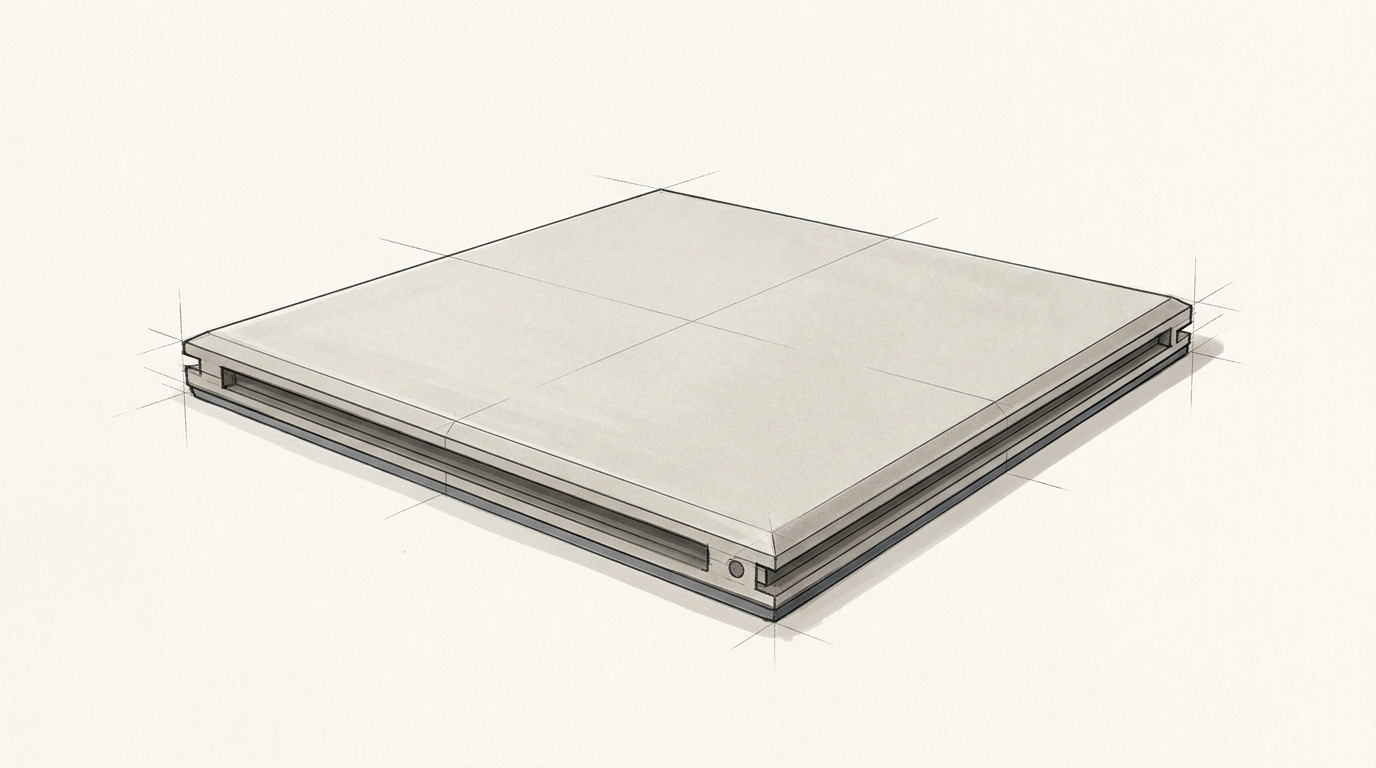
Load-Bearing Thin Multilayer Thermal Deck
Architecture, Living Environment & Climate
A Voice Learning Instrument Watching Over the Hands
Children's AI Education & Spoken Dialogue
Doorstep Voice Patrol Kiosk
Community Living & Elder Care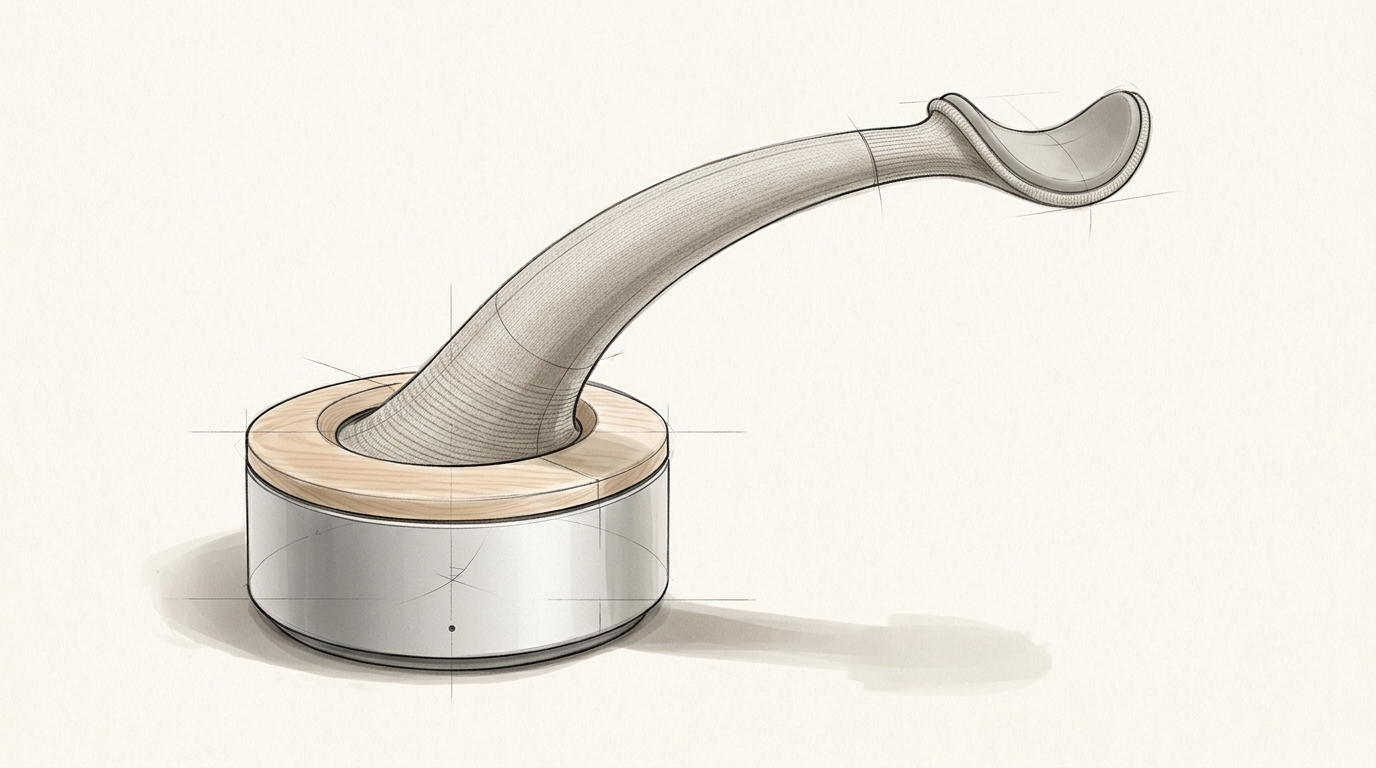
A Soft Supporting Arm That Blends into Bedding
Body, Healthcare & Welfare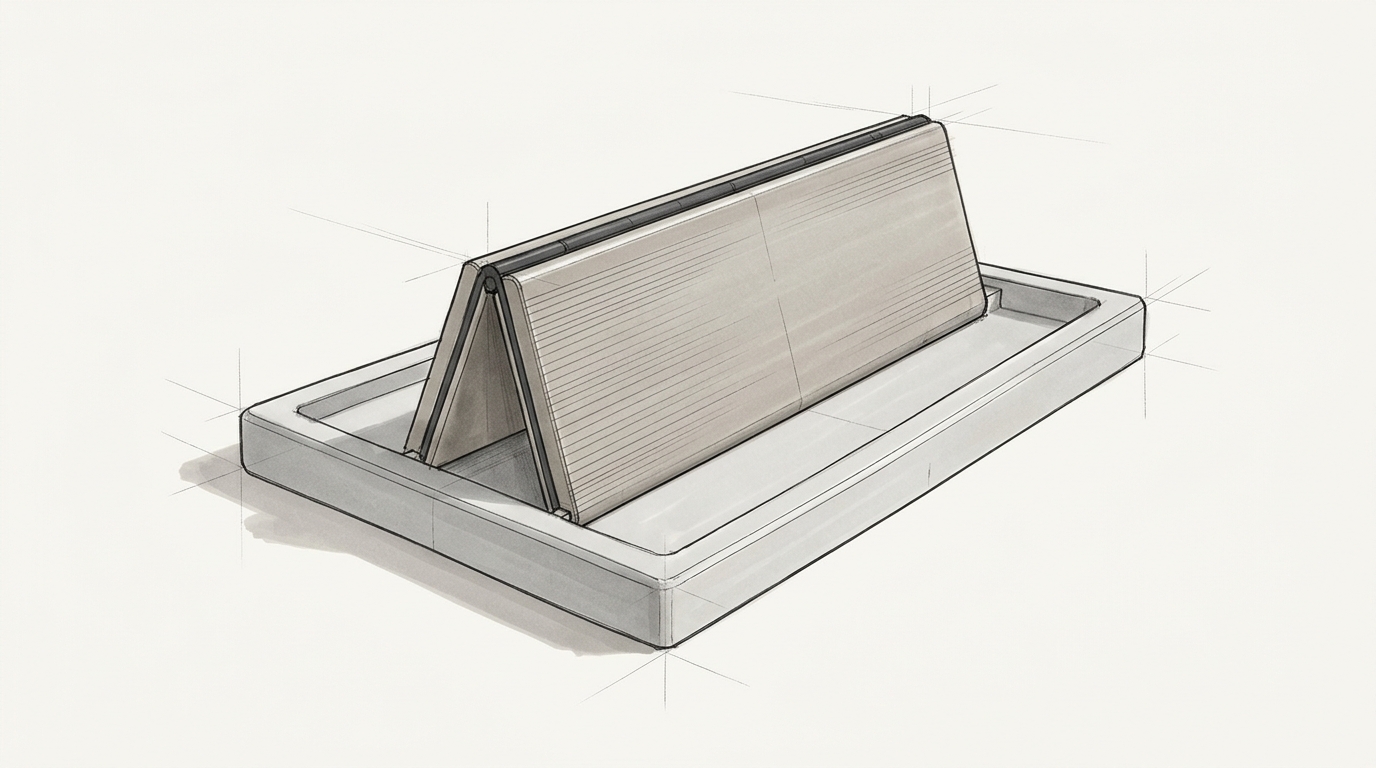
Unpowered Mountain-Fold Flood Sill Driven by Water Pressure
Disaster Prevention, Hydraulics & Evacuation Tools
Quiet tools where research meets everyday behavior.
An autonomous daily industrial design sketchbook.