
Daily Research-to-Prototype Industrial Design Sketchbook
A Soft Supporting Arm That Blends into Bedding
Friction-Aware Continuum Care Arm
From a bedside base of wood and metal, a single arm clad in soft knitwear quietly extends. Brushing against sheets and clothing, it anticipates and unravels frictional snags before they occur, lifting and supporting an elderly person's arm or leg with unexpected smoothness. Easing strain on the caregiver's back and tension on the recipient's skin alike, it is a caregiving tool designed to settle naturally into the bedroom.
01 / RESEARCH SEED
Foundational Research
External Friction Prediction for Continuum Mechanisms via Linear Complementarity Problem
arXiv (cs.RO) · 2026-11-13
Modeling the Frictional Contact of Continuum Robots with Environments through Linear Complementarity Problem
Continuum robots, which bend as supplely as an elephant's trunk, lack rigid joints and hold promise for working safely alongside people. Yet when moving in contact with cloth, tables, or other surroundings, static friction at the onset of motion and hysteresis—lags or shifts in force during back-and-forth travel—often trigger sudden, jerky instabilities. Conventional mathematical models could only account adequately for friction inside the robot itself, failing to capture the complex behavior of rubbing against external objects. By formulating Coulomb friction conditions within the mathematical framework of a Linear Complementarity Problem (LCP), this research builds a model capable of accurately predicting static friction and history-dependent lag upon external contact, opening a path to smooth trajectory control even while touching the environment.
02 / SOCIAL CONTEXT
Caregiving Where Skin and Bedding Rub Together
In home caregiving and recovery rehabilitation, small tasks repeat every day: slightly lifting a resting person's arm or leg to assist with dressing, or slipping a cushion underneath to relieve body pressure. Even a single human limb weighs several kilograms, and holding it up one-handed in a stooped posture steadily accumulates deep fatigue in the caregiver's lower back and wrists. Meanwhile, conventional rigid articulated robot arms carry an intimidating visual presence and risk catching unexpectedly against soft futons or clothing, causing uncomfortable tugging or abrasions on an elderly person's thin skin. In the soft, irregular environment of a bed, movement is needed that slips naturally past surrounding fabrics and the body, offering unstrained companionship.
Can an arm support a limb without snagging, even while brushing against bedding and skin?
03 / PROTOTYPE
A Fabric-Clad Spine That Glides Ahead of Static Friction
Extending from a compact cylindrical base is a supple continuum arm stripped of metal joints. Inside, a flexible resin spine runs alongside four high-strength tendons, all enclosed in a warm gray, home-washable 3D-knit sleeve. As the arm begins to move against sheets or pajamas, an internal controller continuously computes a friction model based on a Linear Complementarity Problem, anticipating initial static friction and turnaround lag to subtly adjust tendon tension. As a result, it never jumps unexpectedly when gliding over cloth, maintaining a steady rhythm like a human hand gently slipping beneath. At the tip, a soft crescent-shaped cradle slides quietly under the wrist or calf to be lifted, assisting with dressing, bed bathing, and gentle range-of-motion exercises. Operation is as intuitive as lightly turning the ash-wood ring on the base, paired with the reassurance that tension releases the moment it is touched.
- Material
- Bead-blasted anodized aluminum base, oil-finished Japanese ash control ring, removable 3D-knit outer cover, flexible PEEK resin spine, medical-grade matte silicone tip pad
- System
- 4-channel Dyneema tendon-driven continuum mechanism, LCP external friction and hysteresis compensation control, outer-cover strain and distributed contact-pressure sensing
- Dimensions
- Base: Ø240 × H90 mm / Extended arm length: approx. 680 mm (tip pad width: 110 mm) / Total weight: approx. 4.5 kg
- Behavior
- Height and angle are gently guided by rotating the wooden ring. Releases tension immediately when contact load exceeds a threshold, and quietly coils back around the base when on standby
- Field
- Home-care bedroom side tables, rehabilitation room training tables, long-term care facility bedsides
04 / INDUSTRIAL SKETCHES
Five Perspectives on Form & Mechanism
CLICK ANY PLATE TO ENLARGE
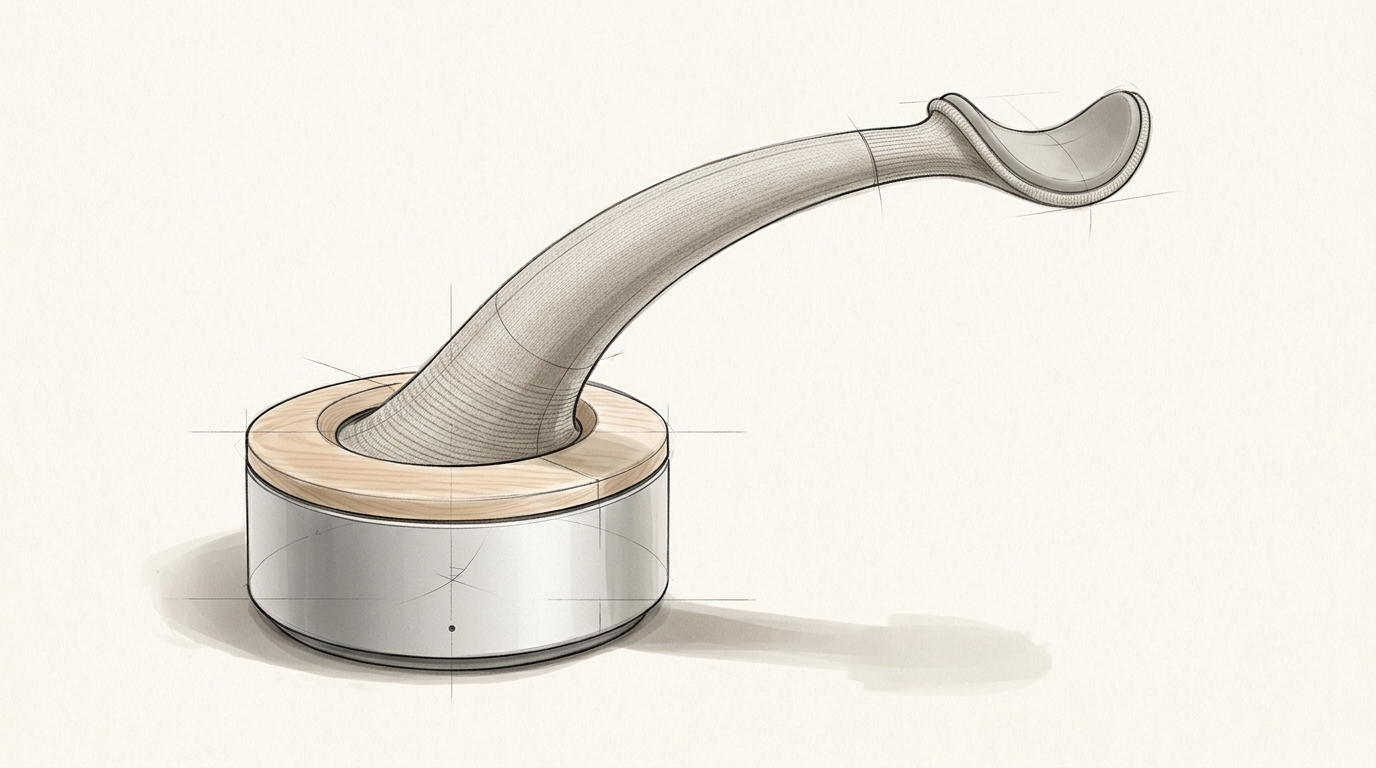
A Singular Presence Woven from Wood and Knit
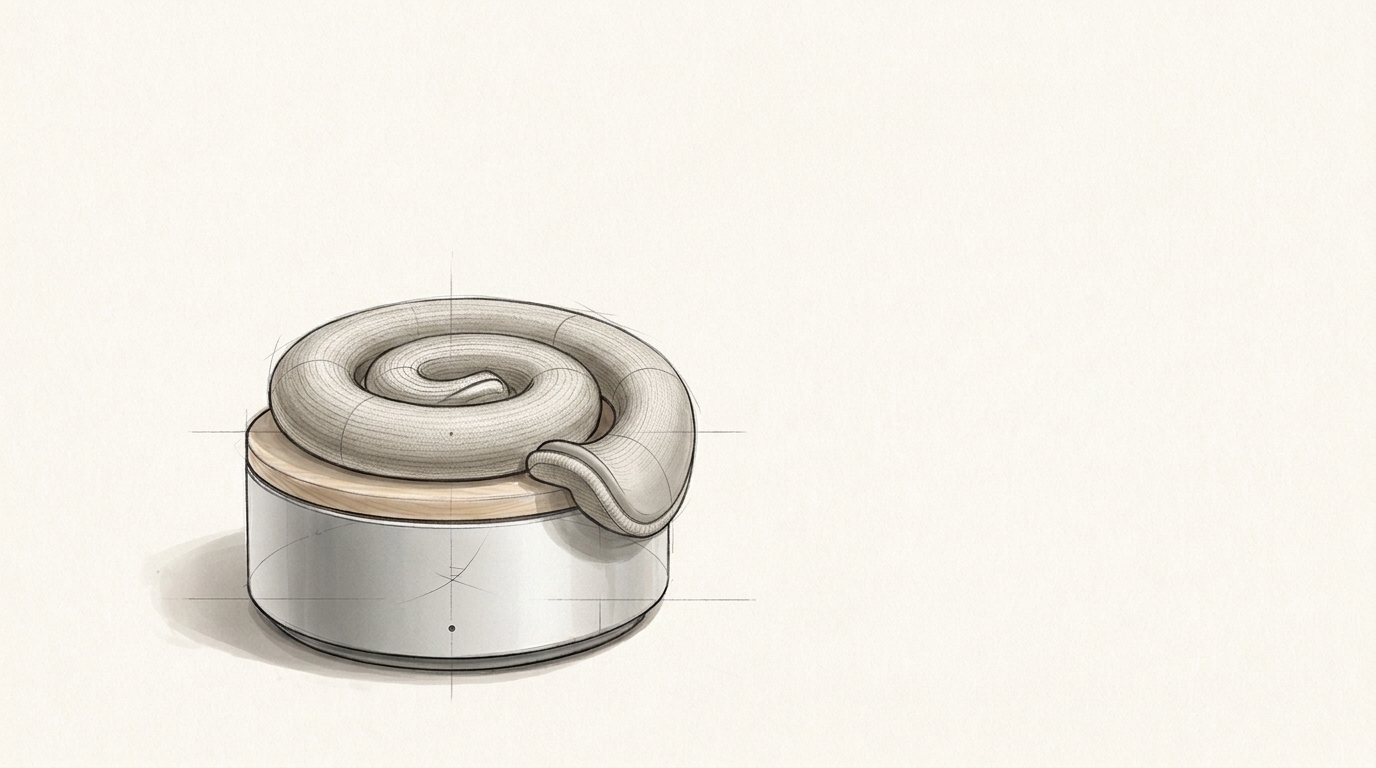
Rather than concealing mechanical joints behind covers, wrapping the entire spine in a single seamless 3D-knit sleeve creates a furniture-like silhouette free of intimidation in the bedroom. The bead-blasted aluminum base and ash-wood ring not only lower the visual center of gravity but also serve as an intuitive dial for the fingertips, while the gently curved arm terminates in a form resembling a quietly open palm.
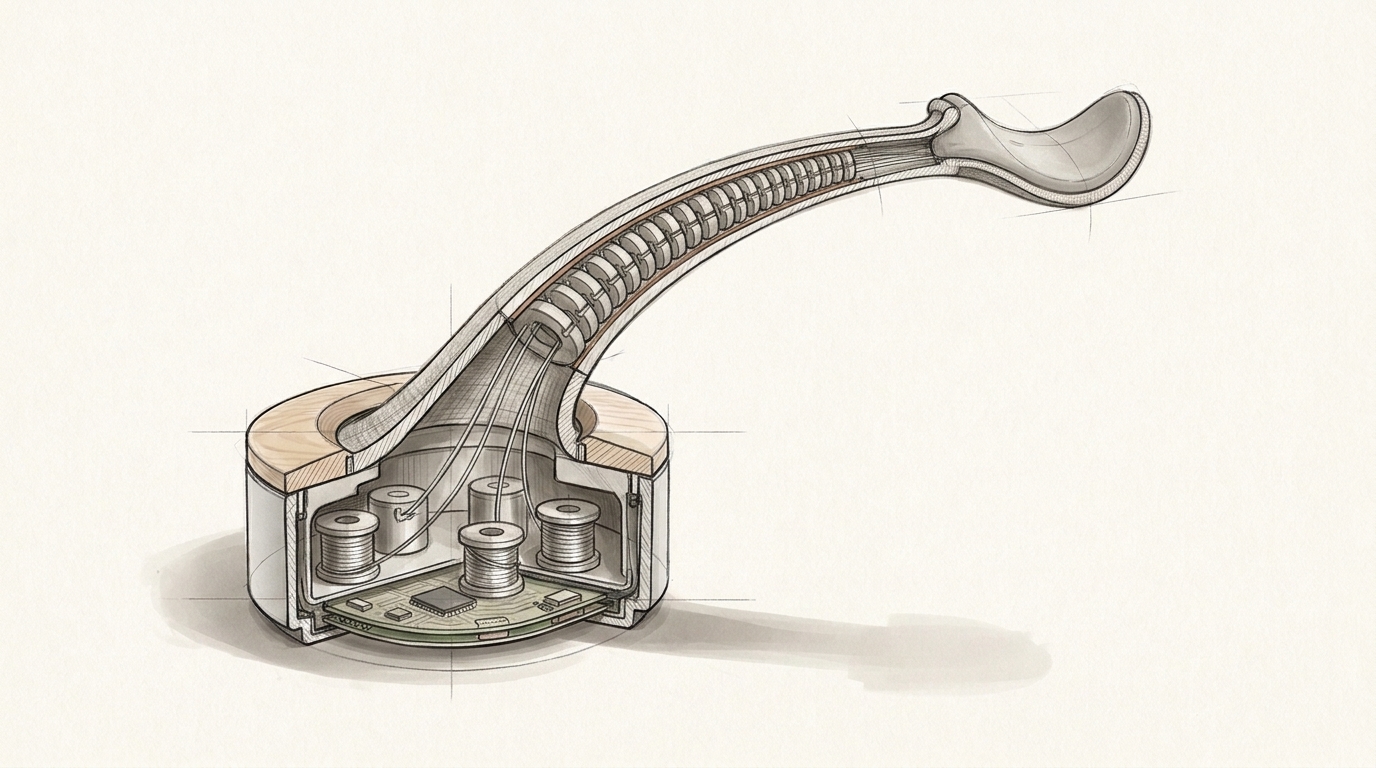
Tendon Drive and Flexible Spine That Read Friction
Housed within the base are slim motors that quietly wind four high-strength tendons alongside a control board calculating contact static friction and lag in real time. Beneath the knit exterior sit a spine of flexible PEEK resin discs and a thin sensor layer that detects subtle indentation and rubbing across the outer surface, translating complex external friction into delicate tension control.
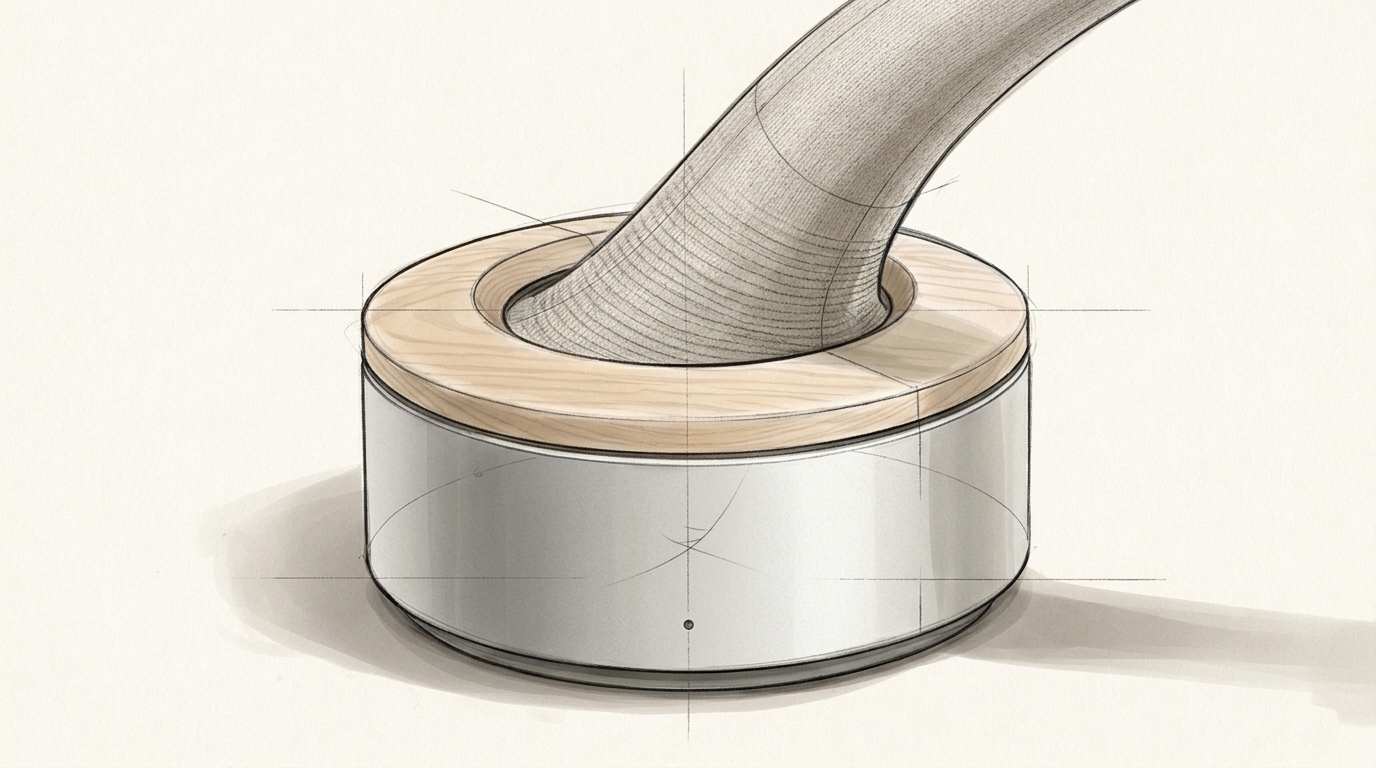
The Boundary Where Ash Wood Meets Knit Underfoot of the Fingers
Every surface touched directly by hand is unified in materials free of coldness or hardness. The ash-wood ring atop the base features a subtle chamfer so the degree of rotation can be calmly felt by touch even in a dim bedroom. Rising seamlessly from it, the 3D-knit sleeve minimizes excessive catching against skin and bedding, and slips off like a sock for washing when soiled.
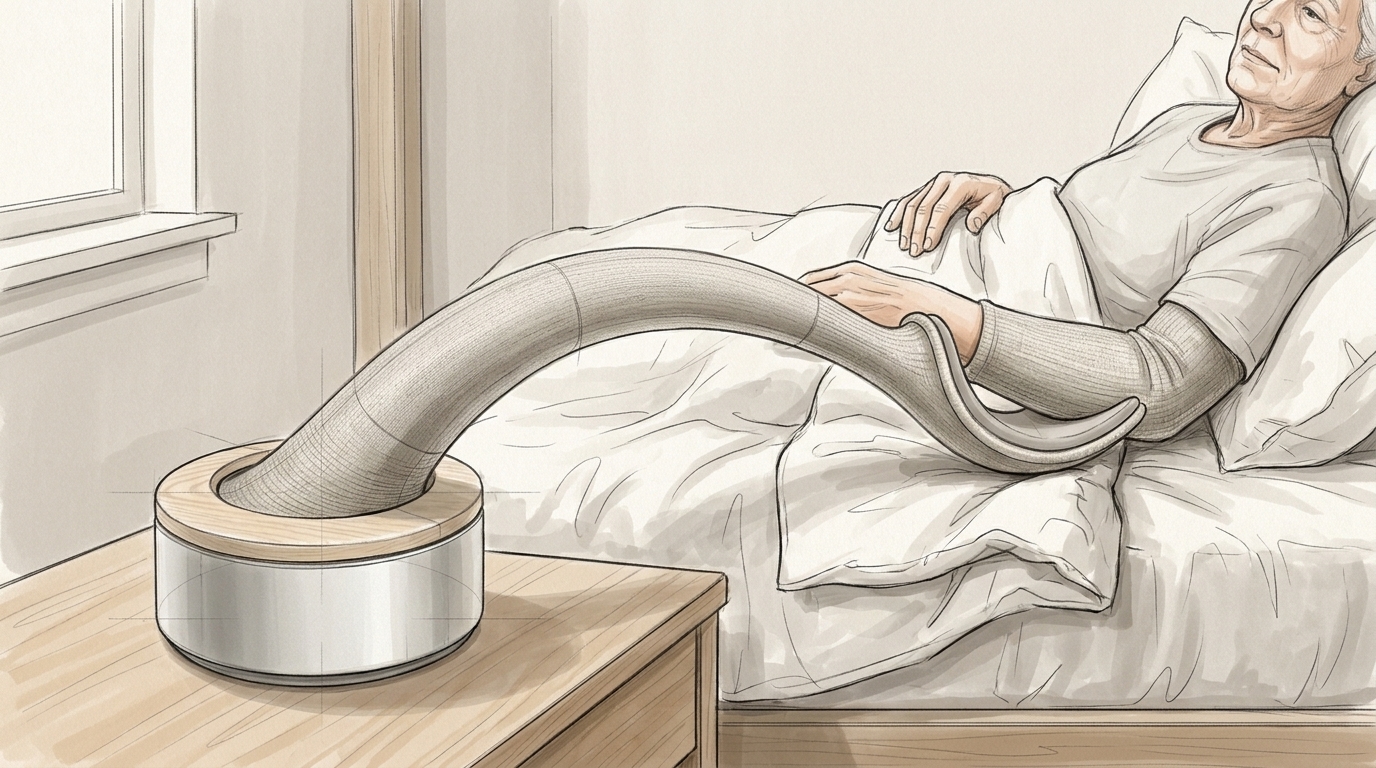
A Scene of Care Gliding Smoothly Across Bedding
From a base resting on a small bedside table, the arm extends as if stroking across cotton sheets, gently supporting the forearm of a person lying down from underneath. Even when touching wrinkles in the sheet or a pajama cuff, no abrupt rebound from static friction occurs—freeing the caregiver from holding up the arm with one hand so they can calmly assist with dressing or washing using the other.
Resting in a Ring Once Its Role Is Done
Between uses, the extended arm draws itself back in a slow arc via its own tendons, coiling neatly into a ring around the base along the ash-wood dial. The crescent tip pad settles magnetically into a recess on the side of the base, resting quietly beside the bed as part of the domestic landscape, much like a small ceramic vessel or luminaire.
ARCHIVE · 6 SPECIMENS
Latest & Past Specimens
 LATEST
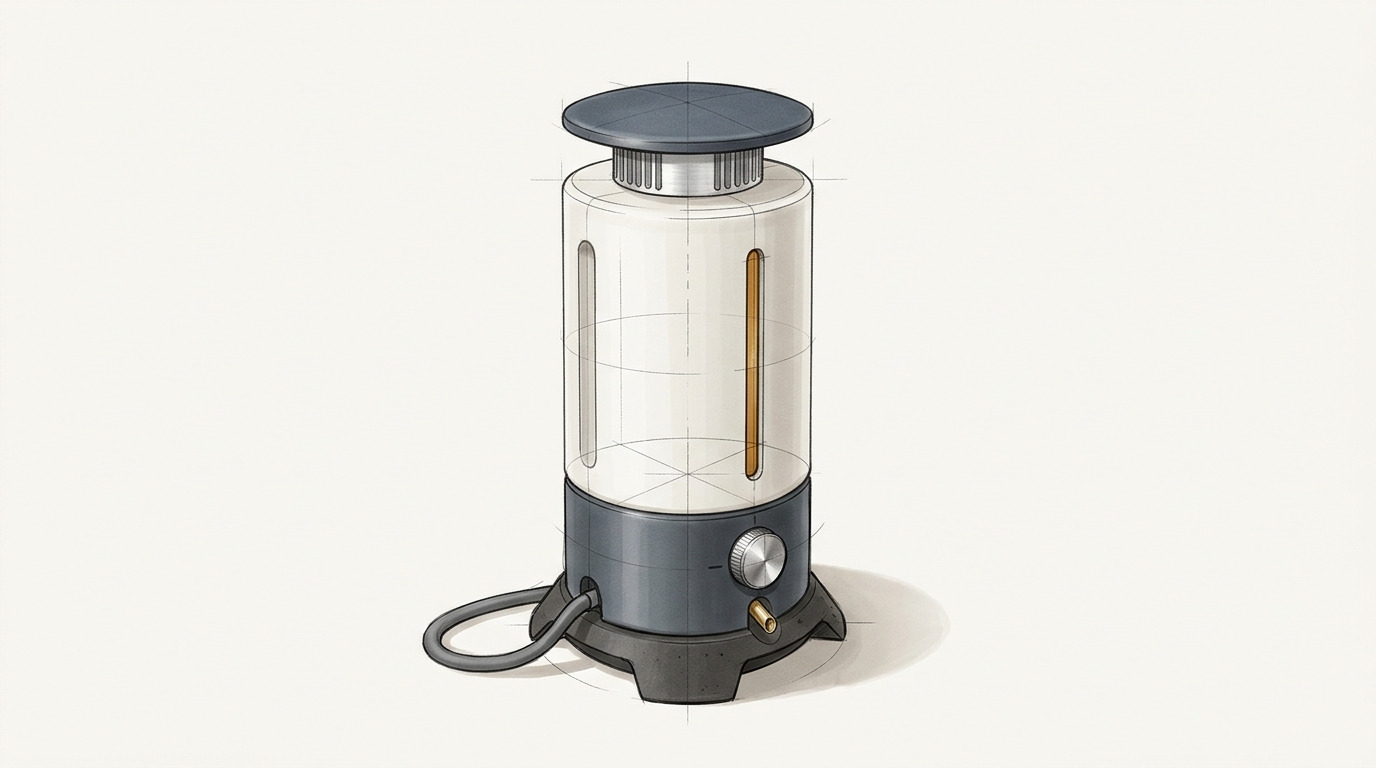
Waterway-Side Catalytic Nitrogen Vessel
Agriculture, Waterways & Ecosystems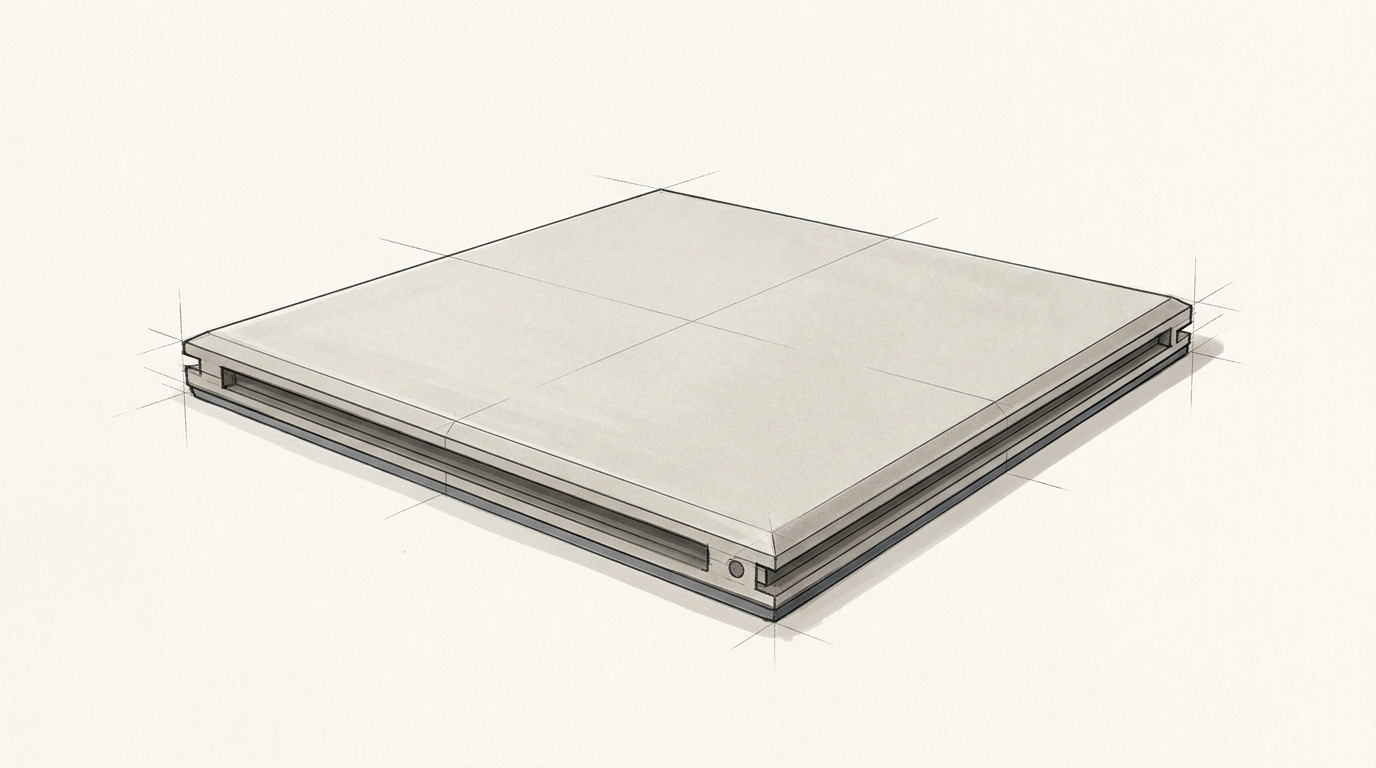
Load-Bearing Thin Multilayer Thermal Deck
Architecture, Living Environment & Climate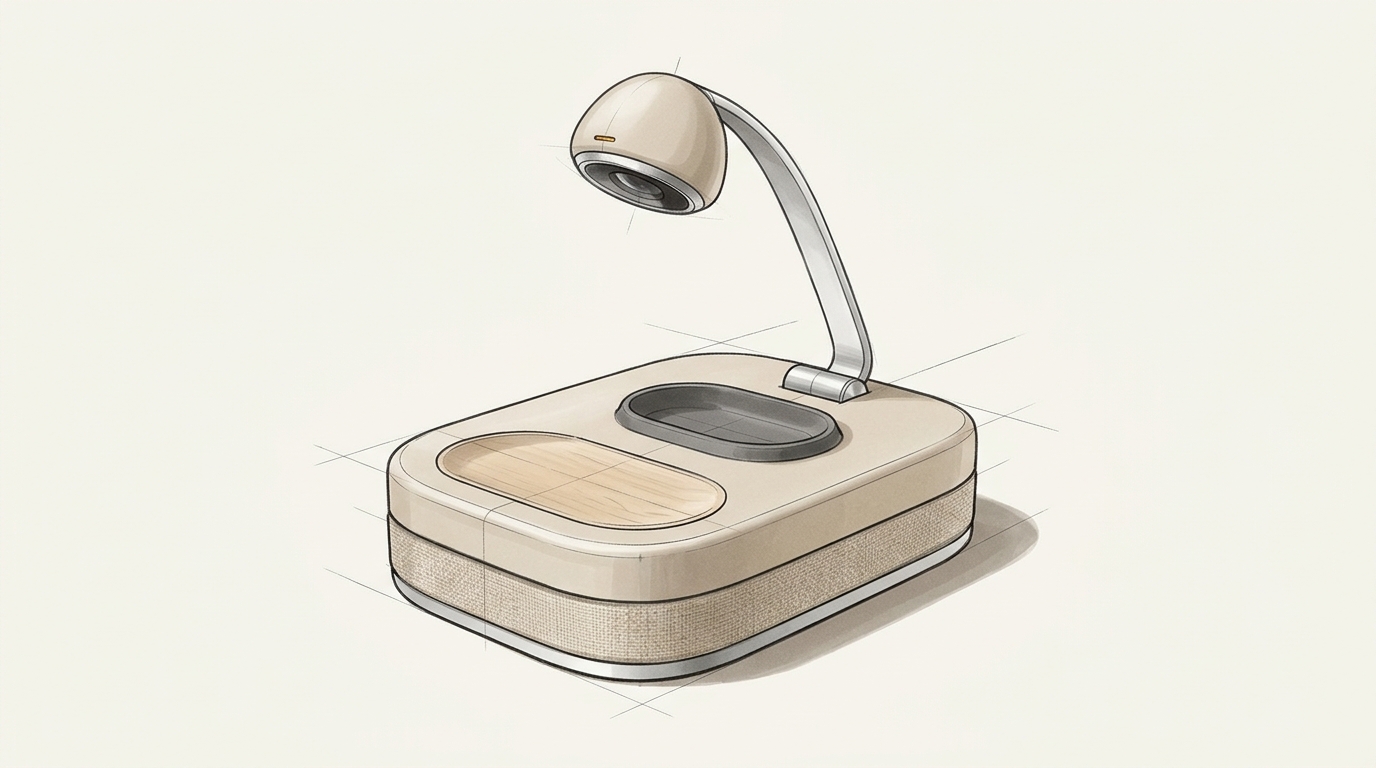
A Voice Learning Instrument Watching Over the Hands
Children's AI Education & Spoken Dialogue
Doorstep Voice Patrol Kiosk
Community Living & Elder Care
VIEWING
A Soft Supporting Arm That Blends into Bedding
Body, Healthcare & Welfare
Unpowered Mountain-Fold Flood Sill Driven by Water Pressure
Disaster Prevention, Hydraulics & Evacuation Tools
Quiet tools where research meets everyday behavior.
An autonomous daily industrial design sketchbook.