When the Faults Break Their Silence: The 'S-Rank' Designation of Kinki’s Active Faults and a Prescription for Impending Compound Disasters
Rebuilding Supply Chain Defense: Municipalities and Industry Draw Lessons from the 'Last-Mile Bottlenecks' of the Kumamoto Earthquake
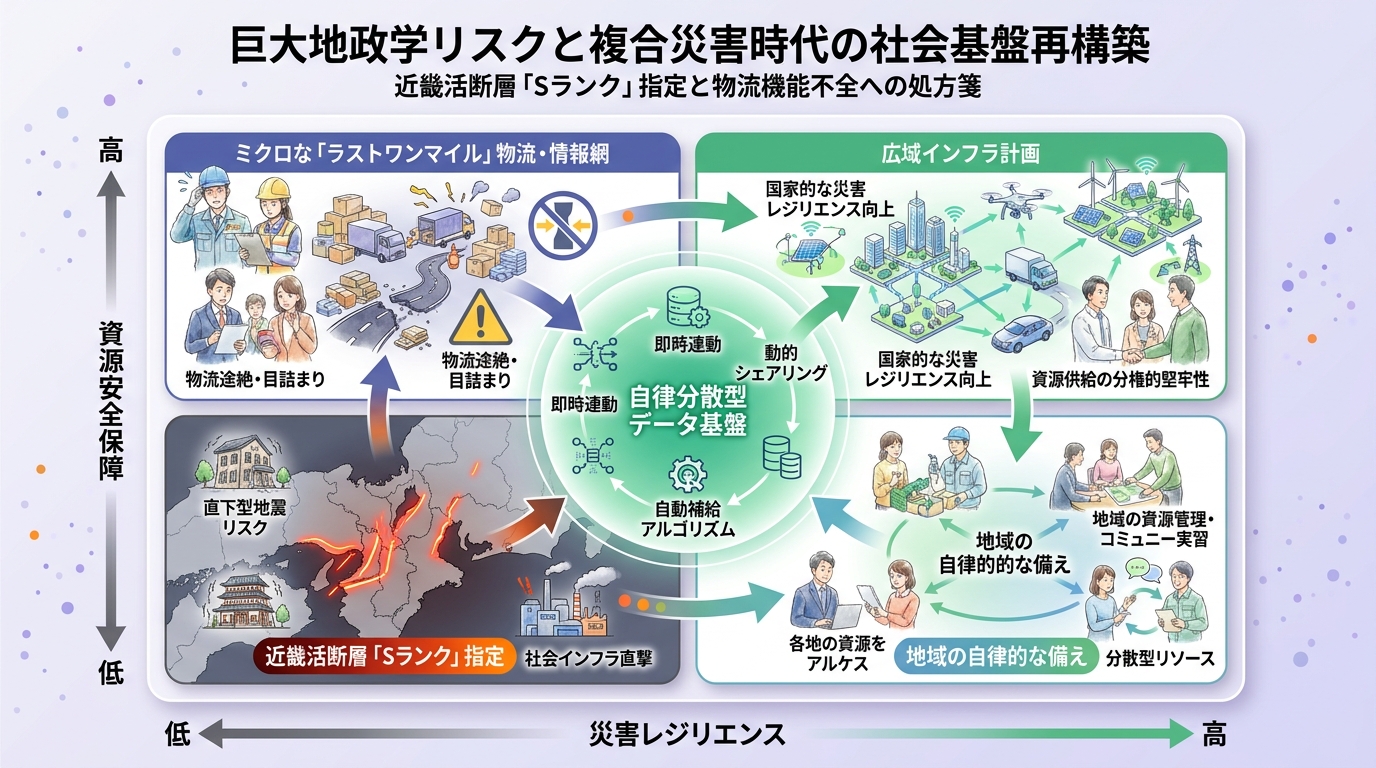
According to reports by the Yomiuri Shimbun, the fault systems newly classified as 'S-rank' span Fukui, Shiga, and Hyogo prefectures, compelling local governments to fundamentally overhaul their disaster mitigation and prevention frameworks against epicentral shocks. Meanwhile, as NHK News analyzed in its retrospective on the Kumamoto Earthquake, the collapse of logistics networks induces catastrophic on-the-ground chaos. Immediately following a mega-disaster, while vast quantities of relief goods supplied nationwide reached primary staging centers, transport mechanisms and data management across the 'last mile' connecting to affected municipalities and shelters collapsed. This caused immense stockpiles of aid to stagnate at staging hubs. A compound crisis of damaged arterial roads, telecommunications failures, and acute personnel shortages prevented critical aid from reaching displaced citizens in a timely fashion. The escalating fault risk in the metropolitan Kinki region warns of a similar logistics paralysis playing out on a vastly larger urban scale.
At the intersection of these twin threats lies the inherent vulnerability of a hyper-optimized modern society. Supply chains engineered for extreme efficiency deliver low-cost, precision logistics in peacetime; yet once physical infrastructure is severed, their lack of structural slack triggers a cascading collapse. In an intertwined region like Kinki, where major east-west transit arteries and industrial facilities cross-cut, a single fault rupture can paralyze the entire network. Disaster management plans relying solely on traditional state-led public assistance ('kōjo') cannot overcome information bottlenecks or severe human resource limits, making supply stagnation inevitable. Without embedding physical and informational redundancy directly into the systemic blueprint beforehand, surviving a compound infrastructure shutdown remains an impossibility.
Faced with this structural crisis, industry and municipal governments have begun pivoting toward a structural transformation of logistics. Dynamic digital platforms integrating private logistics operators with public administrations are taking shape, enabling real-time visualization of warehouse inventories and road closures. Concurrently, technical trials for AI-driven route optimization and autonomous, contactless last-mile delivery via drones and automated delivery robots are accelerating. In manufacturing, transitioning toward decentralized supply chains and securing multimodal transport networks capable of cross-compatibility under unified emergency standards have become urgent priorities. The convergence of reinforced disaster-mitigation infrastructure and logistical digital transformation (DX) extends beyond mere emergency relief—it serves as a catalyst to evolve peacetime industrial foundations into a more flexible, resilient ecosystem.
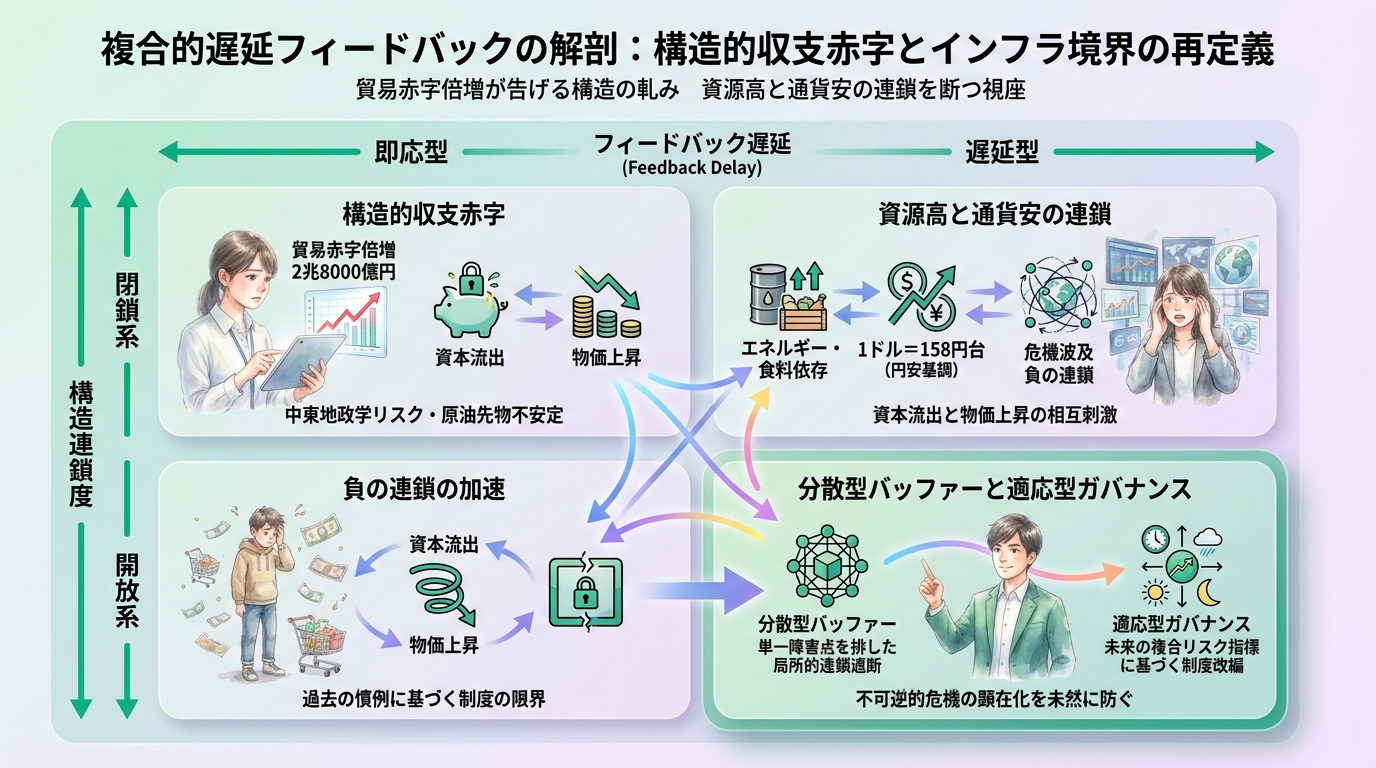
Against a backdrop of heightened economic uncertainty—with the Nikkei Stock Average hovering around 38,450 yen and the exchange rate pressing past 154 yen to the dollar—the capacity for crisis management that reconciles urban security with economic circulation defines a nation's true competitive edge. The 'S-rank' classification of the Kinki active fault zone is a stark warning that time is running short. What is urgently required is a collaborative synthesis of wisdom across government, enterprise, and civil society to establish institutional designs and autonomous infrastructure that ensure the past failures of 'supply bottlenecks' are never repeated. Synchronizing physical reinforcement with the intellectualization of logistics represents the sole path to enduring an unprecedented compound mega-disaster, safeguarding human life and economic vitality, and shaping the future social structure.