The 'Memory of the Hand' in Code-Governed Chassis: Toyota's 10-Million SDV Strategy and the Proposition of Suriawase (Tuning)
The Antinomy Between Digital Abstraction Driven by the Mass Production of the 'Arene' Vehicle Platform and the Physical Embodiment that Grips the Pavement
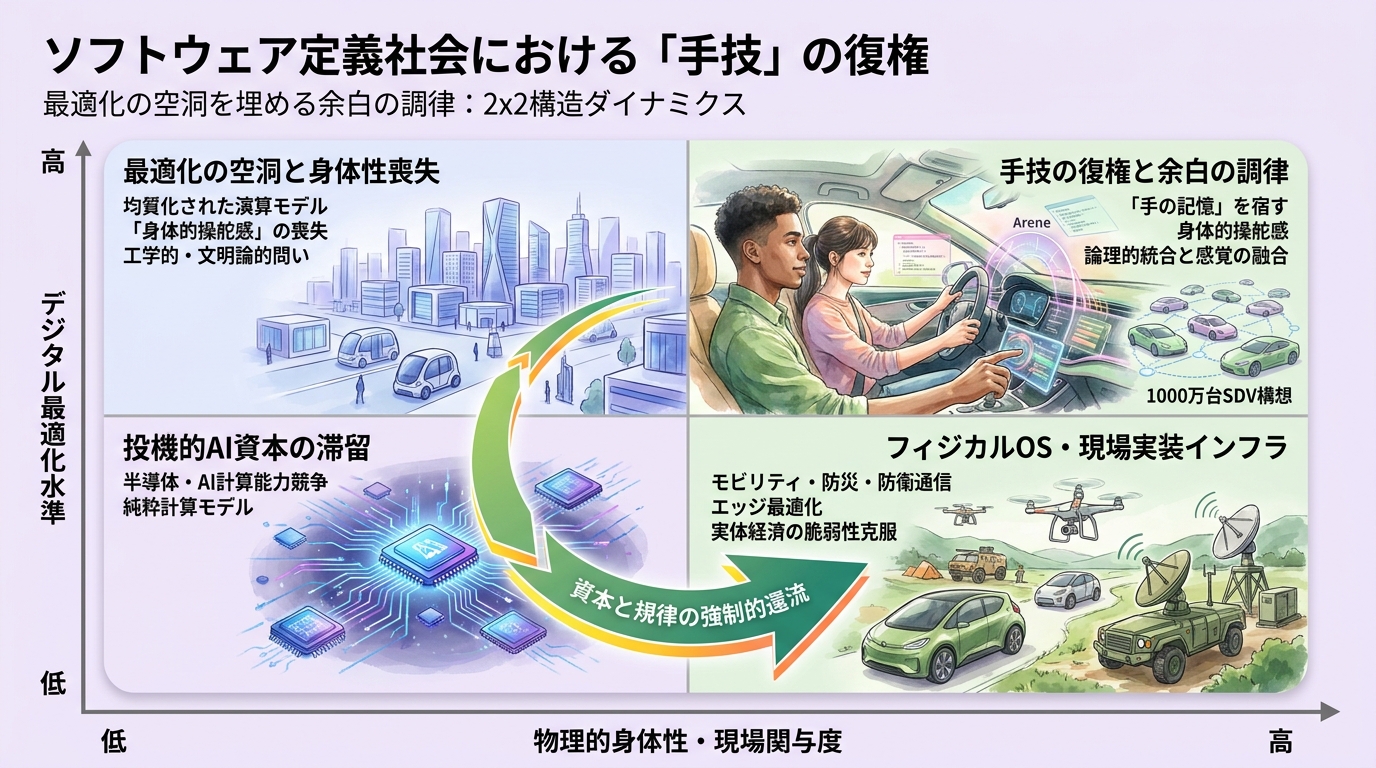
Centralized control via an automotive OS bundles circuits once dispersed across countless electronic control units (ECUs), dramatically elevating development efficiency and updateability. However, the more perfectly logical circuits attempt to model vehicle behavior, the greater the design congestion caused by abstraction. Non-linear phenomena—such as micro-surface irregularities on the road, tire wear, and changes in rubber bushing hardness due to ambient temperature—tend to be discarded as errors during the mathematical formulation process. As efficiency is pushed to its absolute limits, while every vehicle exhibits a uniform and flawless response, the subtle tactile feedback once experienced by drivers in dialogue with the road, and the margin for harmony between driver and machine, fall away from the chassis. The purer the logic becomes, the more the visceral texture of the ride hollows out.
In mechanical systems, 'fluctuations' and 'imperfections' that deviate slightly from rigorous calculation are not mere defects; they provide the flexibility to withstand disturbances. The long-standing strength of Japanese automotive manufacturing has been 'suriawase'—the artisanal tuning executed through the fingertips of test drivers and the craftsmanship of mold artisans, defying complete capture by blueprints or simulation metrics. By intentionally building compliance or resilience into sub-millimeter rigidity balances and suspension damping characteristics, vehicles acquire the tenacity to respond flexibly and stably to unexpected gusts and ruts. No matter how precise digital control becomes, it cannot entirely anticipate the behavior of physical friction and aging. The tacit knowledge accumulated through craft techniques has served as an antibody protecting passengers from sudden environmental shifts.
The question at hand is not whether to pit rational code against on-site craftsmanship. Rather, it is an attitude of taming software not as a superior layer replacing physical phenomena, but as a 'new tool' to faithfully reproduce and expand the tactile sensations and anomalies cultivated by artisans. For instance, this involves the endeavor to weave microscopic backlash and ground load transition feels favored by veteran craftsmen as digital parameters directly into the precise actuator controls governed by Arene. When the cold logic of the programmer and the physical wisdom of the test track evaluator intersect on equal terms, the SDV is elevated from an inorganic calculator into an organic tool that extends the driver's bodily senses. At the forefront of development, an artisanal aesthetic that advances engineering abstraction while resolutely refusing to relinquish the feel of physical matter is in high demand.
The true challenge facing the automotive industry is not merely completing a scale race concerning OS adoption figures or processing speeds. It lies in the design of a civilization: how to preserve the subjective tactile feedback and trust of humans operating machines within a highly automated mobility space where all behaviors are rectified by algorithms. Within the whirlwind of radical technological innovation, an attitude that merely pursues short development cycles and uniform optimal solutions will never birth a tool cherished across generations. The agile updateability brought by digital technology and the robust physical embodiment hand-carved and tuned by frontline artisans: precisely where both acknowledge each other's margins and resonate with exquisite precision, a rich future of human-vehicle symbiosis—surpassing the mere metric of 10 million units—will unfold.