The Shock of the $70,000 U.S. Student Work Visa Fee: Institutional Barriers Shaking the 2036 Brain Circulation
The Reorganization of Knowledge Under Threat of Closed Doors: Designing a Decentralized Symbiosis Beyond Concentration and Stagnation
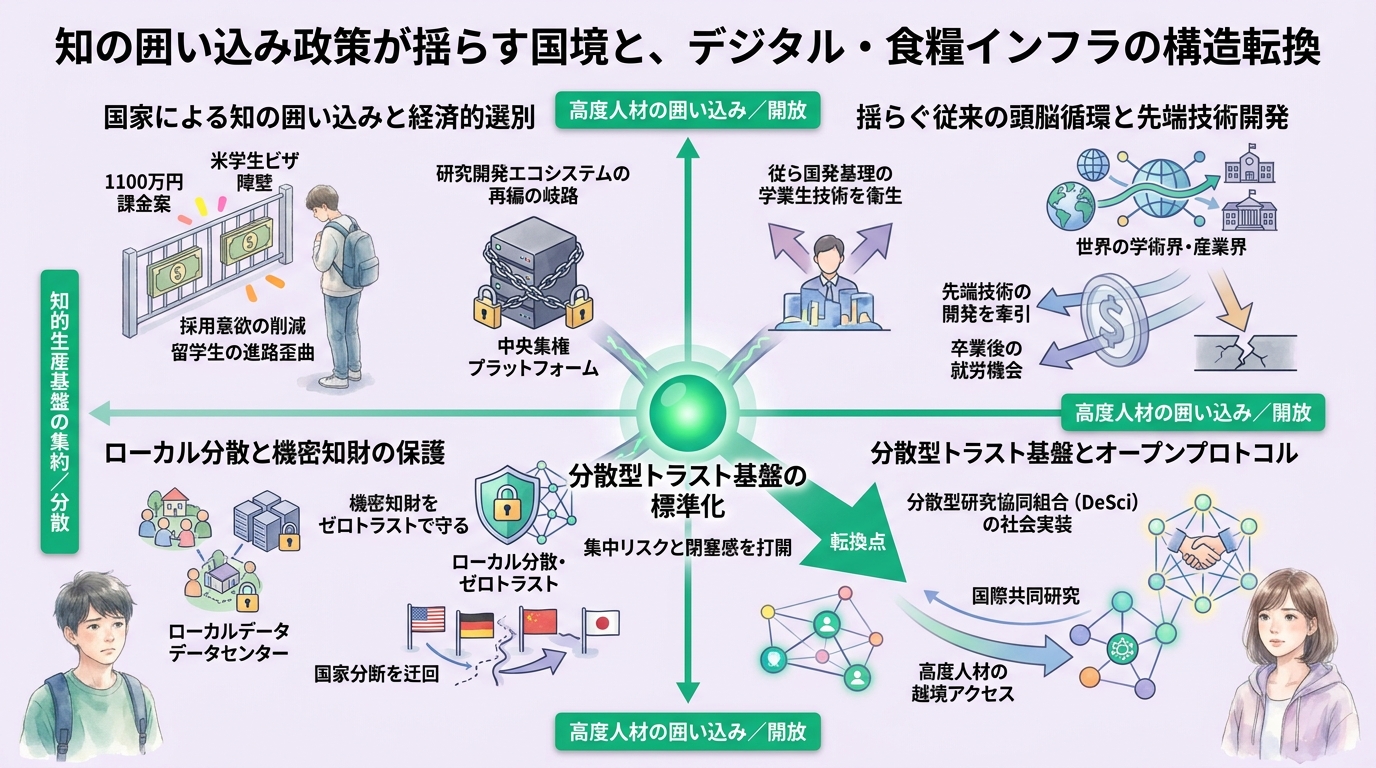
The intrinsic impact of this regulatory proposal extends far beyond a mere visa fee revision; it forcibly shifts the criteria for talent allocation from "ability and ambition" to "the capital strength of the sponsoring organization." A financial burden of $70,000 is a threshold that early-stage startups and non-profit organizations dedicated to basic research simply cannot absorb, forcing them to abandon the recruitment of young foreign researchers. While many international students aspire to contribute to scientific and technological frontiers beyond their home borders, this policy threatens to narrow the traditional pathways through which academic achievements flow back into the U.S. market. This represents a critical juncture where the autonomous driving force of innovation, long sustained by an open research environment, could be undermined by state-led economic barriers to entry.
The primary scenario predicted should this policy advance is an "over-concentration" of talent within mega-tech corporations wielding massive surplus capital. Only a handful of multinational enterprises capable of absorbing the exorbitant fees will monopolize global elites, accelerating the privatization of intellectual property and advanced research. Conversely, a secondary scenario is a "global research stagnation" driven by a cascade of protectionism. If other nations introduce retaliatory fees or travel restrictions, researcher mobility will plummet, shrinking cross-border collaborative experiments and data sharing. Regardless of which path is taken, the room for nameless young individuals with diverse backgrounds to bring about serendipitous discoveries will shrink, and the foundations of technological innovation will rapidly wither.
Yet, a third path to avert catastrophe can also be explored: the construction of a "decentralized network of symbiosis" through the cooperation of multipolar research hubs. This scenario moves away from centralized brain accumulation dependent on a single hegemonic power, connecting research cities in Europe, Asia, the Middle East, and beyond via egalitarian protocols. If the international community establishes foundational infrastructure for remote collaborative research and flexible researcher visa frameworks mutually recognized across multiple nations, an intellectual infrastructure independent of physical border controls can emerge. A tuning mechanism that allows researchers to relocate and share hubs based on their academic value, unconstrained by capital volume, will form the stable bedrock for long-term technological innovation.
Looking ahead to 2036, what is required now is not passive lamentation before closing doors, but the redesign of receptacle institutions. Rather than standing idly by as top talent leaks due to U.S. fee policies, Japan and other nations should develop reception bases and funding allocation models that allow researchers to autonomously exercise their capabilities. Simultaneously, the industrial sector will be tested on its willingness to diversify investments into cross-border basic research, unhindered by short-term cost-effectiveness. In the face of attempts to restrict the movement of knowledge through financial means, how we ensure enduring open connectivity remains paramount. The institutional decisions made today will define the horizon of human knowledge for the next decade.