Newspaper Subscriptions Drop Below 50% for First Time: The Loss of a Shared Morning and the Genesis of an Algorithmic Knowledge Order
The Dissolution of the Print-Sustained Public Sphere: Individually Optimized Cognition Demands a Redesign of Democracy
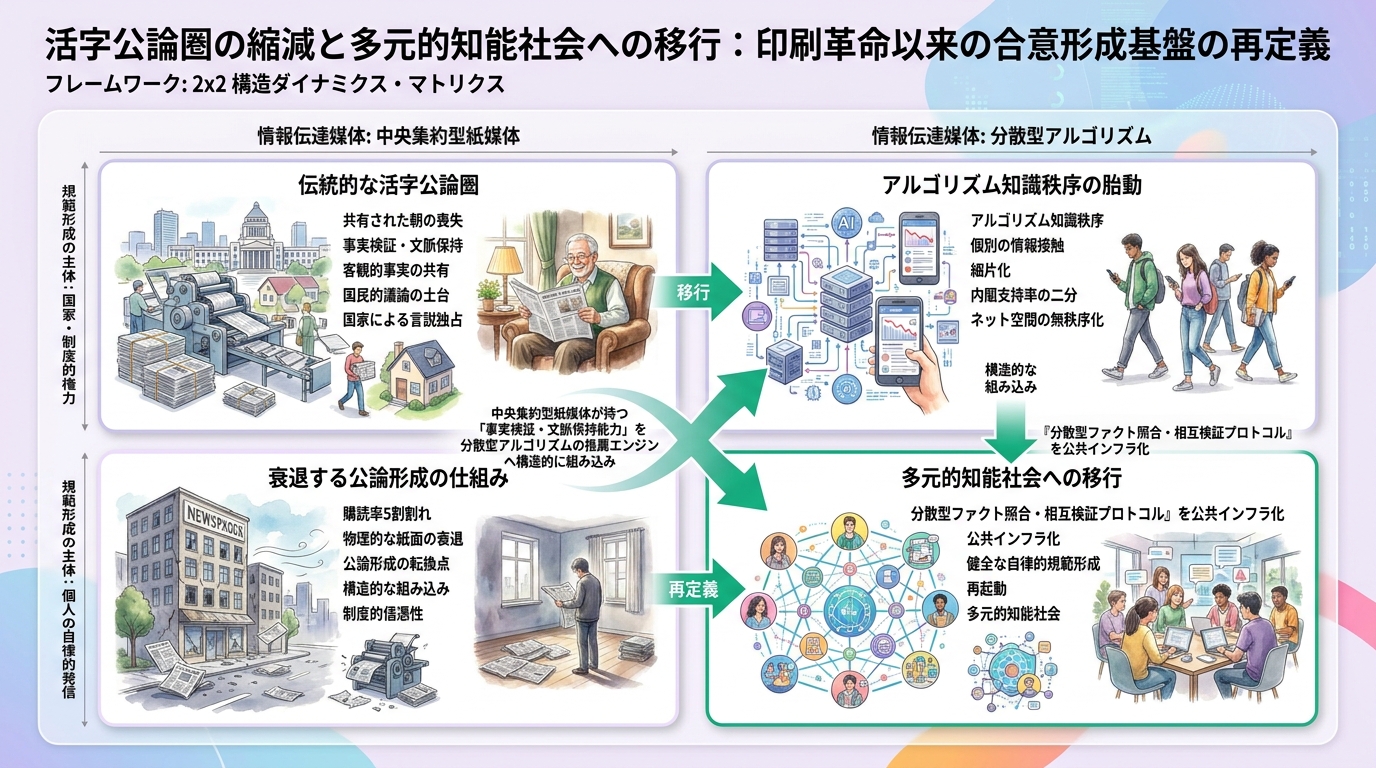
The enduring consensus that 'opening the morning paper outlines the contours of society' has statistically receded. The findings of the survey graphically illustrate the irreversible shift of public attention from physical print toward digital devices. The era in which a single morning broadsheet on the dining table set the societal agenda—spanning politics, business, foreign affairs, and daily culture—has drawn to a close. The foundational premise of modern democracy, wherein households debated diverse opinions upon a common bedrock of shared facts, is yielding to an environment where information intake diverges per household, per individual.
A historical reflection reveals that ever since Johannes Gutenberg developed movable type in the mid-15th century, humanity has forged nation-states and civil societies through the vehicle of mechanically reproduced, uniform text. As Benedict Anderson famously observed, the collective awareness of reading identical printed material concurrently with unseen strangers formed the very cradle of the modern 'public sphere.' Neither the Protestant Reformation nor the great modern revolutions could have materialized without the circulation of standardized language and logic enabled by print. The transition confronting us today is the structural dismantling and reassembly of a 500-year-old print culture that sustained human thought and governance, catalyzed by the upheaval of telecommunications.
The structural irreversibility of this shift stems from the fundamental transition in information distribution from 'editorial curation' to 'algorithmic optimization.' Traditional newspapers mapped diverse events across the scarce, two-dimensional space of the page in order of editorial weight, affording readers serendipitous encounters with unexpected knowledge. In contrast, today's smartphone-mediated digital landscape relies on platform algorithms that parse individual interests, dwell times, and emotional volatility, continuously supplying optimized, piecemeal content. The union of economic efficiency—minimizing the cognitive load of the consumer—and digital technology has spawned fractured perceptual realities shorn of common premises, steadily eroding the foundations of social cohesion.
The dissolution of the print community compels a profound reconsideration of our epistemic rituals—specifically, how we apprehend reality and forge consensus with others. Deprived of the holistic perspective and contextual depth once guaranteed by the printed page, deliberative discourse struggles to survive in an attention economy ruled by sensational headlines and bite-sized rhetoric. Within a knowledge order hyper-tailored to individual tastes, how can citizens verify shared facts and sustain dialogue across deepening divides? In the void left by the retreat of the morning paper, the urgent question confronting citizens and chroniclers alike is what ethical frameworks and institutional architectures must be erected to rebuild a shared public forum.