The Artisan's Touch Catching the Wind: Reevaluating 'Craft' in an Age of Computation
What Human-Powered Aircraft Reveal: Reclaiming Physicality and Imperfection Beyond the Wave of Automation
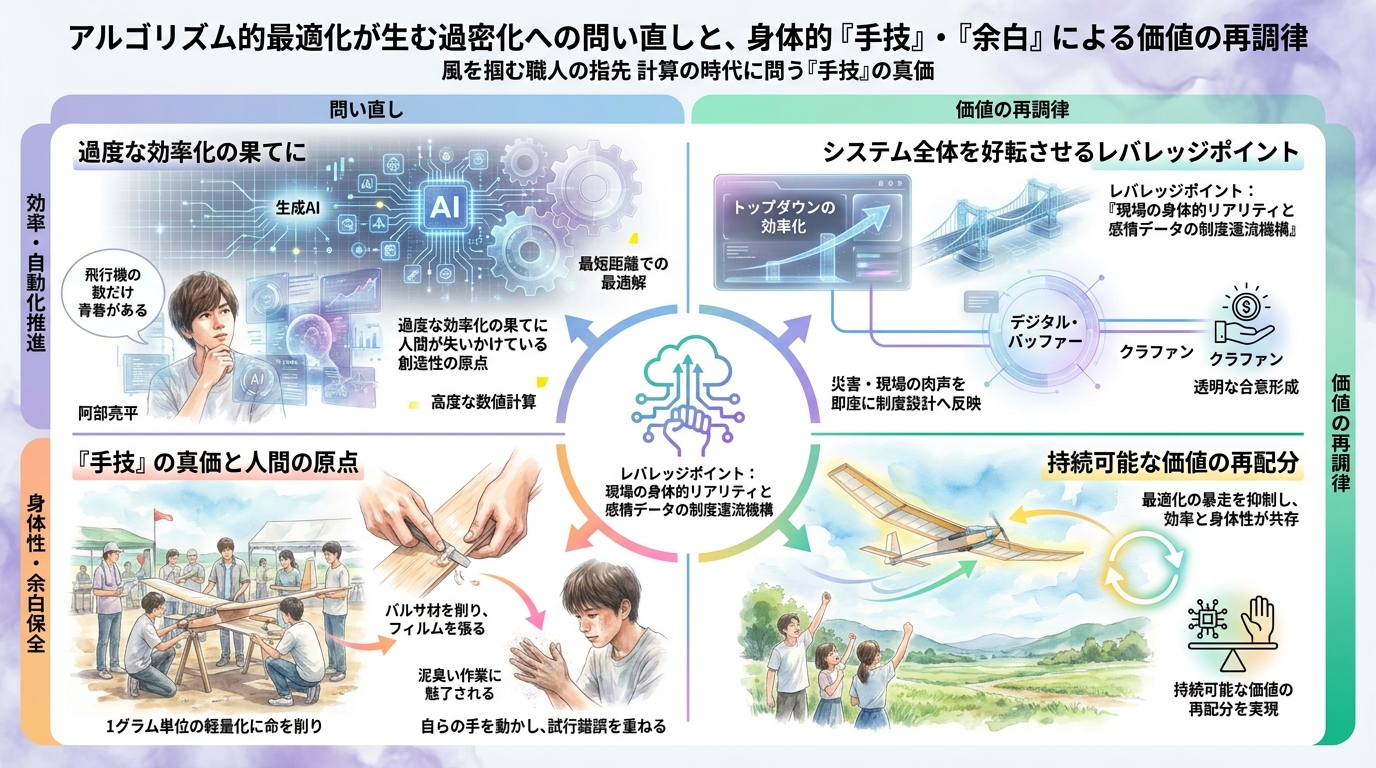
In modern society, where digital twins and CAD systems optimize industrial blueprints in record time, manufacturing efficiency has surged exponentially. Yet as the pursuit of total calculability reaches its zenith, our surroundings have become saturated with uniform, homogenized products stripped of all redundancy. Entrusting ourselves to algorithms designed to eliminate error and dodge failure yields impressive short-term results; however, it ultimately breeds intellectual passivity and an emptiness of vision. The fervor witnessed by Mr. Abe—'When captivated by a dream, people move with resolute purpose'—can never be generated simply by following optimal solutions on a digital screen. The essence of human intellect and passion, untranslatable into mere numbers, thrives precisely within the gritty process of trial and error: confronting capricious winds and structural distortions that defy calculation, while sharpening one's own physical intuition.
Even a design that perfectly satisfies the theoretical calculations of fluid dynamics cannot fully cope with the irregular wind currents sweeping across Lake Biwa. In the meticulous process of hand-carving a wing and feeling out subtle structural variations through bodily intuition, there lies an imperfection that algorithms routinely discard. Yet it is precisely this uncalculable 'margin' that equips a system with resilient adaptability against unexpected shocks. Machines that operate solely in perfectly controlled environments are inherently fragile; only when augmented by human intuition and experiential knowledge gained through handcraft can a structure withstand unforeseen gusts. The 'fluctuations of manual craft,' so often pruned away in the name of efficiency, serve as crucial antibodies against systemic rigidity—the very wellspring of vitality.
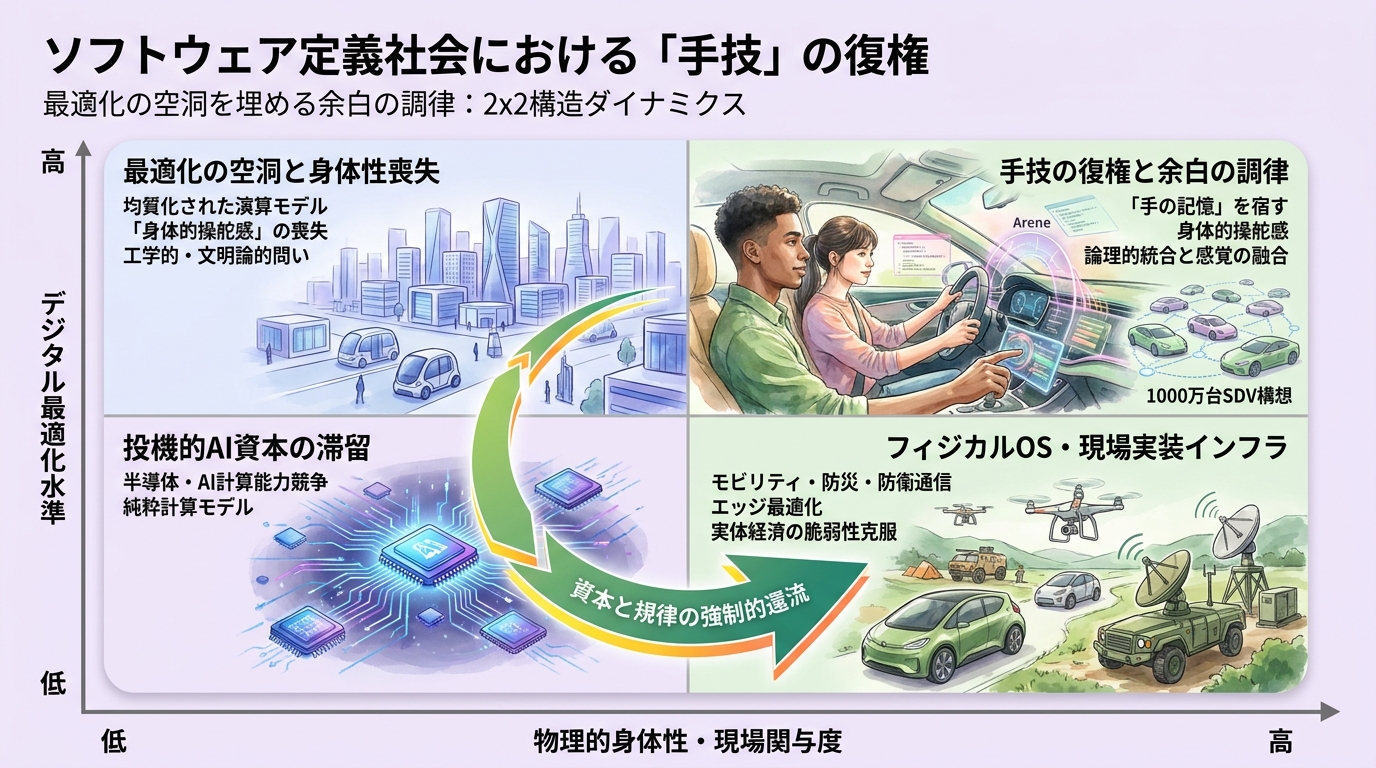
This is by no means a rejection of digital technology. Rather, it offers a new artisan aesthetic that tames AI and advanced simulations into subservient tools, harmonizing them at a higher plane with human craft. While AI can present initial design candidates from vast search spaces, the final tactility of the wing and the micro-adjustments of its joints are determined by the artisan's honed intuition. Rather than being subservient to our tools, this approach expands our physical agency through dialogue with them, clearly defining the human role in the AI era. It asserts a proud conviction: even while harnessing state-of-the-art computational power, deciding that final millimeter remains the domain of human experience and intuition. Hybrid creativity is achieved only when we resist being swallowed by technological velocity, retaining the tactile sensation of manual craft as our guiding compass.
By stepping back from a civilization obsessed with hyper-velocity and short-term gains, we gain a new discipline for cultivating mature intelligence. What these hand-built aircraft present is not mere nostalgia, but a tangible invitation to reclaim human agency. Rejecting efficiency as the sole yardstick enables us to reclaim a rich appreciation for the process of trial and error itself. Refusing to blindly accept machine-generated solutions and choosing instead to re-engage with the world through our bodily senses will instill a resilient intellectual depth in the social structures of the next generation. The sight of young builders painstakingly assembling a single aircraft on a wind-swept shore quietly reveals a tuned future beyond the age of automation—a world where humanity and technology exist in true harmony.