The Rush-Buy Trap: How Interest Rate Hike Expectations Spawn Delayed Risks in Ultra-Long Mortgages
Homeownership rates among those in their 20s hit record highs as looming rate revisions and household debt fixation cast a long shadow over the future
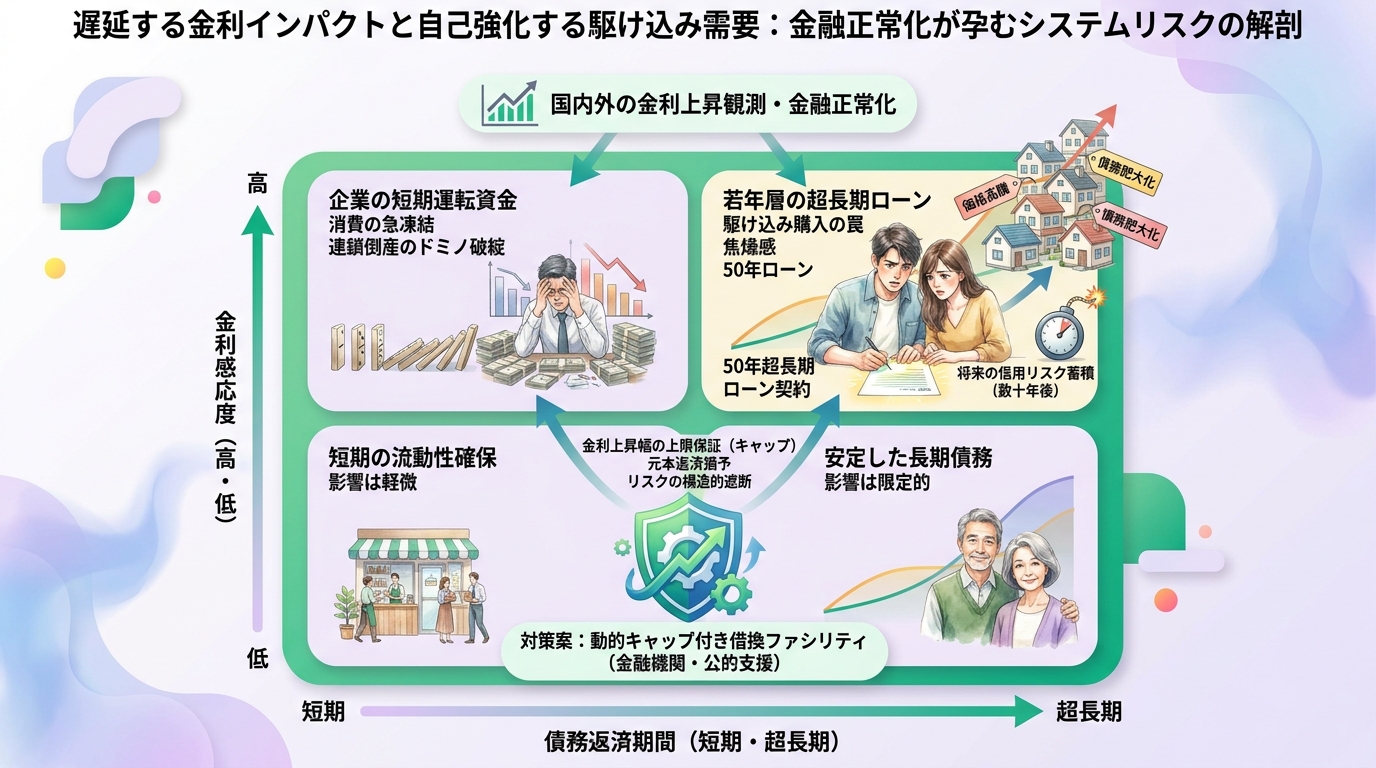
Uncertainty within financial markets is cascading directly into the most fundamental decision of civic life: home acquisition. According to reports drawing on Ministry of Internal Affairs and Communications surveys, the homeownership acquisition rate among young households has reached unprecedented levels. Prompted by the prolonged low-interest-rate era, buyers fearing rising borrowing costs are rushing into contracts, while sellers eagerly roll out 50-year financing products to stimulate demand. Meanwhile, in the US market, expectations of rate cuts have faltered as persistent policy rates remain a focal point, leaving the trajectory of currencies and interest rates fraught with uncertainty. Households attempting to preemptively evade future vulnerabilities are ironically taking on the largest long-term liabilities in history.
Beneath this phenomenon lies a self-reinforcing feedback loop where preemptive demand fuels further price escalation. The anxiety of 'if I do not buy now, I will be priced out' pulls forward purchase timing, and this concentrated demand easily absorbs the passing-on of stubbornly high construction material and land costs. To fit inflated property prices into monthly affordability limits, financial institutions have extended loan terms from the traditional 35 years to 40, and even 50 years. While lengthening the repayment period suppresses immediate monthly burdens, it inflates total interest payments and drastically slows principal reduction. This localized optimization to escape the future pain of rising interest rates creates a structural vulnerability, validating extreme loan extensions system-wide and undermining resilience against asset depreciation.
The leverage point for correcting this chain reaction lies in the pragmatic tightening of credit screening by financial institutions and the proper disclosure of risk information. In the underwriting of ultra-long mortgages, it is difficult to argue that rigorous stress tests incorporating future interest rate hikes and household income fluctuations—rather than superficial debt-service ratios predicated on current ultra-low rates—are functioning adequately. Rather than reducing the issue to a matter of borrower financial literacy, a systemic framework must be rebuilt to quantitatively visualize the degree to which lenders shift interest rate fluctuation risks onto borrowers, thereby curbing over-borrowing dependent on loan-term extensions. Sound market discipline must be restored before the easing of terms driven by lending competition becomes institutionalized.
Contracts signed out of attraction to low upfront payments threaten to become ticking time bombs for household balance sheets a decade or two down the line. When fixed-rate periods expire or variable rates are revised, concurrent increases in education costs, post-retirement income drops, and rising debt service will transform default risk from individual bankruptcies into a systemic blow to institutional asset assessments. To preemptively prevent the systemic risks born of rational individual actions, a perspective is indispensable that calmly reconciles the development-finance complex chasing near-term sales volumes with consumer psychology swayed by interest rate forecasts. Beyond the exhaustion of low-interest benefits lies a heavy, long-term responsibility borne by a generation that has pledged time itself—the duration of the loan—as collateral.