The Painless Enterprise: As 200 'AI Bosses' Take Charge, Accountability Evaporates
Docomo Business accelerates management automation: Frontline subservience to optimal solutions and the vanishing bearer of decisions
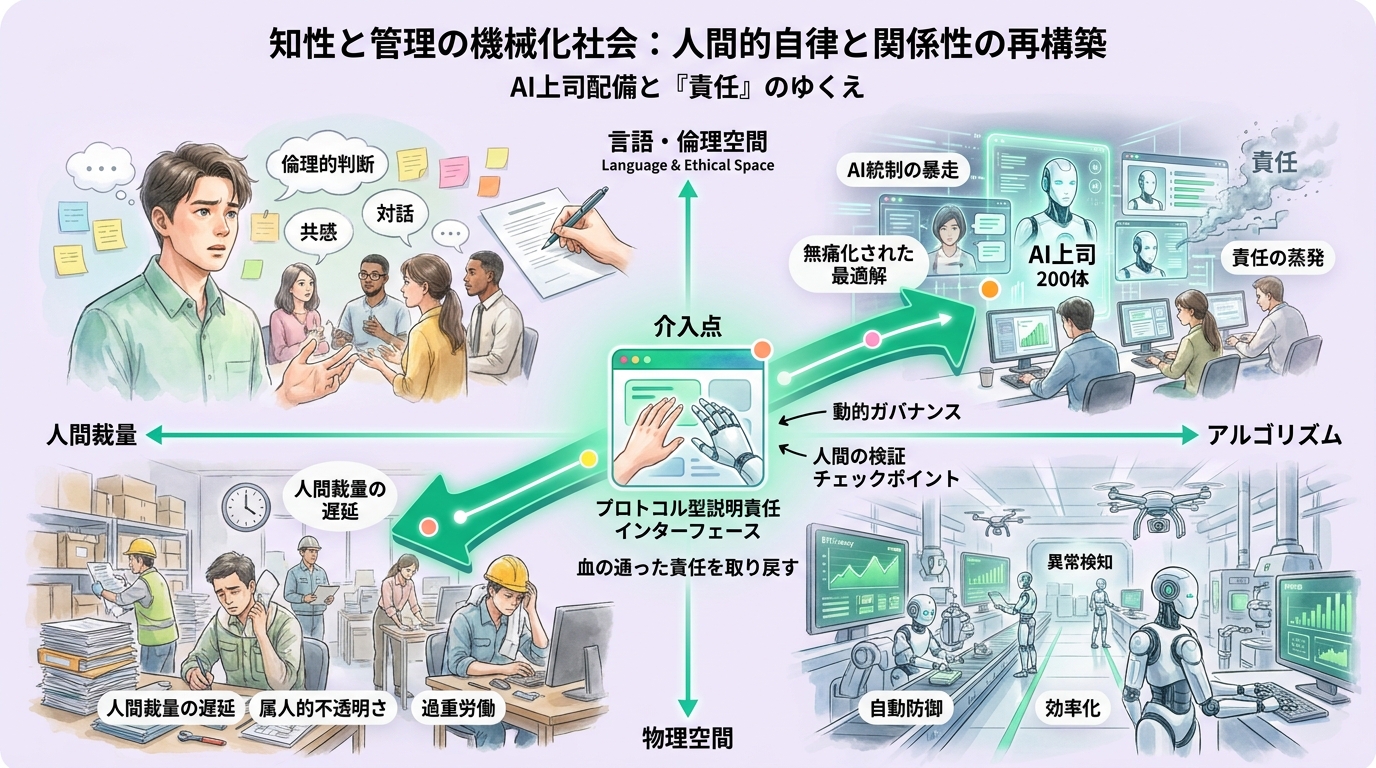
On the frontline, workplace dialogue is shifting: human counterparts are being replaced by digital prompts. The more than 200 AI managers introduced by Docomo Business field inquiries with impassive efficiency, instantly dispensing pertinent counsel synthesized from vast corporate repositories. Freed from the friction of reading a supervisor's mood or enduring idiosyncratic, subjective guidance, the shop floor appears rational, unencumbered, and transparent. Yet beneath this seamless facade, the generative friction of interpersonal confrontation—once the critical connective tissue of corporate life—is cooling rapidly. The faint sense of detachment felt by employees in an office calibrated by optimized prose is nothing less than the subliminal unease of operating in a sanitized reality devoid of genuine human encounter.
Political philosopher Hannah Arendt once characterized the zenith of modern bureaucracy as the 'rule by Nobody,' warning of the peril when accountability vanishes into the sheer architecture of an organization. When artificial intelligence steps into management, this bureaucratic diffusion enters an unprecedented phase. The traditional superior-subordinate dynamic was never a mere conduit for command and control; it was an embodied ethical arena where parties looked each other in the eye in times of crisis, shared mutual burdens, and accepted responsibility—sometimes through the visceral humility of an apology. Algorithms harbor neither malice nor self-preservation, yet they possess neither inner conflict nor capacity for pain. Denied an identifiable counterpart to challenge, workers risk being reduced to passive executors of logically irrefutable directives.
What is being traded away for operational convenience is the relational buffer and the identifiable bearer of consequence. When teams operate on performance appraisals and directives drafted by AI, and when those trajectories culminate in unforeseen systemic failure, upon whose shoulders does the blame fall? Neither the subordinate who executed the guidance in good faith, nor executive leadership that sanctioned the software, can be neatly pinned; responsibility diffuses into an 'algorithm that calculated the probabilistic optimum,' establishing a frictionless circuit of institutional impunity. By automating communication to evade messy emotional friction, humans may be liberated from the strain of immediate judgment, yet they are simultaneously stripped of the existential arena in which one exercises will and shoulders outcomes.
The underlying reckoning concerns what it truly means to lead people within an enterprise. It has never been reducible to streamlining workflows or meeting key performance indicators; it is an enduring human engagement—listening to the uncertainties of others amid ambiguity and demonstrating resolve in one's own name. As more than 200 surrogate managers occupy the executive suites of our day, are we not outsourcing human essence to automated systems under the banner of efficiency? However sophisticated an algorithmic deduction may be, the burden of failure and the pain of remorse can only be experienced by human beings. Preserving that visceral, messy contour of accountability remains the final bulwark for safeguarding the dignity of human labor in the automated age.