New Professional Educator Programs for Career Professionals Challenge the Limits of the 'Omnicompetent' Teacher: A Path Toward Collaboration Beyond the Clash of Open Doors and Specialization
Ministry of Education outlines creation of alternative certification paths, navigating friction between private-sector expertise and instructional leadership to map the future of school organization
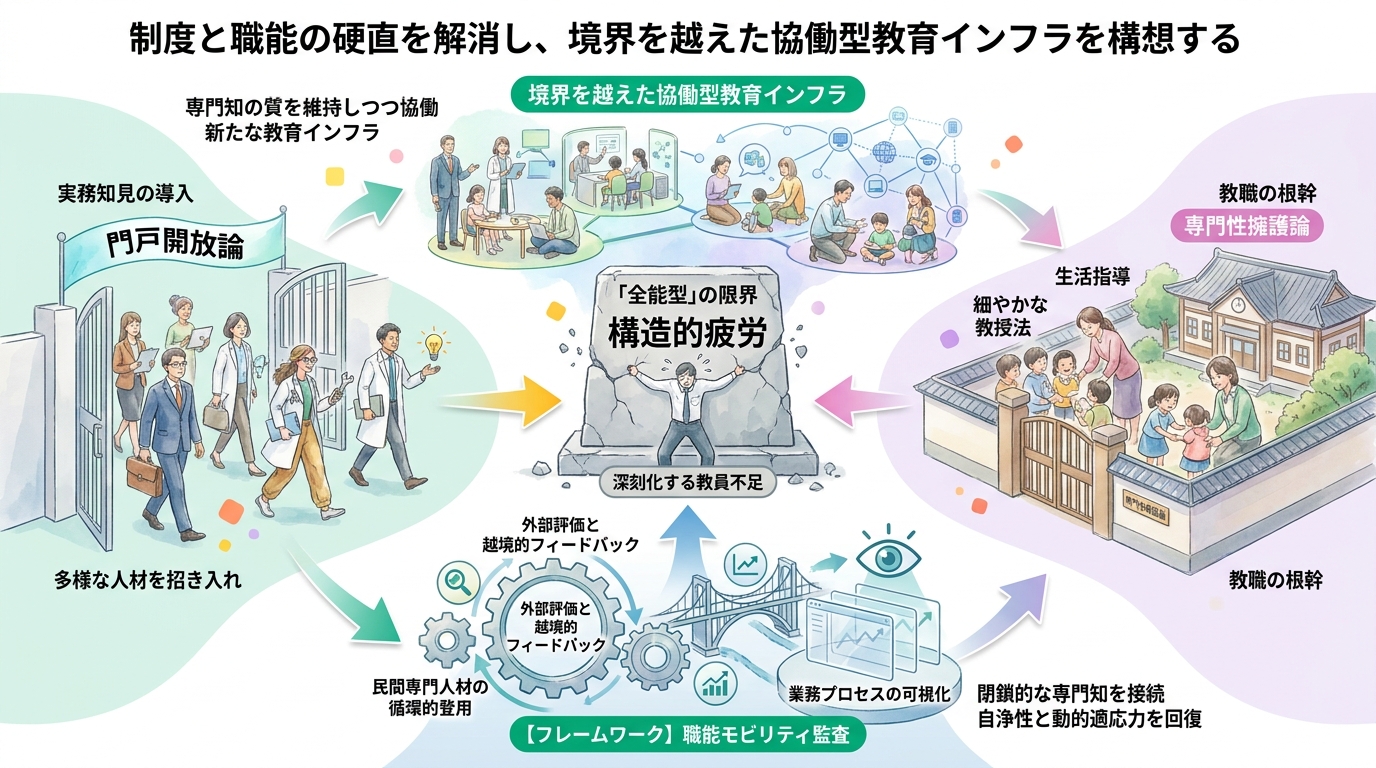
Advocates of the open-door policy express deep concern that schools remain insular spaces disconnected from a rapidly changing social structure. Their logic dictates that responding to advanced technological progress and economic complexity requires the perspectives of professionals with hands-on corporate experience and specialized skills. In contrast, educators and conservative voices raise serious apprehensions. The mastery required to transmit academic knowledge is fundamentally different from the capacity to receive students' fluctuating emotions and unify a classroom collective. The argument that shortening or exempting practical training and educational psychology coursework will lead to deficient classroom teaching and student guidance—and that children will ultimately bear the cost—carries considerable persuasive weight.
A meticulous examination of this dichotomy, however, reveals that both sides are trapped by a shared assumption: that recruited professionals will be expected to step into the exact same self-contained role as traditional educators. Open-door proponents assume that practical capability automatically translates into classroom leadership, while traditionalists fear that newcomers will fail to manage conventional classroom dynamics, dragging down educational quality. Yet, as long as the current working model persists—where a single teacher is burdened with every responsibility from early morning to after-school club guidance, school lunch administration, and parent relations—introducing external talent risks becoming a war of attrition that simply drops experienced outsiders into a punishing work environment.
The key to transcending this conflict lies not in viewing teaching as an all-encompassing individual task, but in an organizational shift toward a "team-based educational model" where multiple professionals divide roles to support children. While corporate-background teachers leverage their specialized knowledge in academic and career guidance, fully trained resident educators and specialized staff take the lead in psychological care and group instruction. Rather than merely lowering certification barriers, clearly redefining the boundaries of responsibilities and building a collaborative framework of shared school administration is the rational path to resolving both sets of concerns.
The creation of these new certification programs must not end as a temporary, palliative stopgap for staffing shortages. What is required is a clearly defined scope of duties for corporate-background teachers upon entering the school environment, backed by institutional frameworks that empower middle leaders, such as head teachers, to oversee the entirety of operations. Defending educational specialization and incorporating diverse external expertise are by no means mutually exclusive. When an organizational model rooted in division of labor and coordination is successfully established, schools will break free from their insular environment and function as open hubs of knowledge, imparting both social reality and rigorous learning to the next generation.