THE SCHOOL OF KAMOS
Connecting Real-world Dev & Academic Intelligence with Intuitive Metaphors
When We Stopped the Relentless Loop Chasing Smoothness, the Screen Began to Flow with Effortless Grace
Subtractive Rendering Design: Releasing the Constant Gas Pedal to Draw Only at the Exact Moment of Change
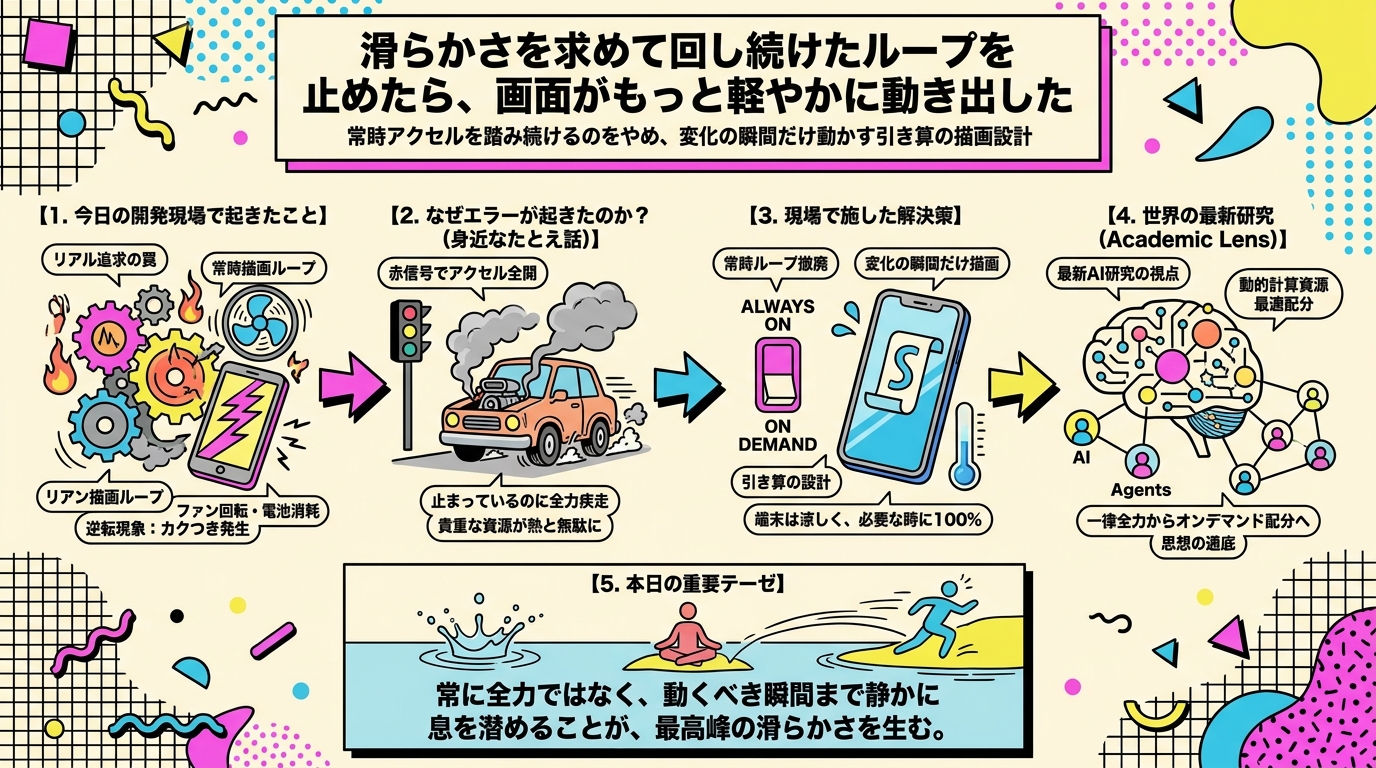
When rendering a 3D natural landscape beautifully on the web, it is tempting to assume that running a relentless 60-frames-per-second update loop is the ideal approach. Yet in production, keeping the rendering loop constantly spinning in the pursuit of realism caused roaring cooling fans, drained device batteries, and triggered a frustrating paradox: the critical scrolling experience itself began to stutter. Ironically, dedicating maximum compute to make the screen feel smooth ended up stealing the very fluidity we sought.
Why did an intuition born of good intentions backfire so spectacularly? To draw a familiar analogy, it was like stepping on the gas pedal at full throttle while stopped at a red light, simply to be ready to accelerate at any microsecond. Even when the car sits motionless and the scenery never shifts, the hardware is forced to sprint flat out 60 times every second. Consequently, precious compute resources were squandered on thermal throttling and wasteful idle spinning, leaving no headroom when the user actually flicked their finger to scroll—resulting in jarring stutters.
The decision the team made, counterintuitive as it seemed, was to completely eliminate the continuous loop. We shifted to an architecture that repaints the frame precisely once, and only when a state change occurs—such as a shift in camera perspective or a transition between day and night lighting. By allowing compute to rest completely during idle periods, the device stays cool, primed to deliver 100% of its power the exact moment it is summoned. This mirrors the compute allocation of AI models: rather than squandering maximum compute uniformly across every single token, reserving margins and focusing exclusively on critical decision junctures is the true key to producing effortless, uninterrupted responses.
"True fluidity comes not from spinning at full throttle indefinitely, but from holding one's breath in stillness until the exact moment demands motion."Key Takeaway
📖 1-Minute Lexicon
A power-efficient rendering technique that redraws the frame exclusively when screen content changes, completely halting processing during static states.
A mechanism that repeatedly invokes screen repaints approximately 60 times per second, synchronized with the browser's refresh rate.
The effortless agility born of shifting from continuous full-throttle execution to on-demand standby
Live Frontier Pulse: Real-World AI Trends
Sharing AI Progress in Mathematics
Shared new findings and progress in enabling AI models to untangle complex steps without logical leaps in advanced mathematical proofs and reasoning benchmarks.
How Does This Connect to Global Frontier Research?
In multi-agent collaborative systems, pouring massive compute uniformly into every generated token is inherently inefficient; this cutting-edge paper proposes a framework to dynamically allocate compute based on per-token complexity. It shares the exact same philosophy as our engineering choice to stop constant render loops on static frames and concentrate compute solely on moments of change. Shifting from uniform full-throttle execution to necessary-and-sufficient on-demand allocation is gaining ground across both contemporary AI and rendering engineering.
Which of the following is the most effective approach to achieve smooth, comfortable performance in 3D graphics and background visual effects?
Past School Paper Backnumbers
型を繋いで技を編む:AIグラフィックを迷わせない3層ハーネスの知恵

The Courage to Prune vs. The Will to Protect: How Predeploy Guards Solved the Cleanup Dilemma
Building the Detour: How to Keep AI from Grinding to a Halt
Current
When We Stopped the Relentless Loop Chasing Smoothness, the Screen Began to Flow with Effortless Grace

The Mathematics of Seamless Waves: Zero-Pixel Tolerance in Background Tile Synchronization

How AI Grew Smarter Once We Stripped 'World-Class Analysis': The Prompt Title Detox

The Luxury of Not Asking AI Every Time: The Wisdom of a 'Directed Reading Graph' Connecting 159 Pages

Clearing the AI's Vision by Erasing the Grading Rule: The High Leverage of Subtracting a Single Line
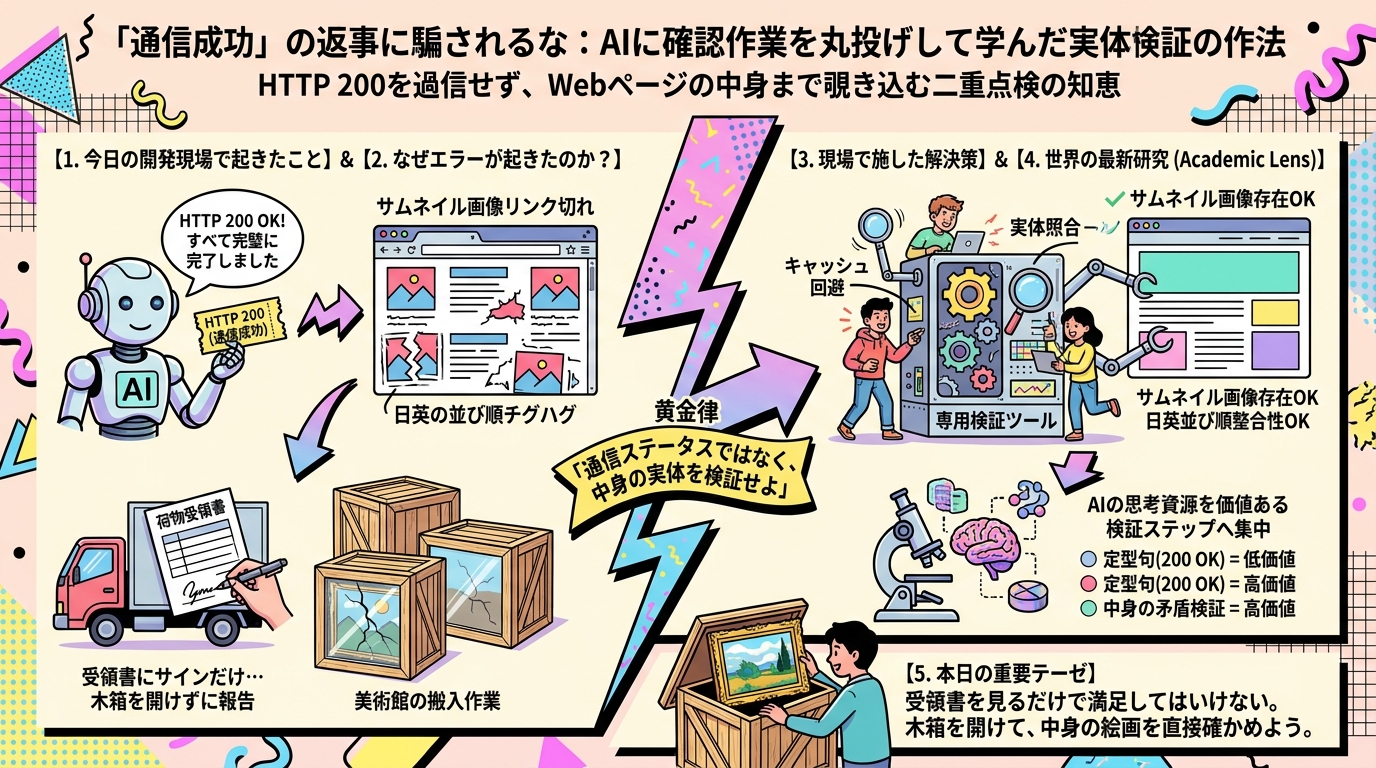
Don't Be Deceived by a 'Connection Successful' Response: Lessons in Live Content Verification from Delegating Quality Checks to AI
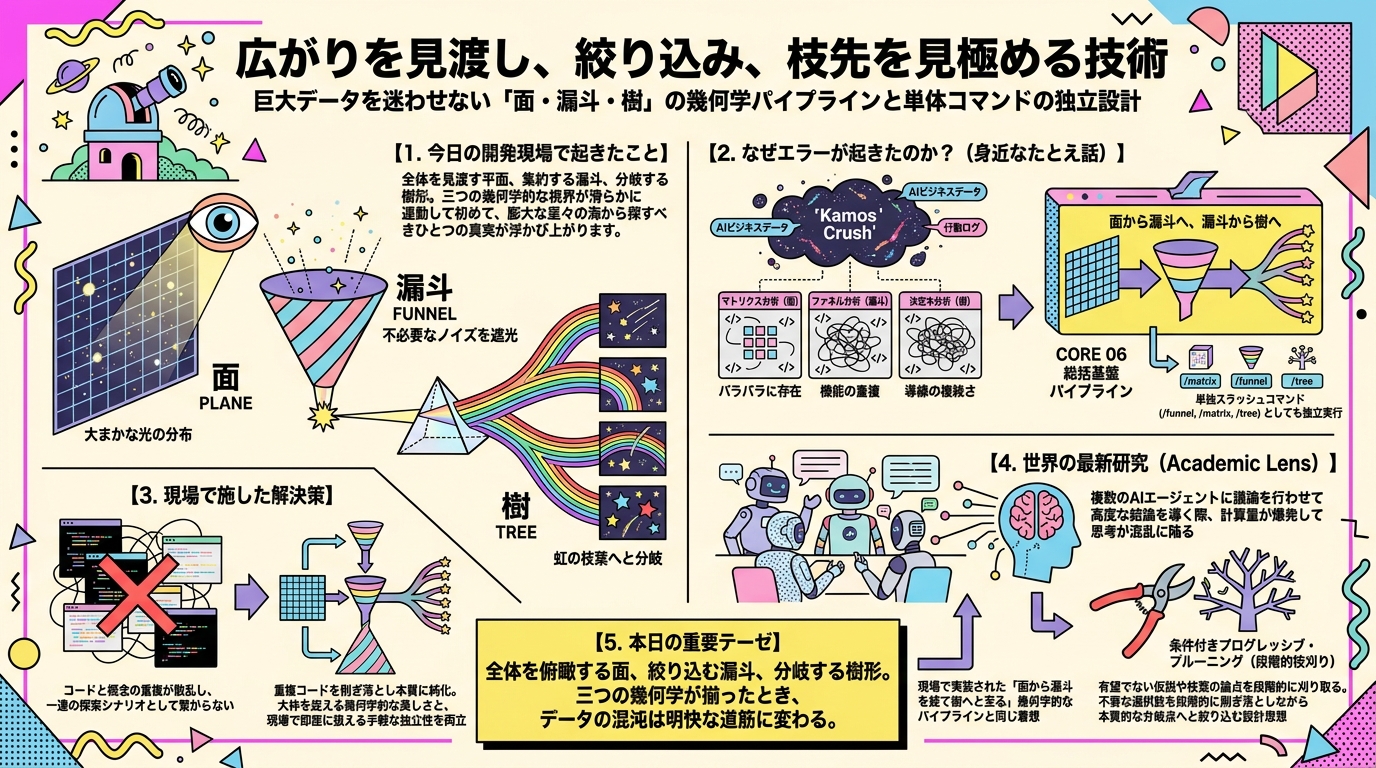
The Art of Surveying the Field, Narrowing Down, and Discerning the Branches

Can Expressive Richness Coexist with Nimble Performance? How Scoped Animation Control Solved the "Fluctuation" Dilemma
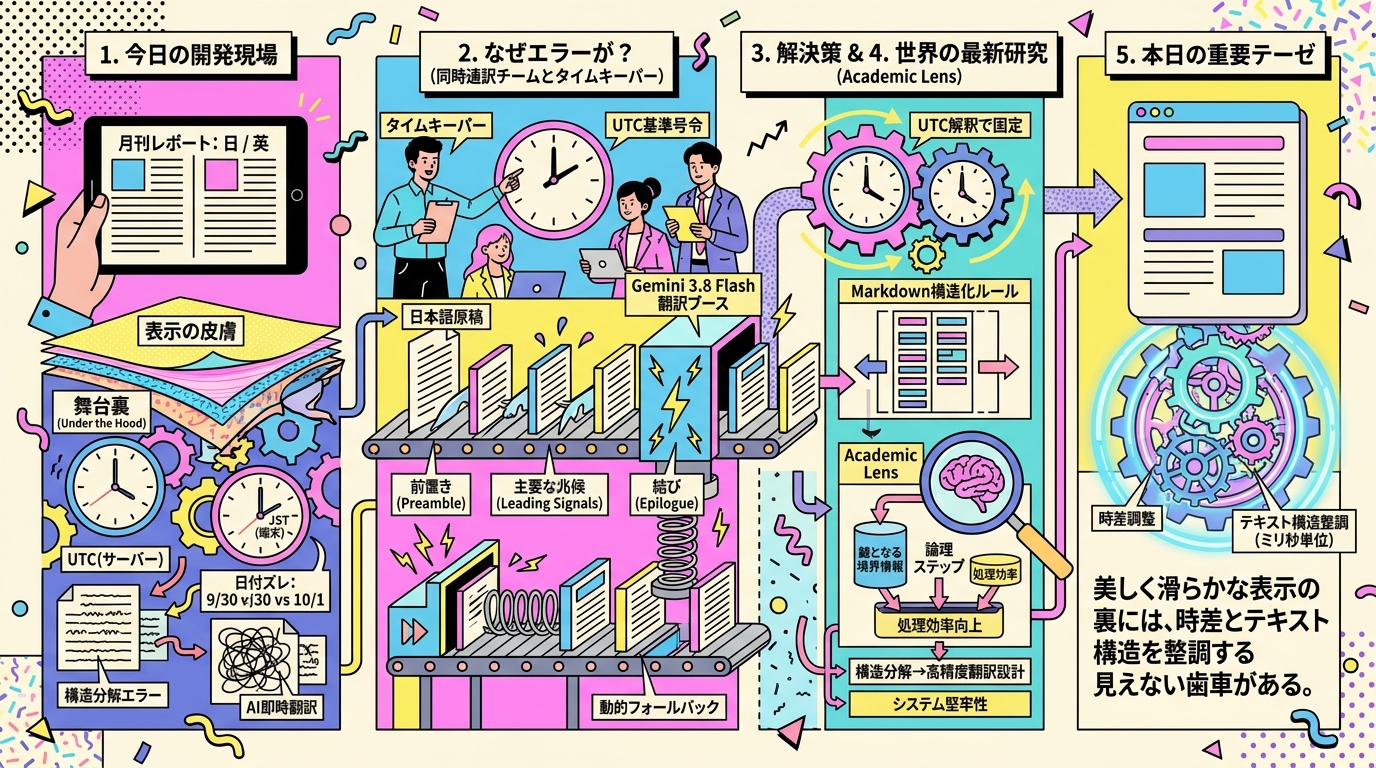
The Gears of Timezones and Translation Stirring Behind the Screen: An X-Ray of the Bilingual Automated Delivery Pipeline

The Paradox of Order: Why Not Asking for Titles Actually Cleans the Clutter