Acceleration of U.S.-Japan 'Economic Security' Cooperation and Supply Chain Fragmentation: The Chain Reaction of Procurement Delays and Institutional Friction Induced by Anti-China Encirclement
The Construction of a Like-Minded Coalition Confirmed at the Summit: Hidden Behind Diversification Lies Escalating Costs and Prolonged Production Lead Times
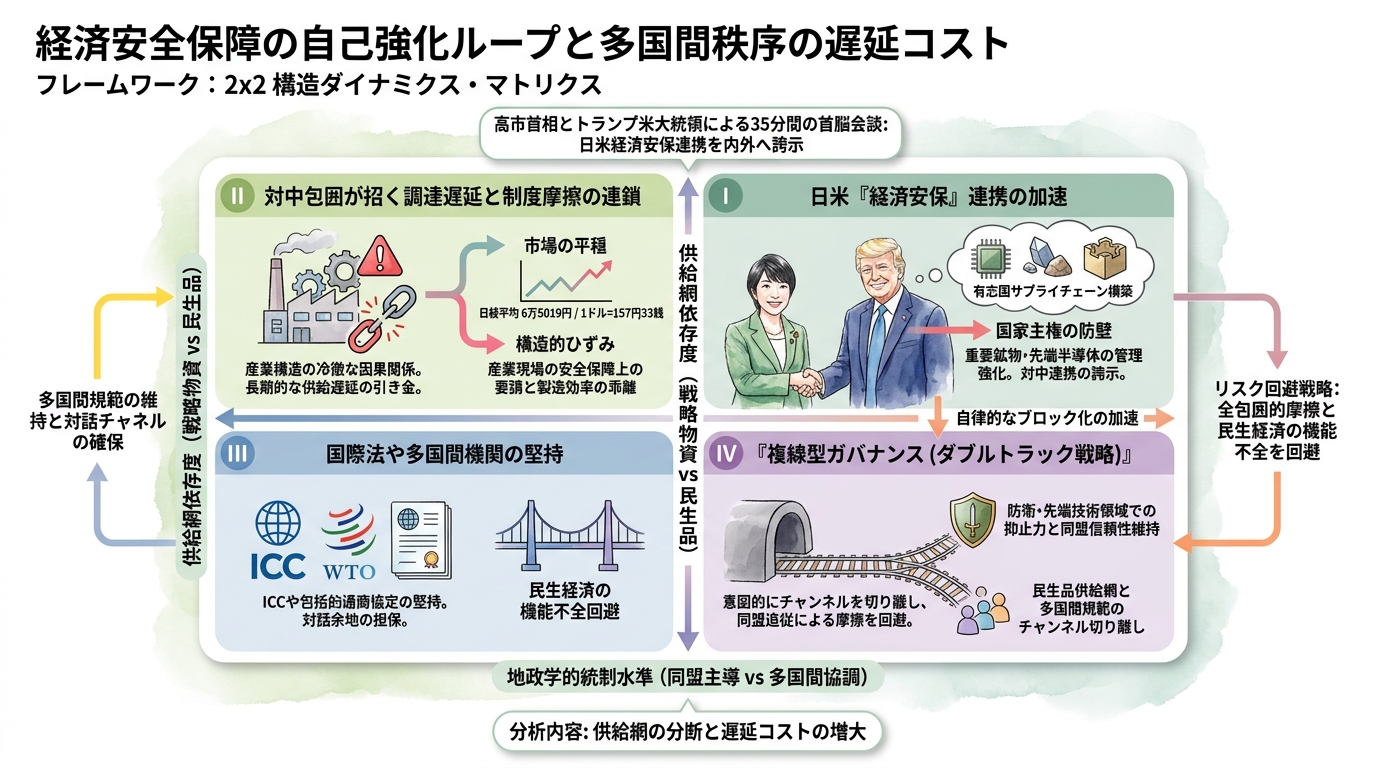
The 35-minute dialogue exchanged at the summit was more than a mere diplomatic preliminary ahead of the U.S.-China talks; it laid bare the reality that the gravity of industrial policy has shifted decisively from 'cost minimization via free trade' to 'risk isolation via strategic autonomy.' The agreed-upon line of cooperation in economic security between Tokyo and Washington translates into the materialization of 'friend-shoring'—corralling the supply chains of advanced semiconductors, automotive batteries, and critical minerals strictly within trusted allied nations. However, this defensive enclosure is nothing less than the deliberate dismantling of globally optimized procurement structures. Beneath the diplomatic veneer of strengthened alliances, heightened surveillance and overlapping regulatory webs have been cast over the movement of goods and technology, injecting an irreversible coefficient of friction into the flow of commerce.
The core dilemma lies within the self-reinforcing causal loop triggered by this policy choice. Should the U.S. and Japan tighten regulations and investment screenings under the banner of security, Beijing will inevitably retaliate by intensifying export controls on vital materials and mandating domestic sourcing. This reciprocal exchange of distrust drives a 'positive feedback loop of protectionism,' automatically deepening the chasm of fragmentation. More critical still is the presence of 'delay effects' inherent in systems theory. Developing mines, launching refining facilities, and commissioning alternative factories require timescales spanning several years to a decade. Because legal restrictions abruptly sever existing procurement networks while a massive time lag impedes the completion of substitute infrastructure, shortages of intermediate goods, prolonged delivery times, and duplicated certification procedures rebound onto industries as a cumulative burden.
The leverage point of the system—the intervention required to arrest this cascading dysfunction—does not lie in indiscriminate decoupling, but in the 'targeted modularization' of strategic materials and the 'standardization of multi-tiered inventories.' Rather than expanding the scope of economic security indiscriminately, a rigorous technical verification regime is essential to identify true military-use thresholds and limit measures strictly to genuinely critical technologies. Furthermore, rather than pursuing the unrealistic isolation of reducing procurement from specific nations to zero, frameworks must be established among allies to unify specifications for vital components and pool peacetime surplus production capacities. Establishing an institutional feedback circuit that directly reflects the engineering realities of corporate procurement lead times into policy-making, countering administrative-led regulatory tightening, is an urgent priority.
If the stability of the global division-of-labor system as a whole is compromised in the pursuit of localized optimization under the banner of security, the national power of participating nations will ultimately be eroded through compounding high costs and diminished inflation resilience. Duplicate investments that replicate single supply chains two or three times over invite a collapse in capital efficiency, threatening to cannibalize investment capacity for next-generation technologies. The forging of the anti-China encirclement showcased at the summit should not merely be applauded as a geopolitical victory; it marks the commencement of a massive experiment fraught with arterial sclerosis on manufacturing floors and supply-chain delay risks. To prevent the new walls erected in the name of security from completely halting the bloodstream of markets, policymakers and industry leaders must continue their tuning efforts to maintain dynamic equilibrium.