The Voice as a 'Symbol of Personality': The Judiciary Draws a Boundary in the Age of Generative AI
Landmark Judicial Ruling on Unauthorized Imitation Imposes Fundamental Discipline on Biometric Data Sovereignty and Commercial Use
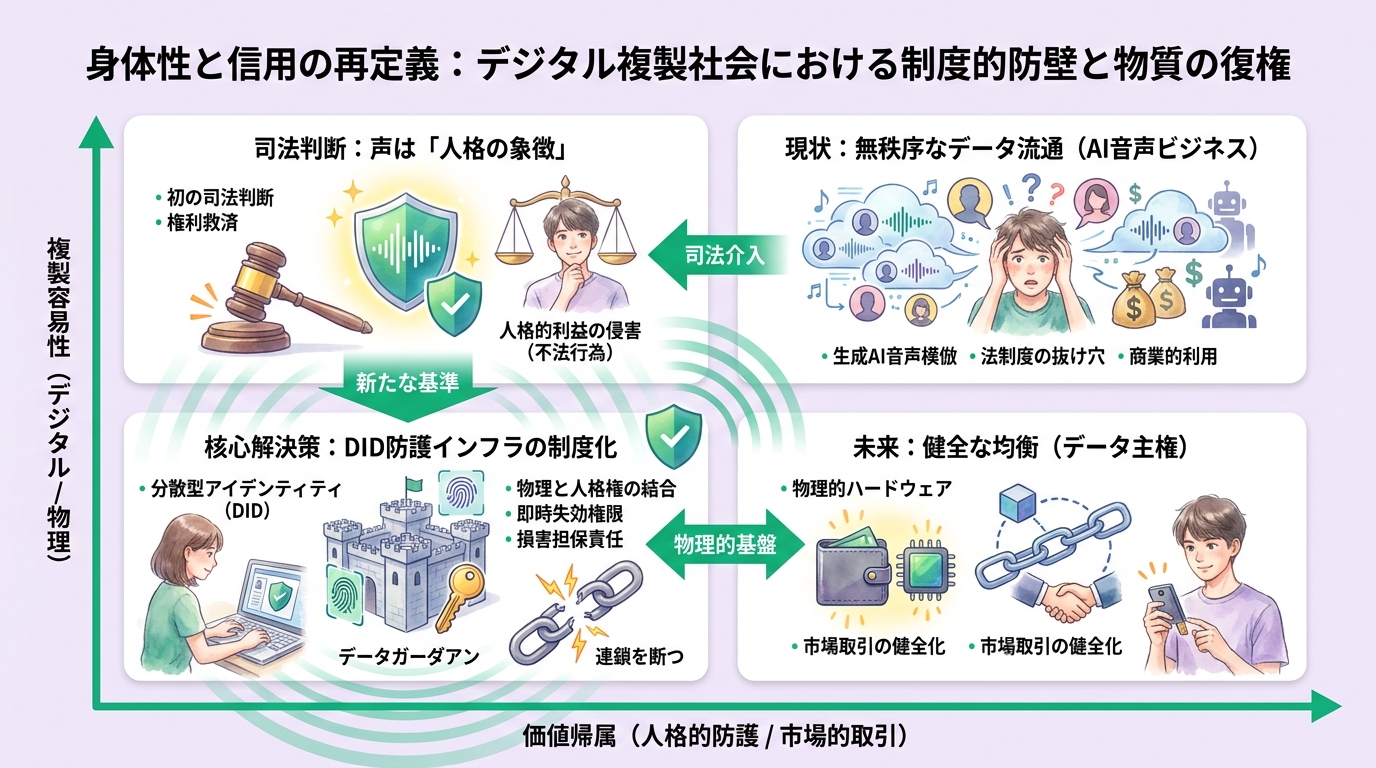
The core significance of this judicial ruling lies in its recognition of voice-generation models—which unauthorizedly learn and reproduce vocal characteristics—and their utilization as essential elements constituting an individual's identity. The verdict explicitly stated that the voice is not merely acoustic and physical waveform data, but rather 'something that symbolizes an individual's personality,' akin to a person's facial appearance or name. Hitherto, performers' rights have been protected via neighboring rights in sound recordings; however, for AI-generated output capable of extracting timbre and intonation from minor speech samples to fluently articulate new sentences, establishing reliance and similarity under traditional copyright law has proved arduous. This ruling serves as a substantive turning point, bridging that legal vacuum through the doctrine of personality rights.
Underlying this is a structural challenge: the rapid advancement of digital reproduction technologies has enabled biometric data to be easily decoupled and circulated as an independent commercial resource. For performers such as voice actors and narrators, the voice represents both the individual identity built through years of discipline and an indispensable economic foundation supporting their livelihoods. Yet, current intellectual property legislation was designed around the protection of informational assets, lacking a comprehensive mechanism to directly safeguard an individual's physical traits as property rights. The judiciary's expansion of personality-rights protection to biologically originating data exerts a strong influence on the application of Article 30-4 of the Copyright Act—which permits free data mining for AI development—and the reinterpretation of the scope of publicity rights.
The ripple effects of this ruling across industry are broad and immediate. AI developers and speech synthesis service providers that have utilized voice data with ambiguous licensing for foundational model training are now compelled to conduct comprehensive audits of their entire supply chain, from data collection processes to delivery frameworks. In the realms of gaming, animation, and advertising production, explicit licensing contracts and the establishment of compensation-redistribution mechanisms when creating and utilizing 'digital voices' of talent and voice actors have become mandatory requirements. By tying vocal rights to personality rights, room has been created for injunction requests against uses contrary to the individual's intent, public order, and morals, or political applications, even if comprehensive licensing agreements exist, making the refinement of contracting practices indispensable.
In an era where biometric information is easily digitized and infinitely reproduced by generative AI, we face a long-term proposition: how to balance individual dignity with technological innovation. The norm established by the judiciary—the 'symbol of personality'—goes beyond merely defending performers' rights; it serves as a starting point for constructing a protective wall to prevent citizens' biometric data from being arbitrarily copied and exploited. How do we design a data society that enjoys technological convenience without compromising individual dignity? Sparked by this judicial ruling, policy discussions anticipating legal reform and the formulation of effective industry guidelines are precisely what is demanded now.