From Perception to Computation, As the Mountains Don White: The Modern History of Observation in Mount Daisetsu’s First Snowfall
Visual Observation Abolished on Mt. Asahidake, Giving Way to Analytical Snow Depth: The Twilight of Somatic Knowledge and the Boundary Where Nature is Quantified
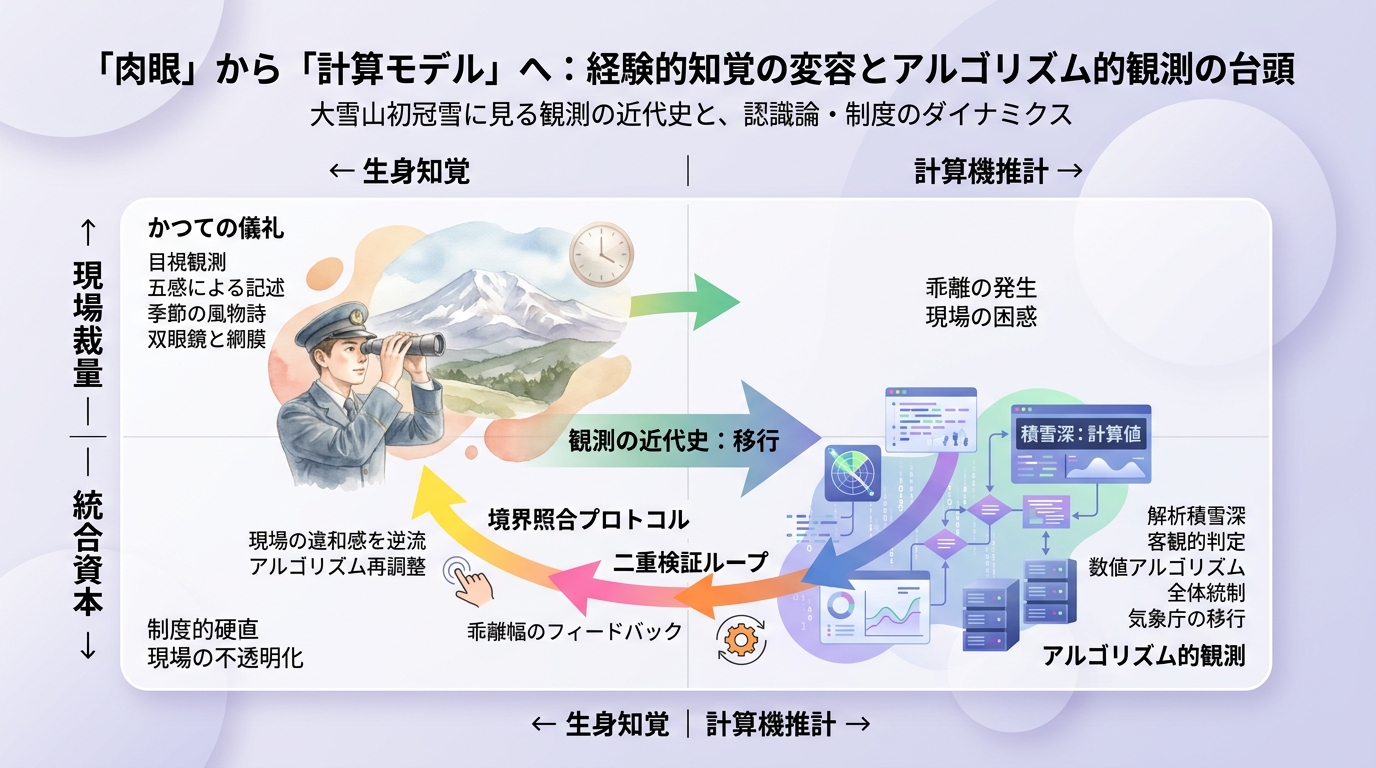
The report that the slopes of Mt. Asahidake have taken on a wintry hue has long served as a definitive cue for northern communities to prepare their heating and conclude their harvests. Once upon a time, the crown of white on the summit, gazed upon from afar by the Asahikawa Local Meteorological Observatory, became official public record only after an observer confirmed the faint whiteness peering through a break in the clouds. If foul weather shrouded the mountain in clouds, the declaration was withheld no matter how deeply the snow had piled above; it was etched into history solely when the human naked eye caught it the moment the skies cleared. Yet the analytical snow depth introduced this season mechanically churns out the estimated presence or absence of snow for every five-kilometer square grid, regardless of whether the site is wrapped in dense fog or blocked by thick clouds. This winter arrival, mediated by no human eye, fundamentally reshapes the relationship between subject and object in the act of observing nature.
This shift mirrors the process in the 15th century when Gutenberg operationalized printing technology, transferring a system of knowledge embodied in oral traditions and manuscripts into standardized type and uniform pages. When medieval storytelling traditions—where memory was communicated through the unique physicality of vocal modulation and gesture—gave way to standardized texts produced by movable type, knowledge departed individual sensation to be entrusted to a reproducible external apparatus. Meteorological observation has followed a similar trajectory. Artisanal somatic knowledge—looking up at the sky, smelling the wind, reading the subtle shadows of mountain ridges—has been homogenized by vast grid data woven together by weather satellites, Automated Meteorological Data Acquisition System (AMeDAS), and numerical forecasting models. The gaze that once connected humans to the mountain, however fraught with subjective ambiguity, has been replaced by a digital grid of uniform resolution.
Such a transition in observation methodology extends beyond practical demands such as the rationalization of administrative organizations and the unmanned status of weather stations. Once technology and institutions are fused, the shift bears an irreversible structural inevitability. The nationwide observation network, high-precision meteorological radar, and the advancing accuracy of atmospheric simulations based on physical laws have achieved an overarching comprehensiveness that far surpasses the visual limits of any single human. The practical utility of tracking nighttime snowfall and severe weather transitions in real time—feats impossible with visual observation—possesses an absolute advantage in disaster management and transportation infrastructure operations. Eliminating subjective oversights and location-specific human eccentricities to build a system evaluative under uniform nationwide objective criteria was an inevitable choice to guarantee fairness and accuracy as administrative information.
Yet when nature is redefined from an object to be 'seen' into an object to be 'calculated,' new questions arise regarding the relationship between humanity and the world. The shift of the first snowfall from visual verification by personnel to algorithmic determination is also a process wherein humanity recedes from a being that directly perceives the world to a guardian who interprets the outputs of sensors. A cluster of machine-estimated numbers confirms the fact that 'snow has fallen,' and people learn of winter’s arrival not through their own vision, but via smartphone notifications. Modern society, which has achieved high safety and efficiency by stripping away direct communion via the five senses, is beginning to embrace a new perceptual framework that consumes natural phenomena as homogeneous information. The white ridgeline of Mt. Asahidake now quietly greets winter as an orderly array of data, requiring no human vision whatsoever.