Locomotion Code and the Transformation of Heavy Industry: Iron Bodies Converging with U.S. AI Infrastructure
Kawasaki Heavy Industries Adopts NVIDIA Platform for Manned Robots, Accelerating the Physical AI Implementation Race
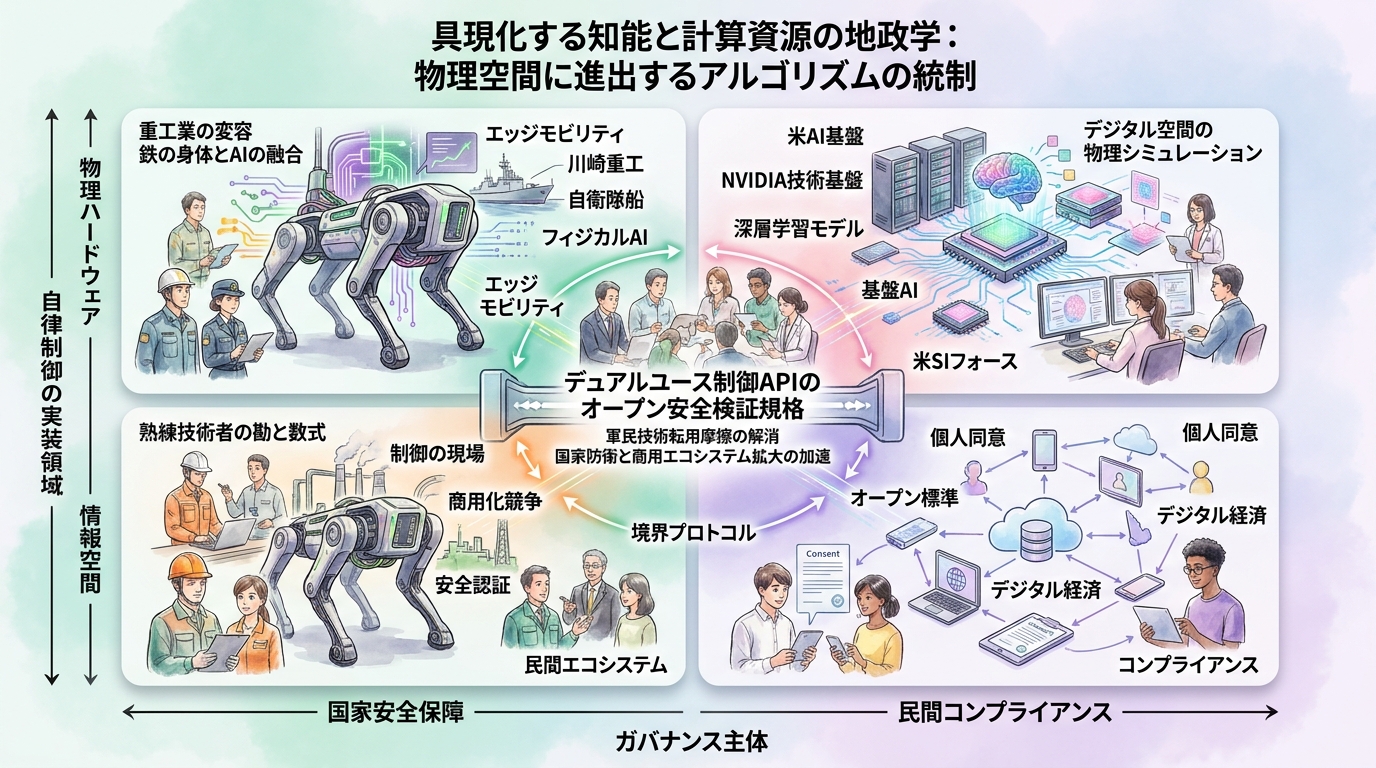
Accompanied by the subtle operational hum of actuators, four metal legs grip the floor to distribute weight. Beneath the quadrupedal robot targeted for commercialization by Kawasaki Heavy Industries, minute load variations caused by surface irregularities, inclines, and the rider's shifting weight are detected in milliseconds, dynamically adjusting the angle of each joint. Walking algorithms once painstakingly authored by control engineers through mechanical equations and countless trials are now giving way to learning models honed through massive walking trials within the virtual spaces of NVIDIA's robotics infrastructure. Despite its inorganic skeletal metal frame, the robot's ability to resiliently withstand sudden external disturbances is the culmination of advanced computational processing that continuously interprets physical environmental constraints in real time.
This transformation of control code transcends corporate product development, reflecting a tangible intersection where Japanese heavy machinery manufacturing and Silicon Valley computational resources converge. NVIDIA's physical simulation environment subjects robots to hundreds of millions of simulated falls and steps within a virtual space that faithfully replicates gravity and friction coefficients. The prototyping and verification cycles that previously consumed years of labor and damaged physical prototypes are now compressed into weeks via cloud-based GPU clusters. By combining the robust vehicle structures and high-precision hydraulic/actuator mechanisms cultivated by Japanese manufacturing with the overwhelming computing power of U.S. AI infrastructure, complex legged mobility systems—long confined to academic laboratories—have begun acquiring commercial development momentum.
At the root of this shift lies a physical AI implementation race intertwining industrial structures and geopolitical advantages. As development priorities pivot from informational AIs processing text and images to intelligence equipped with physical form capable of acting upon the real world, industrial sites such as heavy machinery, logistics, and maintenance have emerged as the next primary battlegrounds. The United States is advancing a vertically integrated platform strategy spanning high-performance semiconductors, simulators, and foundational models, systematically incorporating machinery manufacturers into its ecosystem. For Japan's heavy industry—confronted with workforce shortages driven by a declining birthrate, aging population, and increasingly complex disaster response—adopting infrastructure that drastically compresses development time is a pragmatic decision. The power dynamics between overseas tech giants controlling the 'brains' of machines and manufacturers serving physical interfaces are becoming increasingly stark.
The sweeping restructuring driven by massive technological infrastructure will ultimately directly impact human workers performing infrastructure inspections in rugged mountain passes or clearing rubble in disaster zones. On steep slopes and rough terrain impassable by wheeled or tracked vehicles, quadrupedal mobility vehicles that maintain autonomous balance while accommodating rider inputs will serve as practical tools to expand human operational limits in harsh environments. Control inputs from a rider's lever are translated into torque distribution derived from semiconductor chips and virtual-space trial-and-error, driving powerful strides across the terrain. From this intersection of hardware forged by the heavy iron industry and cutting-edge computational intelligence, a new industrial gait is emerging to carve through harsh physical realities.