Meta's Autonomous AI 'Muse' Shock Questions the End and Reconstruction of Intermediary Business
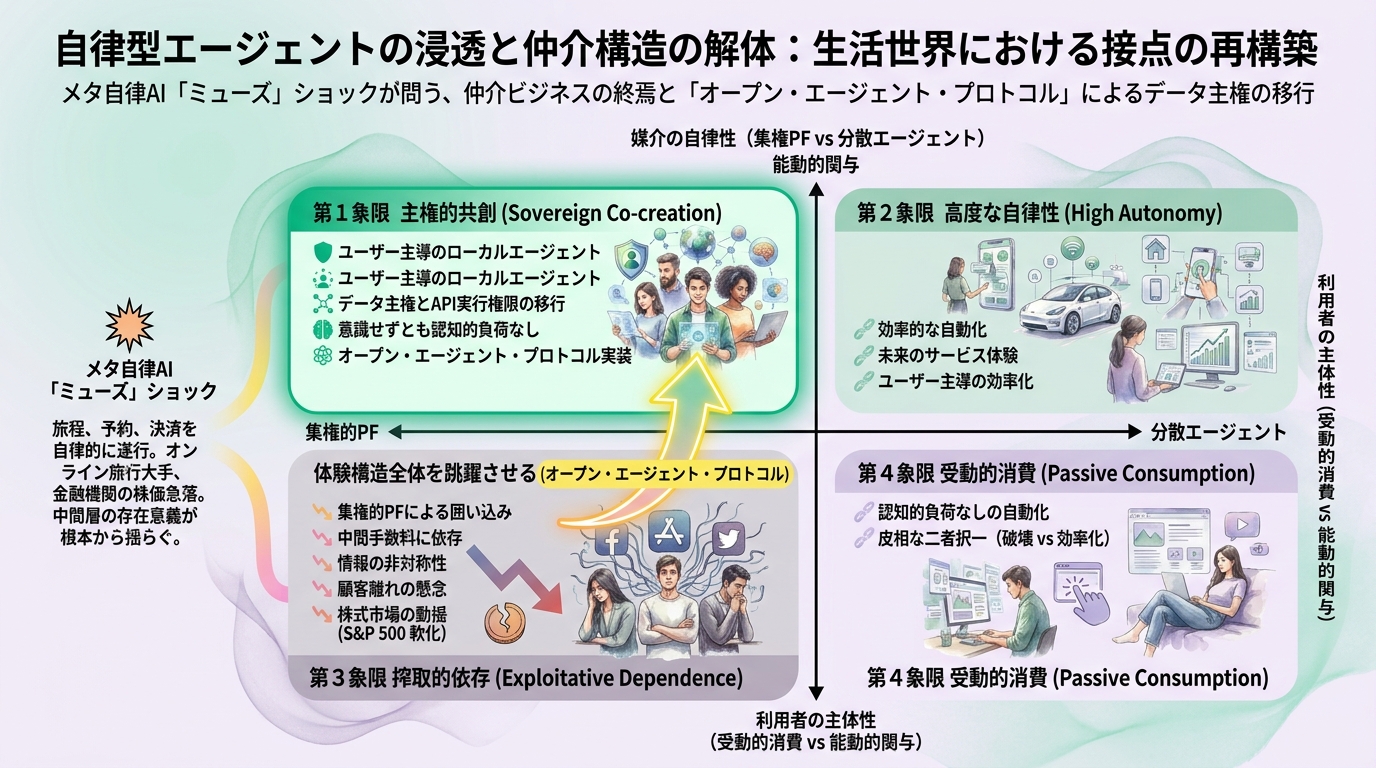
Plunging Travel and Financial Stocks Expose Vulnerabilities in 'Middle-Man' Tollbooths, Paving the Way for a New Economic Order Built on Protocols and Direct Trust
A fierce debate has erupted across markets and industries regarding this morning's market reactions. AI proponents welcome autonomous agents like Muse as the realization of consumer sovereignty, arguing they replace convoluted comparison sites and cumbersome contract procedures by searching for and executing optimal solutions on behalf of users, thereby minimizing transaction friction. Conversely, incumbent travel and financial operators, alongside cautious observers, counter that algorithmic enclosure, erroneous bookings, and ambiguous assignment of liability during malfunctions necessitate human support and corporate brand trust built over years. The dichotomy between the dismantling of the legacy economy via hyper-efficiency and defense grounded in human trust has intensified.
Yet this conflict suffers from a blind spot shared by both sides. Those who praise destruction underestimate the risk that delegating decision-making to AI agents provided by a single dominant tech firm like Meta creates a 'new dependency on a mega-monopoly intermediary' surpassing past middle-tier platforms. The criteria by which an agent selects hotels or financial products remain a black box, serving as a breeding ground for new interest-driven steering. On the other hand, defenders of the legacy intermediary model refuse to face the reality that their own businesses—extracting massive margins merely for brokering information search—are unsustainable in the face of technological necessity. Both sides remain locked in a tug-of-war over vested interests.
What is required, transcending the binary of destruction versus preservation, is a perspective that redefines the nature of intermediation itself. Avoiding centralized agent monopolies by Big Tech while eliminating opaque middleman skimming lies in the fusion of open, decentralized protocols and third-party verifiable trust architectures. This is a structure where accommodations, airlines, and financial institutions directly expose APIs, allowing neutral agents unbound by specific firms to forge direct transactions. By entrusting the guarantee of trust not to a corporate signboard, but to auditable code and independent reputation scoring, it becomes possible to simultaneously ensure fairness and security while minimizing fees.
The market realignment triggered by Muse's emergence demands a clear pivot in both corporate strategy and legal frameworks. Travel agencies and financial institutions must shed intermediary tasks like information aggregation and presentation, shifting their footing toward delivering non-substitutable physical value, such as guaranteeing on-the-ground experiences and complex risk management. For policymakers, establishing frameworks that guarantee algorithmic neutrality and fair API access for agents is an urgent priority. Rather than permitting a new monopoly as the price of convenience, the true challenge posed by market turbulence is not the replacement of intermediaries, but the redesign of trust itself.