Who Holds Sovereignty in Orbit? The Starlink Disconnection Threat Exposes the Risks of 'Tech Oligopoly'
Private Capital Controls Communication Infrastructure on the Ukrainian Frontline: Three National Survival Scenarios Toward 2036
Musk's recent remarks have vividly exposed the perils of an era where security infrastructure is concentrated in private hands. Ukrainian military operations, drone control, and artillery data integration rely heavily on Starlink's high-speed, low-latency communications. The assessment that a communication blackout would deal a fatal blow to the frontlines accurately reflects military realities. However, the current reality—where a handful of mega-tech corporations can effectively sway the course of conflicts and the sustained combat capabilities of sovereign nations—shakes the foundational premises of the traditional Westphalian state system. The fact that corporate 'terms of service,' rather than treaties or international law, can restrict battlefield boundaries and operational maneuverability represents a novel geopolitical risk born from the expansion of private platform power.
If current trends persist, two extreme scenarios are projected toward 2036. The first is a scenario where hyper-corporations monopolizing capital and technology become the de facto rulers of orbital space. States fail to maintain independent communication defense networks and grow increasingly dependent on procuring private infrastructure, permanently cementing a structure where policy decisions and rules of engagement are constrained by private corporate intent and user agreements. The second, reactionary path is the 'fortress of national sovereignty,' wherein nations rush toward exclusive nationalism and expend massive public funds to construct fragmented, isolated satellite networks. This trajectory risks technological isolation and redundant investment, while paralyzing international cooperation on orbital frequency coordination and space debris mitigation.
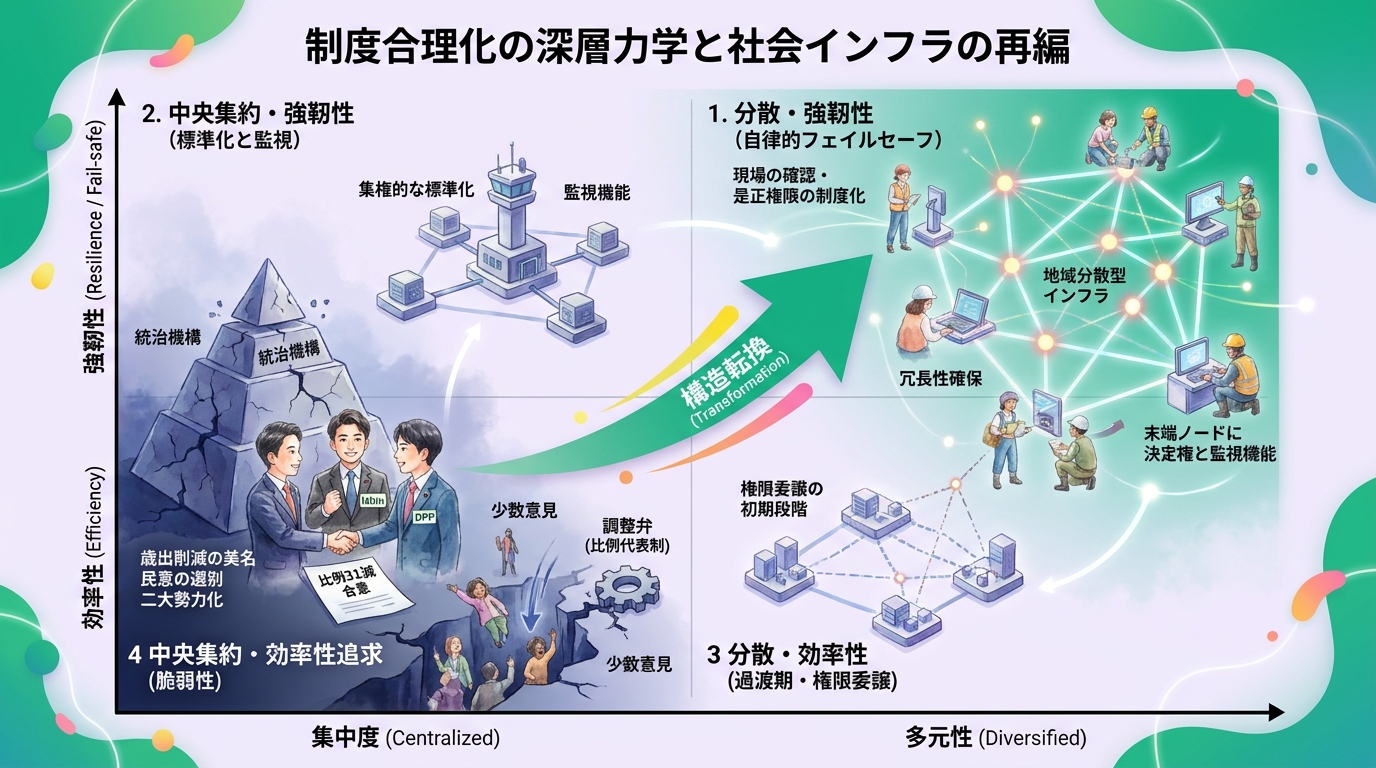
A third, cooperative approach avoids these extremes through the 'multilateral public ownership and interoperability' of orbital infrastructure and the construction of 'distributed open mesh networks.' Rather than relegating satellite communication networks to the private property of a single corporation, this framework establishes rules akin to those governing the high seas or international airspace, utilizing multilateral agreements to guarantee operational continuity in peacetime and contingencies. Simultaneously, to prevent dependence on a single private operator's ground stations or proprietary standards, multi-layered inter-orbital communication standards would be standardized, implementing a distributed network where small satellite constellations launched by public agencies and diverse operators autonomously interconnect. This ensures technical fault tolerance, averting single points of failure or arbitrary service suspensions by specific entities.
To forge a desirable future, strategic decisions required by Japan and other nations are clear. While leveraging the superior cost-effectiveness and responsiveness of private services, nations must not neglect investments required to secure multilateral redundancy and technological sovereignty in core defense communications. It is essential to multi-layer alternative systems capable of withstanding the operational suspension of any single provider by organically combining national communication networks, integrated architectures with allies and partners, terrestrial fiber-optic networks, and high-altitude platform stations (HAPS).