A Decofold Leap in Compute Resources Yields a Mere 10% Gain in Practical Performance: Scrutinizing the Divergence Between Frontier AI's Marginal Costs and Real-World Efficacy
Benchmark Saturation and the Wall of Practical Complexity — Mathematical Models Confront the Scaling Law Plateau
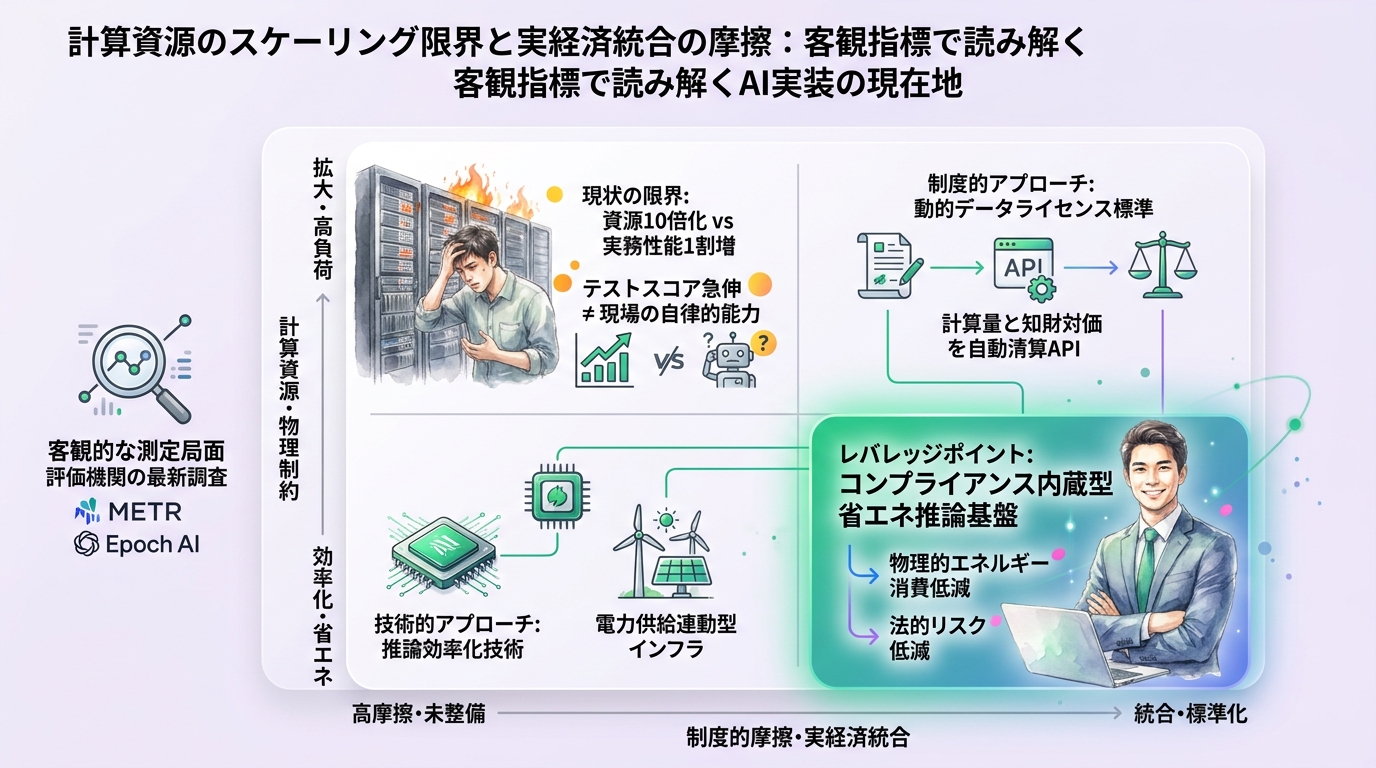
Public data and objective verification have highlighted a glaring disconnect between evaluation metrics and field operations. While static benchmarks such as multiple-choice tests and short-form code generation yield accuracy rates exceeding 90%, initial resolution rates for the latest generation of models hover in the low-to-mid 30% range on real-world tasks involving dozens of debugging steps, environment setup, and the resolution of ambiguous specifications (such as SWE-bench Verified). In contrast to the steep trajectory of training compute (FLOPs), the probability of successfully completing complex workflows displays a logarithmic curve of deceleration, confirming via independent replication that capital deployment and autonomous operational viability in actual business settings are not strictly proportional.
Underpinning this deceleration are the intrinsic statistical properties inherent to autoregressive language model architectures. Mechanisms anchored in next-token prediction excel at compressing and reproducing correlations embedded within vast historical corpora to an extreme degree; however, they structurally carry the risk that minute probabilistic errors accumulate and lead to catastrophic failures in downstream decisions as context lengths and reasoning steps expand. Although test-time compute expansion and chain-of-thought generation—areas of intense recent focus—have yielded notable score improvements in specific domains of mathematics and competitive programming, current sampling methodologies remain insufficient to control the explosion of the search space in operational environments where preconditions dynamically shift and interaction with external systems is indispensable.
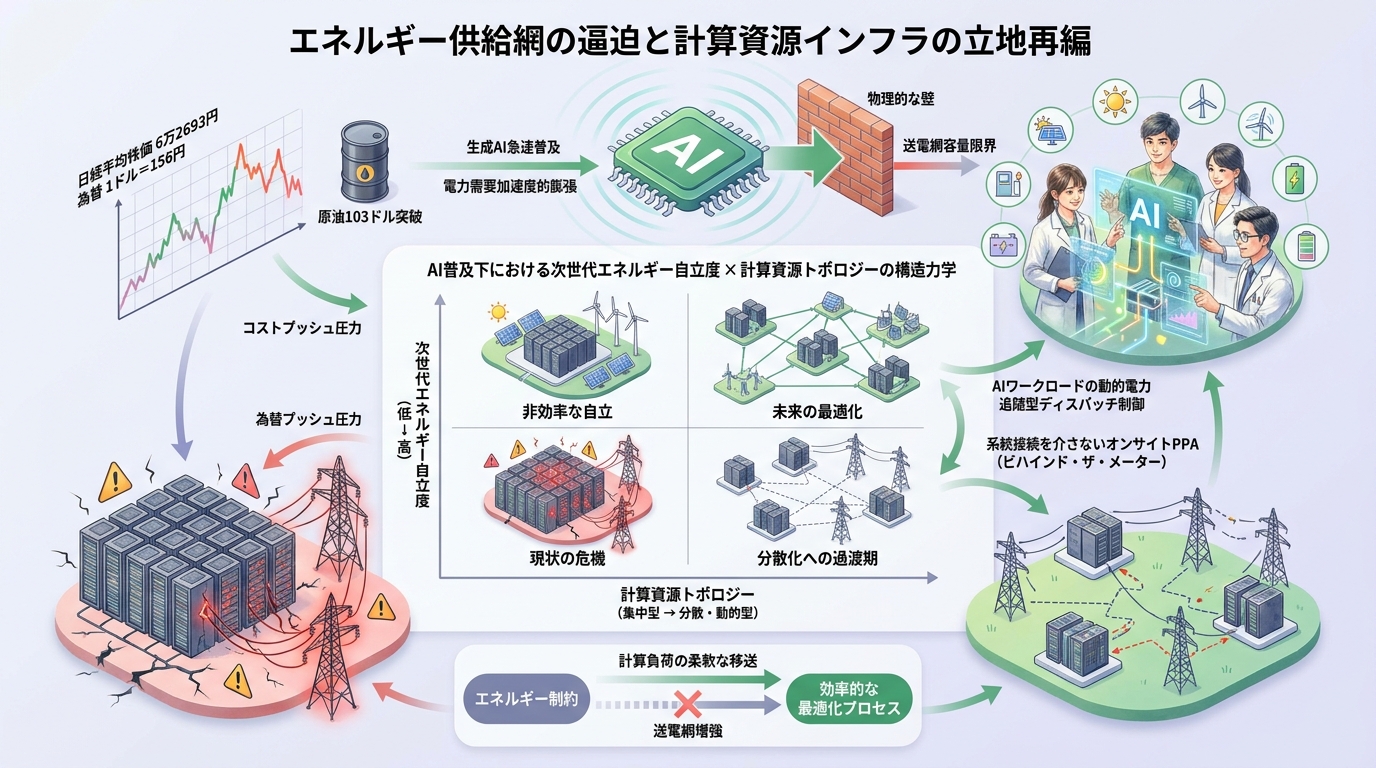
Even more critical is the emergence of physical and institutional constraints lying beyond algorithms. The vast majority of high-quality human expert documentation has already been absorbed into training sets, and recursive learning utilizing synthetic data generated by the models themselves carries the hazard of eroding expressive diversity and triggering model degradation. Compounding this, rising data center power consumption, delays in power grid interconnection, and supply constraints for advanced liquid cooling infrastructure are driving up the capital cost of a single training cycle. While financial markets maintain expectations for AI infrastructure-related equities with the S&P500 hovering near 7,677, and the USD/JPY exchange rate trades in the mid-157 yen range, a lengthening payback period for Return on Invested Capital (ROIC) against massive capital expenditures is surfacing as a pragmatic concern among enterprises pursuing practical implementation.
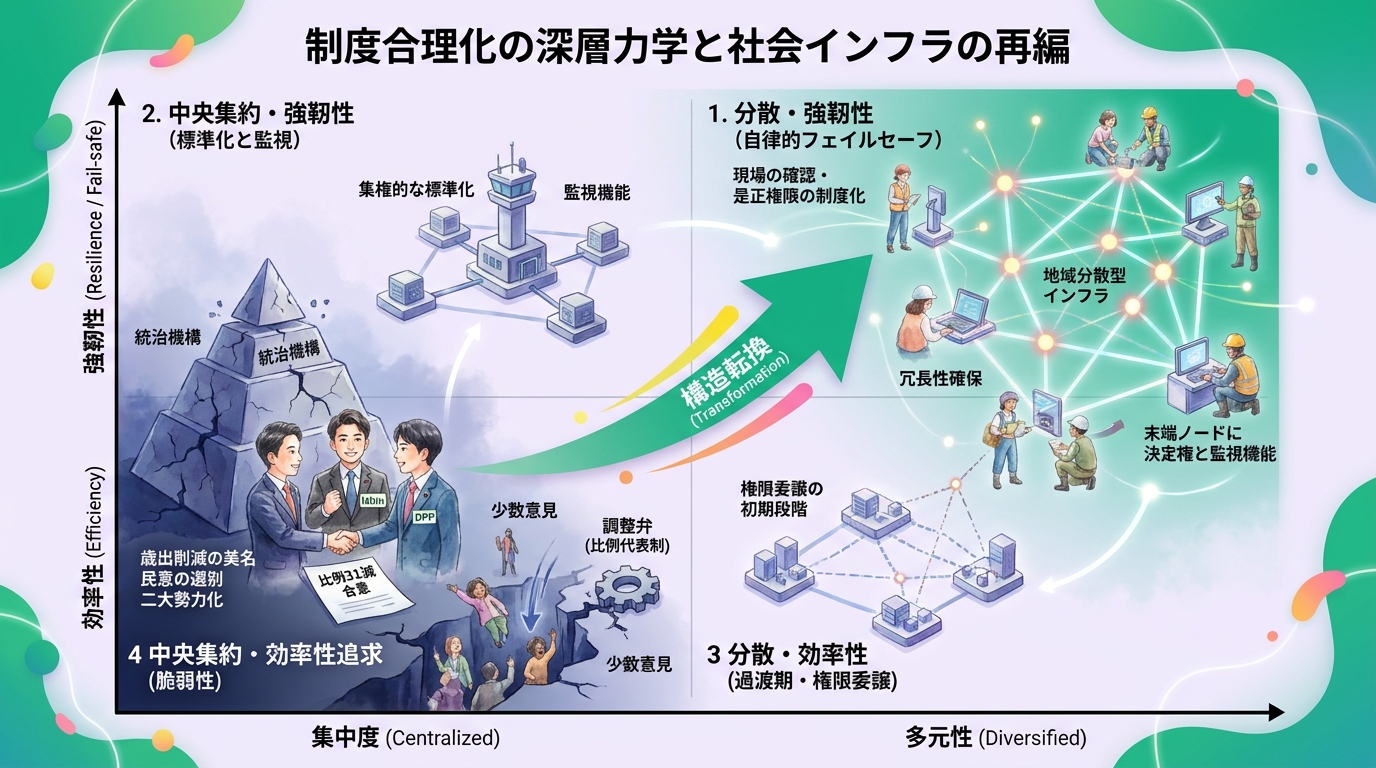
The challenges at hand do not signal technological limits, but rather a transition into engineering maturity. The center of gravity in development is shifting away from the indiscriminate scaling of model size toward hybrid systems incorporating domain-specific logic verifiers, and decentralized cooperative designs that grant compact models explicit constraints and autonomous tool-use authority. Dispensing with hyper-optimistic expectations of omnipotence and rigorously quantifying the trade-off between error rates and computational costs—inherent to probabilistic software—offers the sure-footed path to embedding artificial intelligence as a robust foundation for next-generation society.