The Impending Overhaul of the Lower House: '31 Proportional Seats Cut' Agreement and the Mechanics of Bipartisan Consolidation Beneath the Guise of Cost-Cutting
LDP, Komeito, Ishin, and DPFP converge to advance legislation / Structural risks as proportional representation loses its balancing function, narrowing diverse policy debates
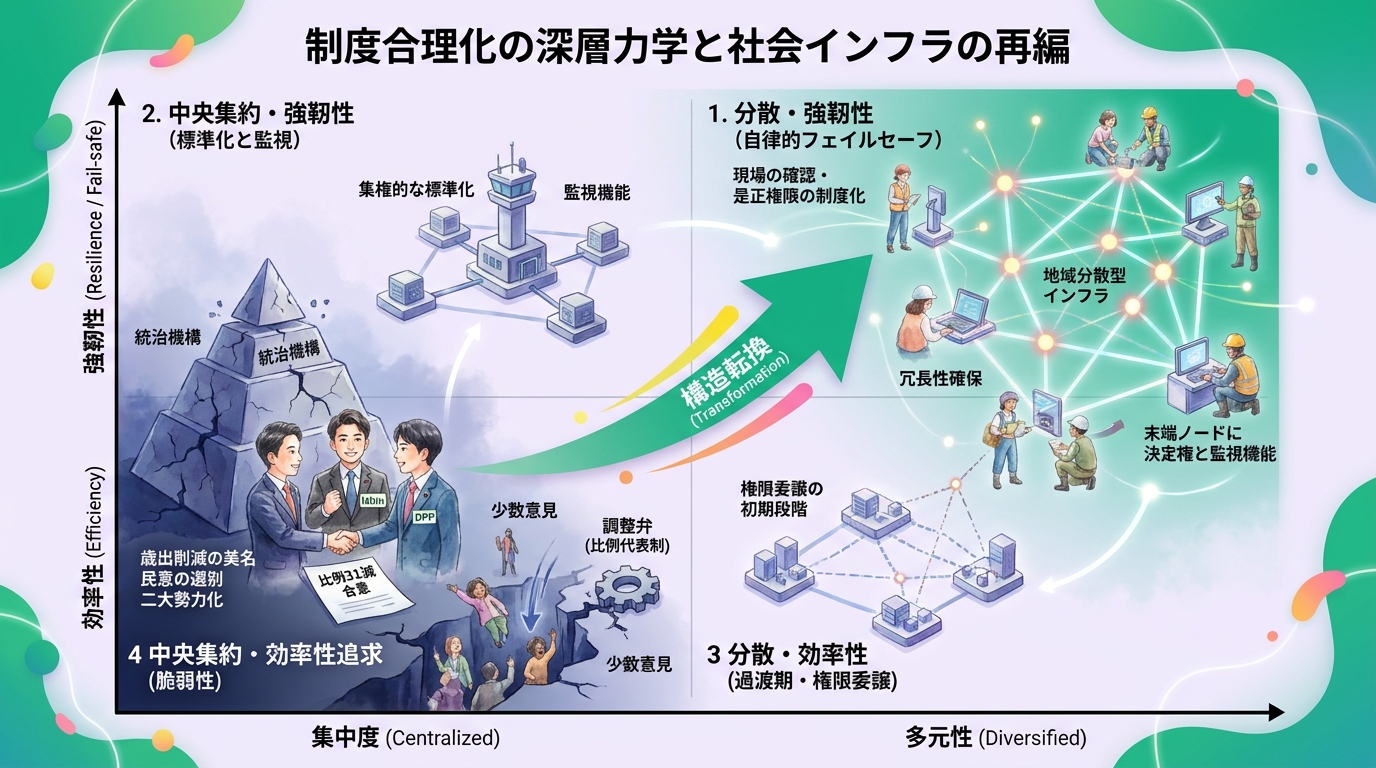
At the core of this blitz-like agreement in Nagatacho is the LDP-led compromise proposal to cut 31 proportional seats. Against the backdrop of a bill reducing the current 176 proportional seats by 31 and shrinking total seats from 465 to 434, Ishin—long an advocate of independent reforms—and the DPFP, eyeing the practical utility of passing the legislation, fell into alignment. While opposing camps such as the Constitutional Democratic Party (CDP) and the Japanese Communist Party (JCP) vehemently protested what they termed a 'discarding of the popular will,' center-right opposition parties holding the casting vote ultimately swallowed the ruling bloc's proposal. While the unifying rationale is framed as demonstrating a commitment to fiscal reconstruction through cuts to lawmakers' salaries and seat numbers, backroom negotiations among party executives undoubtedly involved meticulous calculation regarding electoral cooperation in the next Lower House election and the securing of legislative dominance.
Yet, observed from an institutional design perspective, the essence of this seat reduction extends far beyond mere cost-cutting. Since the introduction of the parallel voting system combining single-member districts (SMDs) and proportional representation, the proportional tier has acted as a safety valve, absorbing the massive tally of 'wasted votes' generated in SMDs and correcting extreme disparities between vote shares and seat allocations. Because SMDs structurally facilitate the monopoly of 70 to 80 percent of seats even with a vote share hovering around 40 percent, shrinking proportional seats translates into an overarching SMD shift for the entire electoral system. As the proportional pool narrows by 31 seats, the minimum vote threshold required to win a seat will inevitably spike, dramatically narrowing the room for small- and medium-sized parties or emerging forces to secure representation. The resulting outcome is the concentration of power into two major forces and the expulsion of diverse public sentiment outside the legislative chambers.
This structural shift alters the very quality of bill deliberation and policy-making processes, exerting widespread ripple effects across industrial and societal fronts. As two-party competition under an SMD format becomes entrenched, election strategies will lean heavily toward metropolitan areas with large pools of swing voters and mainstream unaffiliated demographics. Consequently, issues that do not directly translate into votes—such as depopulation countermeasures in rural regions, support for niche small- and medium-sized manufacturers holding specialized technological domains, or welfare policies for minority constituencies—will increasingly be pushed to the back burner. In industrial policy, the dynamics that prioritize large-scale subsidies or tax cuts designed to capture public attention over the short term risk taking root, superseding long-term fundamental research and development or the nurturing of niche top enterprises. This rough-hewn consensus-building, stripped of the tempering friction of diverse values, exacts the price of perpetuating distortions in the industrial structure.
The view that cutting seats automatically restores trust in politics is a conclusion that trivializes the inherent coordination costs of democracy. Stripped of the corrective functions proportional representation has historically played amidst the inherent trade-off between the aggregation and reflection of public will, a parliament lacking these safeguards is prone to generating extreme seat swings driven by transient political winds, undermining long-term policy consistency. If the seat-reduction bill passes in the current Diet session, it will mark a watershed moment where Japan’s representative democracy makes a sharp pivot from the 'inclusion of diversity' to the 'efficiency of governance.' Pruned alongside the 31 eliminated seats is not simply the operating budget of Nagatacho, but the very choices that voiceless citizens and future generations ought to have delivered to the legislature.