The Domestic Illusion: What the 'Homegrown' Tech Push Conceals in East Asia’s Semiconductor and Capital Chains
Beyond the fantasy of self-sufficiency: confronting South Korea’s chaebol concentration and the choke points of international division of labor
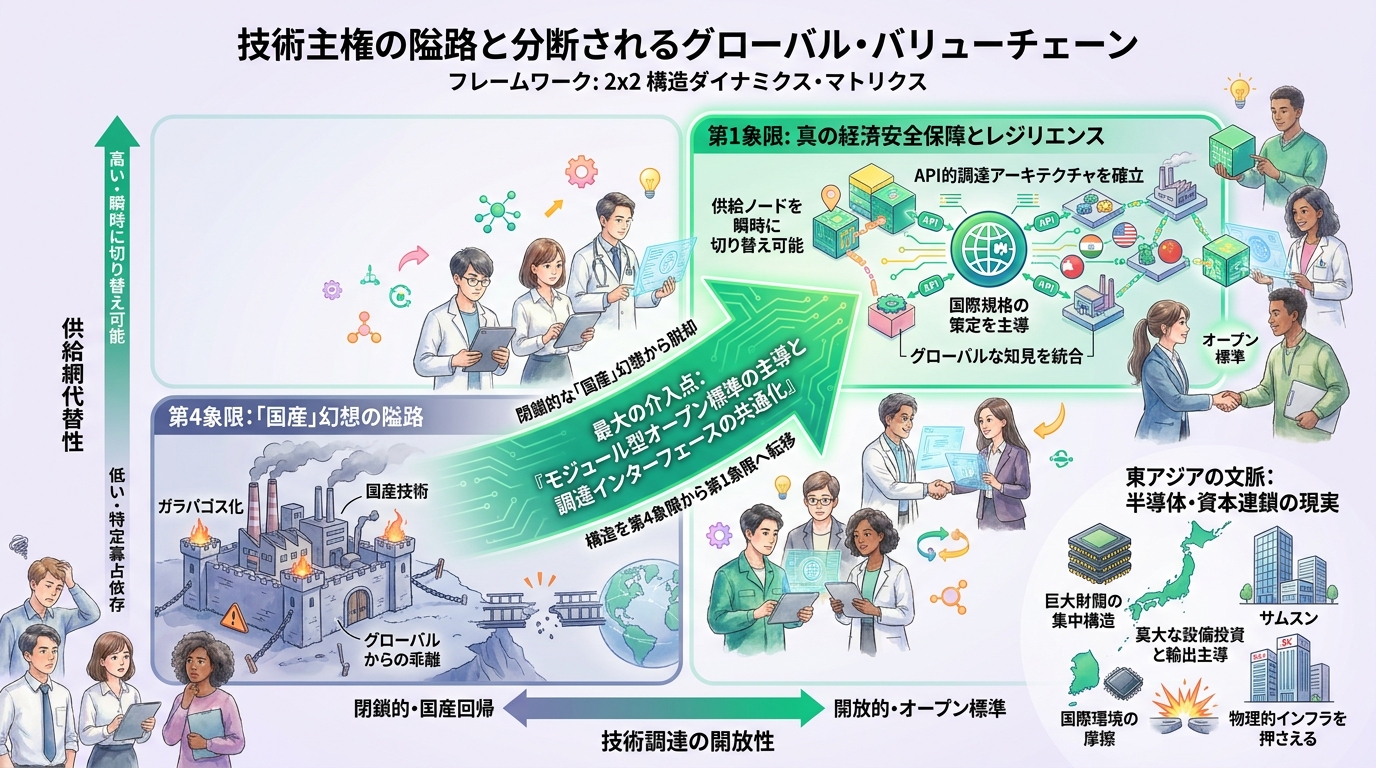
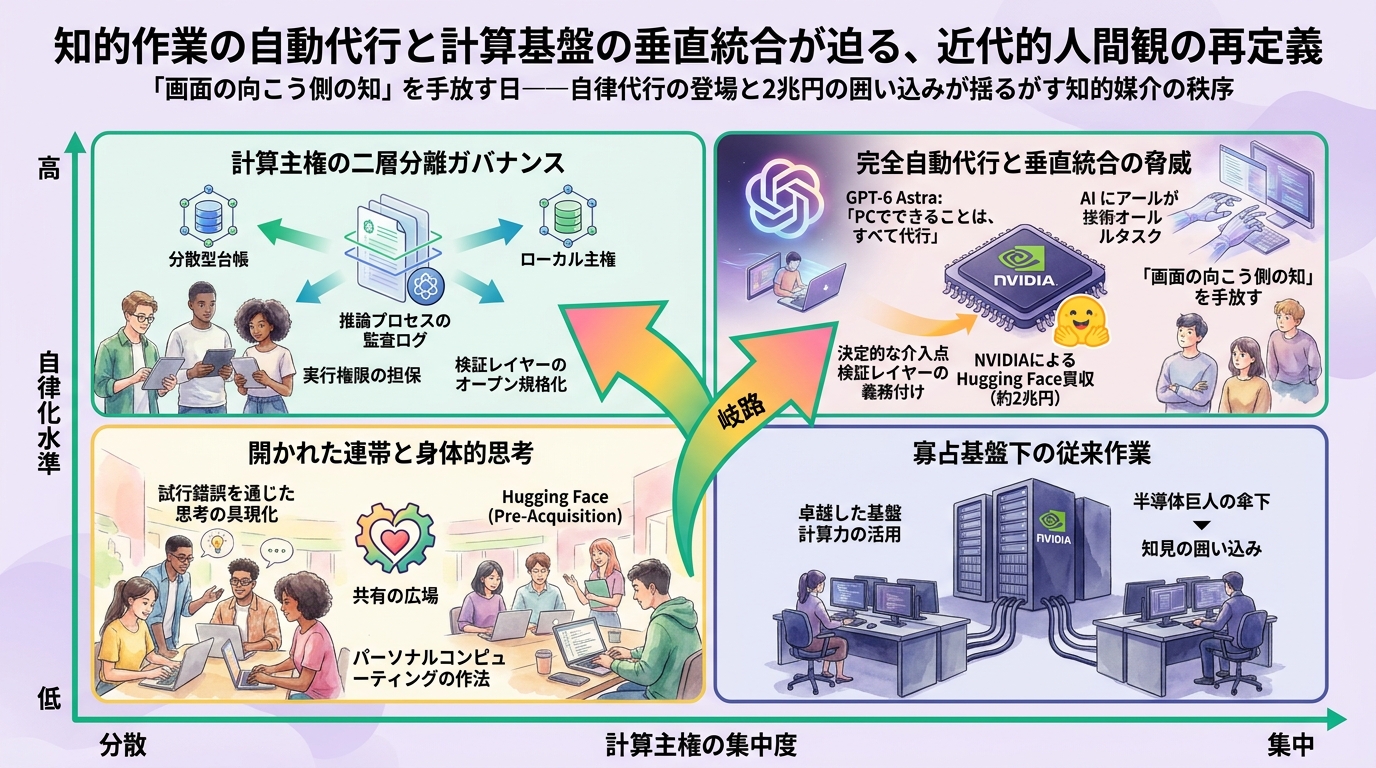
Driven by the expansion of data centers and AI infrastructure underpinning digital spaces, the East Asian supply chains supplying components and chips are facing unprecedented stress. According to a report on South Korea’s industrial structure via the 'Industry Map,' the nation’s economy remains deeply dependent on the financial muscle of its major chaebols. Notably, staple components such as high-bandwidth memory (HBM) supplied by major chipmakers serve as the indispensable physical foundation for global generative AI hardware. Even as semiconductor-related stocks gain traction—with the Nikkei Stock Average hovering in the 64,400-yen range on the Tokyo Stock Exchange—discussions surrounding 'domestic clouds' and 'domestic AI' within Japan will amount to idle speculation unless they confront the international chain of silicon wafers, photolithography equipment, and back-end packaging that supports them.
An inspection of supply chain choke points in East Asia makes it clear that absolute self-sufficiency is impossible for any major power, regardless of its strength. While US corporations retain much of circuit design and intellectual property (IP), Taiwan shoulders the most advanced stages of contract manufacturing. Meanwhile, South Korean chaebols overwhelm competitors in production scale for advanced memory mass production, and Japanese companies command dominant market shares in extreme ultraviolet (EUV) photoresists, ultra-high-purity hydrogen fluoride, and precision film-deposition equipment required for their manufacture. Advanced devices cannot be completed without every single link of this intricate mutual interdependence. Just as South Korean chaebol management secured global market share through fierce top-down investments while generating domestic consumption imbalances and disparities with subcontracted small businesses, any model where a single player monopolizes every stage inevitably carries the limitation of distorted resource allocation.
As policymakers worldwide pour massive subsidies into economic security arguments to rush domestic repatriation and fence in homegrown technologies, a widening gap is emerging with the business strategies of multinational corporations. Field engineers and business heads seek open international standards and the highest-grade components that deliver optimal solutions at maximum speed, not closed architectures limited to domestic origins. Although the reinforcement of export controls and investment restrictions catalyzed by US-China friction has prompted the rerouting and restructuring of supply chains, this functions not as 'national isolation,' but as the 'repositioning of nodal points among trusted alliances and aligned nations.' Policies that channel massive public funds solely under the banner of domestic production risk breeding isolation detached from global standards.
In a volatile international environment, the condition for building a resilient supply chain does not lie in aimlessly expanding the scope of in-house manufacturing. Rather, it boils down to how many 'nodes extremely difficult for other nations to substitute' a country can secure. Just as South Korea’s industry maintains an indispensable position in memory miniaturization and stacking technology despite structural issues of excessive dependence on chaebols, Japan must discard the illusion of all-encompassing 'domestic production.' Solidifying specific engineering choke points—such as high-functional materials, precision measurement instruments, and advanced component machining—while simultaneously maintaining institutional flexibility to connect smoothly with open development communities and procurement networks worldwide is what will form a sustainable industrial base in an era of fragmentation.