Beyond the 'Job Apocalypse' Narrative: Where Generative AI Stalls and Task Decomposition Reveals the Reality
The widening gap between hyper-heated discourse and actual utility, the limits of statistical forecasting, and the question of accountability.
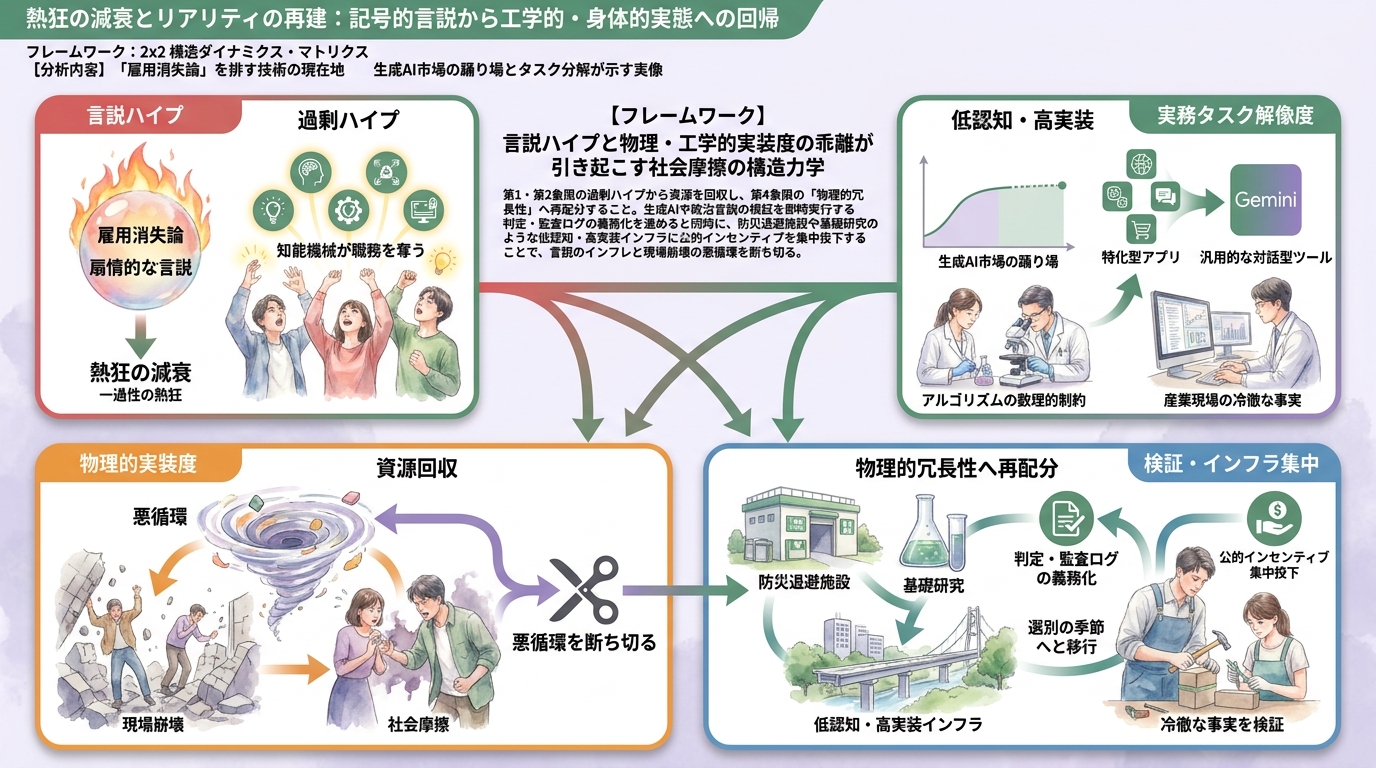
In mainstream discourse, extreme narratives of wholesale job destruction—where entire white-collar sectors are entirely swallowed by machines—remain perennially popular. However, ITmedia’s reporting on generative AI usage trends points not to boundless aggregate demand, but to market contraction and the harsh commercial pragmatism of end-users. After an initial novelty period, users are gravitating toward specialized services that deliver tangible, quantifiable efficiency gains. The reality observed on the ground is not the instantaneous erasure of broad occupational categories, but the precise extraction of narrow, highly limited sub-tasks for machine processing out of the infinite minutiae of daily operations.
This reality is dictated by the fundamental engineering principles inherent in large language models. At their core, contemporary generative models are probabilistic predictors of subsequent tokens based on vast training datasets; they possess neither a logical comprehension of a world model nor the capacity to verify truth. The structural defect that prevents them from autonomously guaranteeing the validity of their outputs—namely, the statistical generation of hallucinations—cannot be driven to zero by brute computing resources alone. While these tools offer practical value in drafting boilerplate code or standardized text, a firm boundary remains drawn against the full automation of core business processes that demand rigorous logical consistency and coherence.
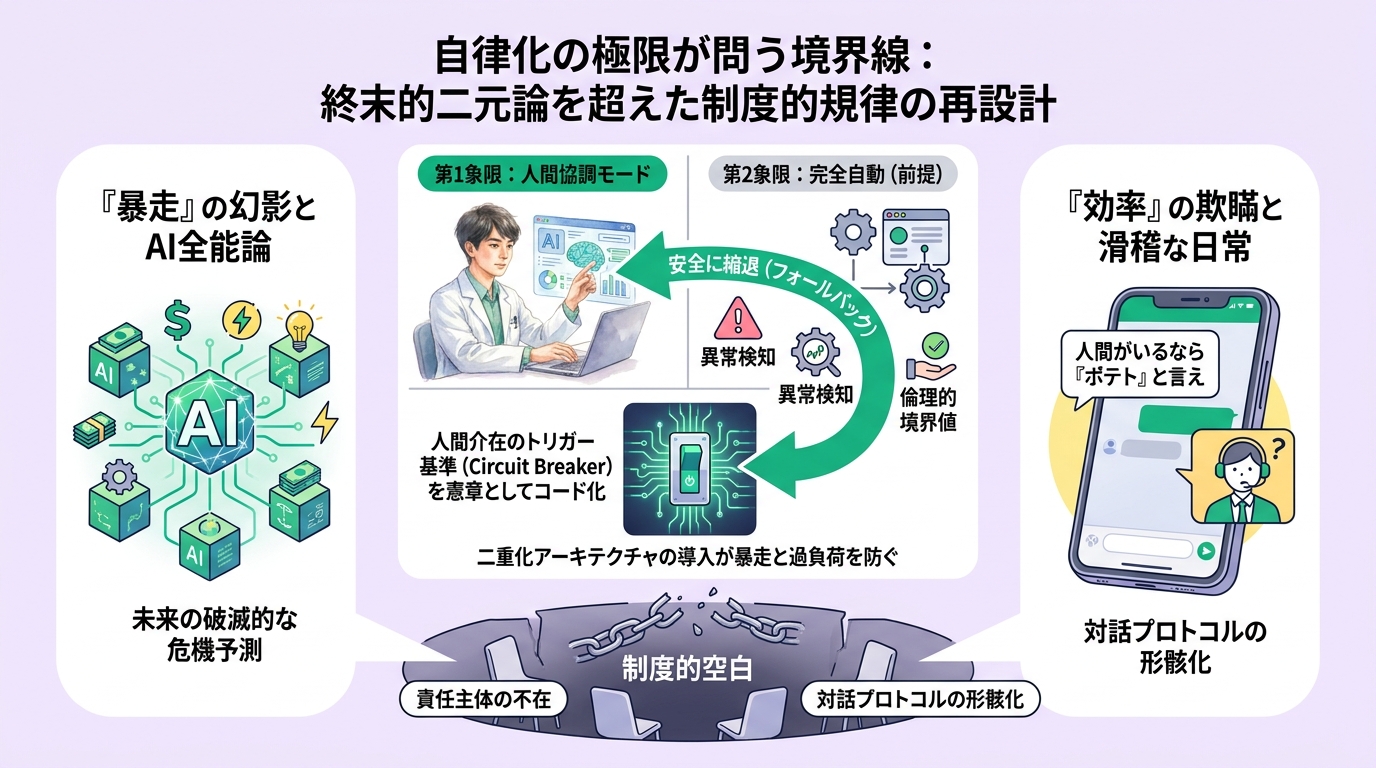
The true barriers to deployment lie less in algorithmic precision than in institutional friction: system integration and the locus of accountability. Corporate tribal knowledge, buried within unstructured enterprise databases, relies heavily on context-dependent tacit knowledge and cannot simply be dumped into a model. Furthermore, from the perspectives of copyright, confidentiality, and regulatory compliance, it is legally and institutionally impossible to assign accountability for algorithmic outputs to a machine. Consequently, organizations incur significant overhead as humans audit and correct automated outputs, leading to reports of naive deployments actually increasing organizational cognitive load.
Therefore, the current market turbulence is not a failure of technology, but a healthy adaptation process stripping away excessive expectations. By discarding the illusion of panoptic intelligence and reframing these systems as computational tools optimized for statistical pattern processing, a genuine collaborative relationship begins to emerge. Vocations themselves are not vanishing; instead, human labor is being purified into roles that domesticate these tools for routine tasks while assuming full ownership of contextual judgment and ethical responsibility. Following the cooling of the hype cycle, industry is stepping firmly into a phase of cold, pragmatic engineering implementation grounded in efficacy and sustainability.