The Blind Spots of the Engineered City: How Underpass Flooding Exposes the Toll of Extreme Optimization
Depressed roadways born of spatial constraints and economic rationalism—The reclamation of 'spatial margin' beyond computable metrics
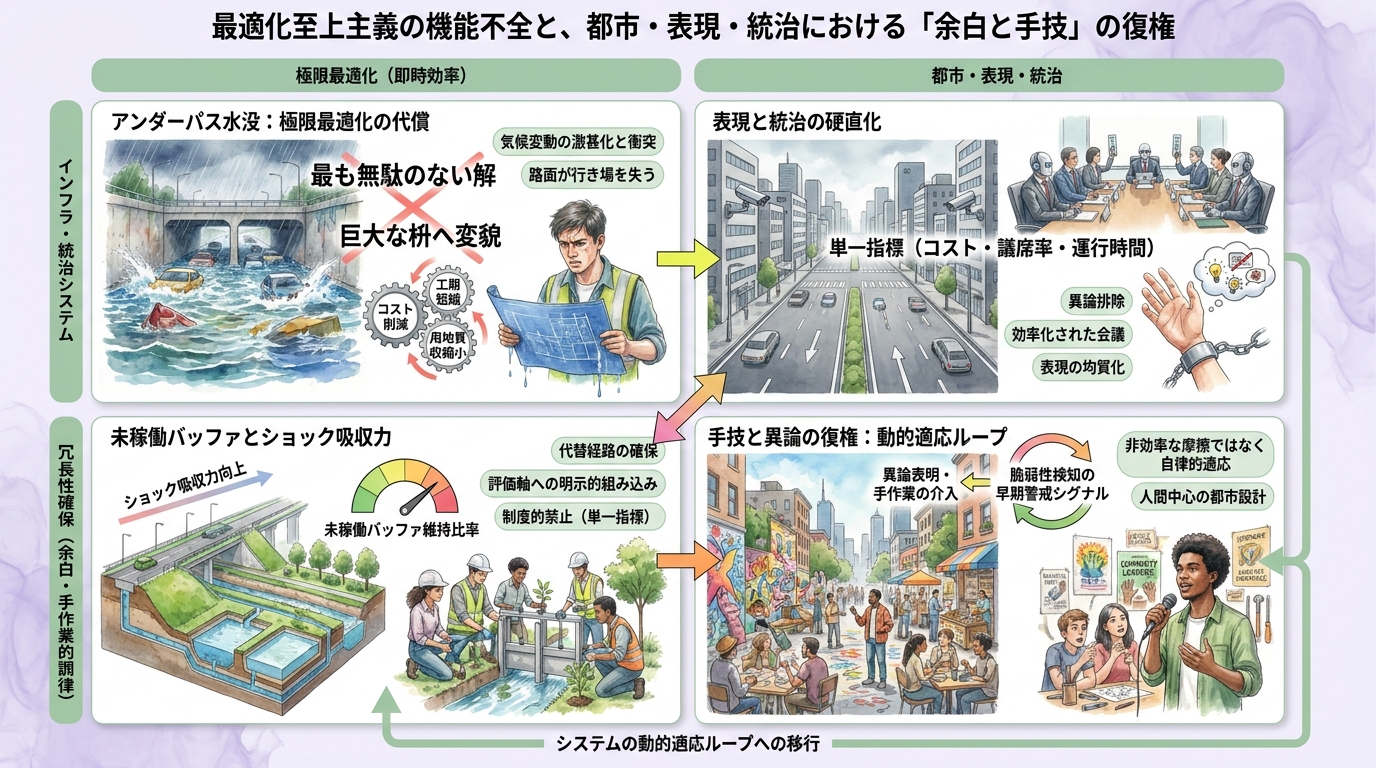
As pointed out by Norimono News, the preference for underpasses in urban grade-separation projects is driven by rigorous pursuit of spatial constraints and economic efficiency. Constructing elevated viaducts demands expansive approach ramps and robust piers, sending land acquisition and compensation costs soaring. Conversely, underground tunneling methods regulate traffic flows while preserving existing streetscapes within minimal spatial footprints. This dual optimization of 'dense space utilization' and 'cost minimization' has yielded remarkable results during normal times. Yet the closed-loop system, predicated entirely on pump drainage capacity, suffers catastrophic functional failure the moment an external force exceeds design thresholds even slightly. An urban structure stripped of waste completely loses the buffer zones needed to absorb sudden environmental shifts, collapsing into operational paralysis precisely because of its high density.
What modern urban planning has discarded is 'immeasurable margin.' Traditional civil engineering and community wisdom did not aim to completely prevent water damage; instead, they incorporated structures embodying imperfection, such as retention basins that temporarily divert water or green zones designed for controlled flooding. Spatial buffers that intentionally avoided straight lines, embraced topographical undulations, and accepted uncontrollable natural fluctuations were dismissed as 'unused waste' by numerical efficiency metrics and systematically excised. Yet the algorithmic mindset attempting to model precipitation and traffic probabilistically to derive millimeter-accurate optimal solutions is precisely what strips cities of antibodies against unknown variances. The more homogenous and seamless a structure, the more vulnerable it is to unexpected blows.
The key to overcoming this bottleneck does not lie in rejecting digital computational technology, but in re-integrating human corporeality and artisan aesthetics into the process. Merely advancing sensors and numerical simulations to automate drainage pumps cannot compensate for the inherent limitations of the design philosophy itself. We must re-establish craftsmanship-driven observational skills—cultivated on-site through the five senses, attuned to the scent of soil, the quirks of water currents, and the memories etched into topography—at the foundation of our designs. While wielding AI optimization engines as tools to push efficiency to its limits, human intuition and aesthetics must intervene in final judgments to 'deliberately leave margins' and 'intentionally secure surplus space.' We are challenged to act as tuners holding the reins rather than becoming indentured servants to machine processing speeds.
What is required is the resolve to deliberately step back from a civilization competing in the minimization of speed and cost. We must rethink the 'space-packing' symbolized by underpasses and, even if it entails taking a detour in terms of construction costs and convenience, pivot toward structures that allocate rich spatial margins above ground, allowing water and green spaces to breathe. Systems that eliminate all waste appear sleek and functional, yet they lack the elasticity necessary for life to survive. Precisely because technology is refined to its absolute limits, we must cultivate new metrics that embrace imperfection and value the depth of space nurtured over time. Restoring human thought and spatial margin to the massive vessel of the city—that is what generates true resilience.