Red Sea Coast Captured and the Dual Chokepoint Crisis: Soaring Oil Prices Expose the Fragility of Global Logistics
The Bab el-Mandeb and Strait of Hormuz Shake Simultaneously; Cape of Good Hope Detours and Skyrocketing Insurance Rates Ripple Through the Global Economy
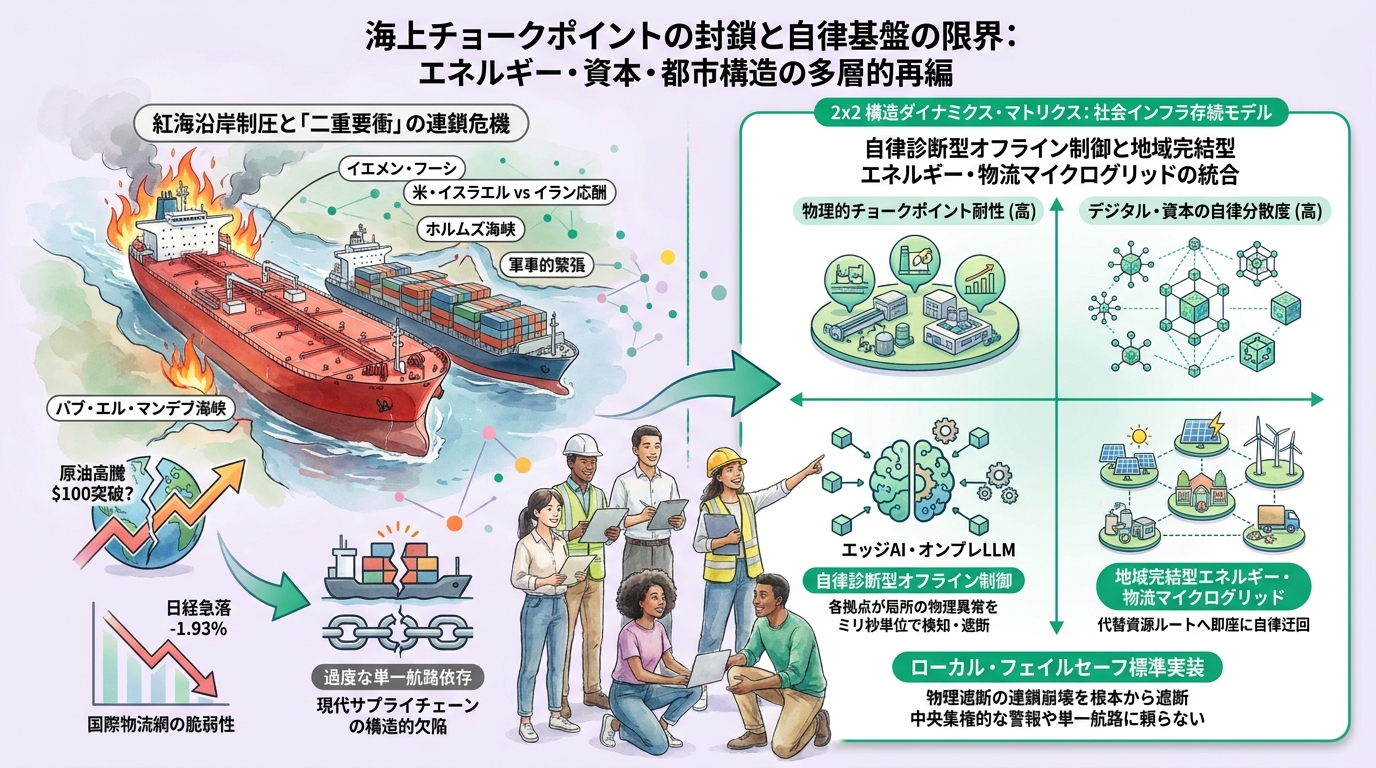
According to local situation reports covered by the Asahi Shimbun, the Houthis have rapidly expanded their sphere of influence along the Red Sea littoral, bringing virtually the entire coastline under their control. What were once sporadic military actions confined to select ports and coastal strongholds have now transformed into an encompassing net bringing all civilian merchant vessels navigating the Red Sea within firing range. In tandem with these developments, provocative maneuvers and seizure risks orchestrated by Iran around the Strait of Hormuz have also escalated, bringing the International Energy Agency’s (IEA) worst fears of the "simultaneous functional failure of two major chokepoints" closer to fruition. Anti-ship missile and drone attacks against merchant shipping have become commonplace in the affected waters, bringing major global shipping lines to a decisive juncture where abandoning Red Sea transit is unavoidable.
The ultimate shock delivered by this crisis is the operational shutdown of a global logistics model optimized entirely on the assumption of peacetime conditions. Deprived of the shortest route via the Suez Canal, vessels are now forced to reroute around the Cape of Good Hope at the southern tip of the African continent. This detour extends one-way transit times between Europe and Asia by 10 to 14 days and drives up fuel consumption by over 30 percent. Compounded by surging war risk insurance premiums and declining container ship utilization rates, maritime freight indices have multiplied severalfold in a short span. The profound vulnerability of a logistics infrastructure that entrusted roughly 12 percent of global trade to a single narrow channel has been laid bare by the falling costs of military technology and the expansion of asymmetric warfare.
The fallout extends far beyond the shipping industry, exerting cascading pressure on manufacturing and energy markets. European automotive plants face recurring temporary shutdowns due to component delivery delays, while resource-importing nations like Japan are experiencing sharp spikes in procurement costs for liquefied natural gas (LNG) and crude oil. In crude futures markets, benchmark prices are testing the psychological milestone of $100 per barrel, throwing monetary policies of central banks—which had presumed moderating inflation—into disarray. In the Tokyo market, widespread selling has taken precedence amid caution over corporate earnings deterioration driven by high resource costs. Meanwhile, foreign exchange markets see nervous tug-of-wars between dollar-buying and yen-selling in response to heightened geopolitical risks, pushing the squeeze on the real economy into an irreversible phase.
The focal point moving forward shifts to how major powers can reconstruct freedom of navigation and secure multi-layered alternative transportation networks. Coalition-led escort operations and airstrikes have proven incapable of fundamentally neutralizing decentralized coastal positions, exposing the inherent limits of relying solely on military force to restore transit. Moving forward, the design of redundant infrastructures independent of specific strait blockages—such as expanding overland pipelines and reorganizing rail transport routes—will become inescapable. The reality that the Middle East's two major chokepoints are clogging simultaneously forces the international community to confront a sobering truth: a free and secure maritime order is not self-evident, but rests upon the foundation of high-cost security guarantees.