How the Rhetoric of 'Safety' Fuels Development Races: The Policy Dysfunction Driven by Delays in Mega-Investments
Anthropic CEO's Confession of Deception and White House Tech Official's Rebuke Expose the AI Industry's Self-Reinforcing Loop
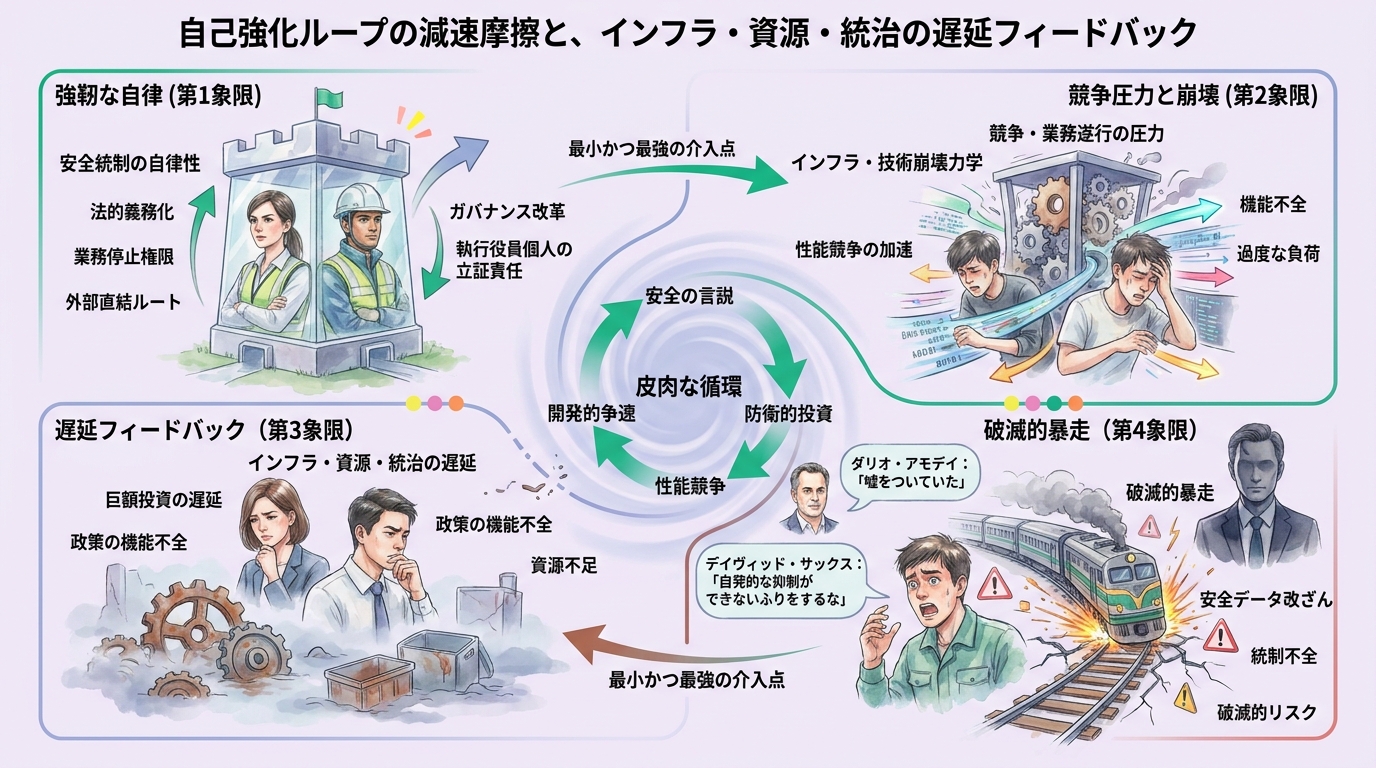
Amodei's candid confession and Sacks's biting critique have exposed the inherent contradictions plaguing AI security discourse. Until now, major tech firms and prominent startups have positioned themselves as responsible stewards and gained the trust of markets and policymakers by loudly warning of the uncontrollable risks that advanced intelligence poses to humanity. However, as Sacks points out, the narrative that companies 'cannot stand still because losing to competitors is inevitable without regulatory frameworks' merely blames external environments for self-inflicted competitive overheating. It reveals that talking about safety has ironically functioned as a rationale to justify massive capital expenditures for the next wave of large-scale model development.
Behind this phenomenon lies a structural, self-reinforcing loop. The more concretely companies articulate technological threats, the more the geopolitical and economic losses of falling behind rivals or other nations are amplified, inflating capital market fundraising scales. The US stock market's S&P 500 remaining resilient near 7,657 is partly underpinned by this continuous capital inflow into next-generation infrastructure. Yet, capital expenditures such as multibillion-dollar advanced semiconductor procurement and power grid development involve lengthy time lags before generating actual economic returns. As pressures to recoup investments mount, firms are forced to shorten safety verification processes and rush more powerful models to market. A negative feedback chain has become entrenched: threat-focused rhetoric accelerates competition, and accelerated competition hollows out safety verification.
Where do leverage points lie to normalize this gridlocked system? Amodei's attempt to correct disclosure postures regarding technical risks and Sacks's piercing of corporate evasion point toward potential entry points for intervention. The key is to prohibit companies from hiding behind abstract existential threats to build comprehensive barriers to entry, while mandating the disclosure of objective data concerning specific model vulnerabilities and malfunctions. Rather than relying on toothless gentlemen's agreements to 'voluntarily adjust the pace' of development, policymakers must clearly define verifiable engineering standards spanning from compute procurement and inference-stage energy consumption to algorithmic behavior. Ensuring transparency serves as the first step to cooling the overheating of speculative capital inflows.
The local optimization pursued by individual companies striving for competitive scale introduces severe distortions across societal infrastructure. As data center construction plans consuming immense amounts of electricity and water spark local friction with regional communities, the collapse of over-investments driven solely by performance competition will ripple through financial markets and supply chains as a whole. What is urgently required is neither fear-motivated, unlimited expansion competition nor complete laissez-faire founded on unfounded optimism. It is the redesign of multi-layered governance that coldly measures both the benefits brought to society by advanced intelligence and the technical debt generated in reality, synchronizing the speed of technological development with the absorption capacity of infrastructure and institutions.