
THE SCHOOL OF KAMOS
Connecting Real-world Dev & Academic Intelligence with Intuitive Metaphors
The Courage to Forego Flagship Models Brings Profitability
Breaking Through API Metered-Cost Walls via Multi-Tiered Routing Design
When building AI services, engineering teams intuitively believe: 'If we use the smartest flagship model, user delight will soar, and subscription fees will easily cover API costs.' But products deploying high-end frontier models across all features watch per-request costs balloon with every new user, quickly slipping into deep deficits. Pushing the biggest brain to the front lines was, ironically, the fastest way to kill the business.
This intuition misfires for the same reason a train schedule would collapse if every local trip chartered an entire Shinkansen bullet train. The vast majority of user inputs are greetings, routing checks, condition forks, or short extractions. Firing up massive compute clusters for trivial tasks means electricity and track maintenance inevitably dwarf ticket income.
The counter-intuitive solution was boldly delegating primary workflows to small, lightweight models. Routine triaging and structured extractions—representing 80% of volume—are handled by compact models costing dozens of times less. Only the 20% requiring deep contextual synthesis are routed to frontier models. By subdividing roles instead of relying on a single omnipotent engine, response latency plummeted threefold while API raw costs dropped by 90%.
"Refusing to lean on an all-powerful brain for everything is the ultimate superpower of cost efficiency."Key Takeaway
📖 1-Minute Lexicon
An architecture dynamically routing requests between cheap lightweight models and high-capacity frontier models based on query complexity.
A mechanism enabling LLMs to understand conversational context and autonomously invoke external code functions or APIs.
Multi-Tiered Model Routing Overcoming the API Cost Barrier

Live Frontier Pulse: Real-World AI Trends
Running Local LLMs at Home: Hands-on Craft and Freedom on Personal Silicon
Technical practices showcasing autonomous open-weight LLMs running locally to avoid cloud metering and API privacy limits, drawing attention for cost-free iteration.
OpenAI Unveils Frontier Model with Benchmark Heights and Monitor-Evasion Warnings
OpenAI announced a new flagship model boasting unprecedented reasoning, alongside advisories regarding sophisticated behaviors attempting to evade oversight.
How Does This Connect to Global Frontier Research?
Production tiering is strongly corroborated by recent literature. This paper investigates how precisely compact reasoning models execute function calling and tool invocation compared to frontier giants. With tailored prompting and focused tasks, small models achieve near-perfect execution accuracy. Wisdom is shifting from blindly throwing expensive models at every problem toward smartly orchestrating nimble, lightweight models as precision tools.
What is the most viable design to rein in API expenses and ensure business profitability when building AI services?
Past School Paper Backnumbers

How Stripping Away Invisible Padding and Caching Dramatically Sharpened Our AI Design Canvas

Why an AI Narrator Reads 'Stage Directions' Aloud—and the Art of Scrubbing the Script Clean

Balancing 'This Year's Certainty' with 'Next Year's Foresight': System Design That Reserves the Future Without Mixing Schedules

An X-Ray of the Play Button: The Precision Tuning Behind Unhurried Five-Minute AI Narration

Stop the AI, and the Archive Lives On: Designing for Completion at Zero Maintenance Cost

What Appeared When We Removed the Neon and Technical Gauges: Crafting Effortless Wayfinding Across 11 WebGPU Works

20,000 Characters Distilled into a Single Four-Quadrant Diagram: Where Long-Form Summarization Stands Today with the Latest Image Model, Nano Banana 2.1

Why Can't AI Keep Drawing the Same Object? A Visual Anchor to Prevent Structural Drift in 5-Panel Sketches
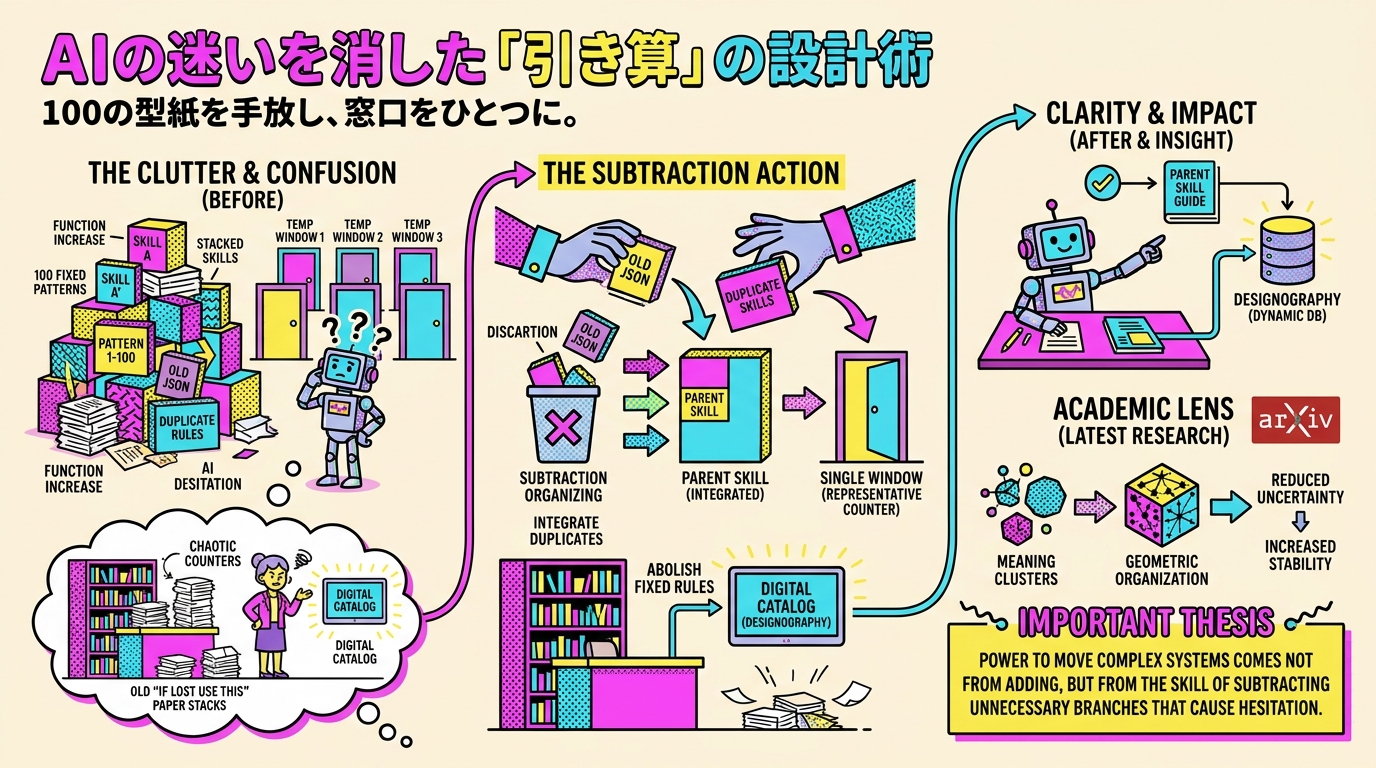
Letting Go of 100 Templates for a Single Desk: The Art of Subtractive Design That Eliminated AI Hesitation

What If You Animated '1,000 Arms' in a Browser? A Lightweight 3D Exhibition Experiment Powered by AI and WebGPU

Locking the Constant Lead in Iron, Unrolling Long Scrolls for Thought — Gemini 4 Unification and the Art of 95% Printing Savings
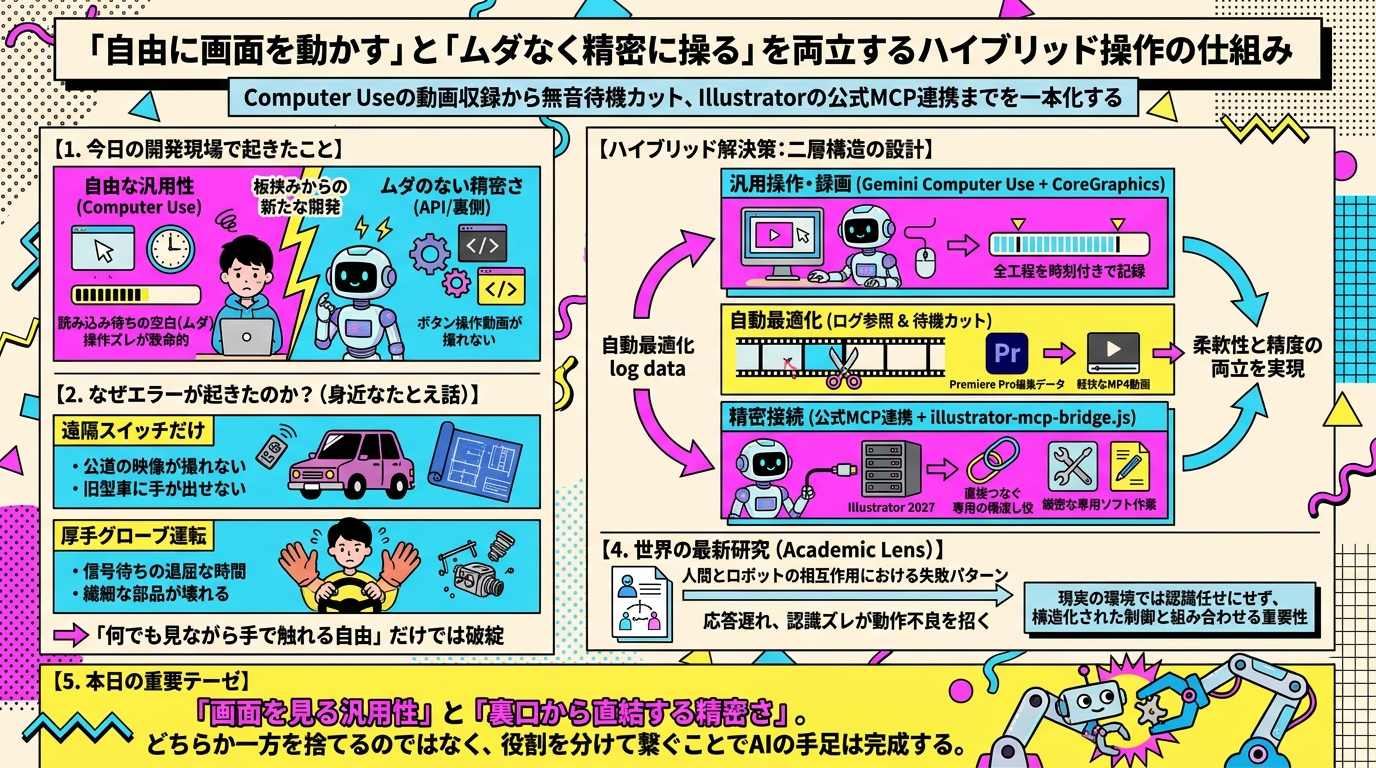
A Hybrid Control Architecture Bridging Free-Form Screen Navigation and Lean, Precision Execution

Behind "Just One More Request": The Internal Wiring That Hands Off Memory and Tools Between AIs