THE SCHOOL OF KAMOS
Connecting Real-world Dev & Academic Intelligence with Intuitive Metaphors
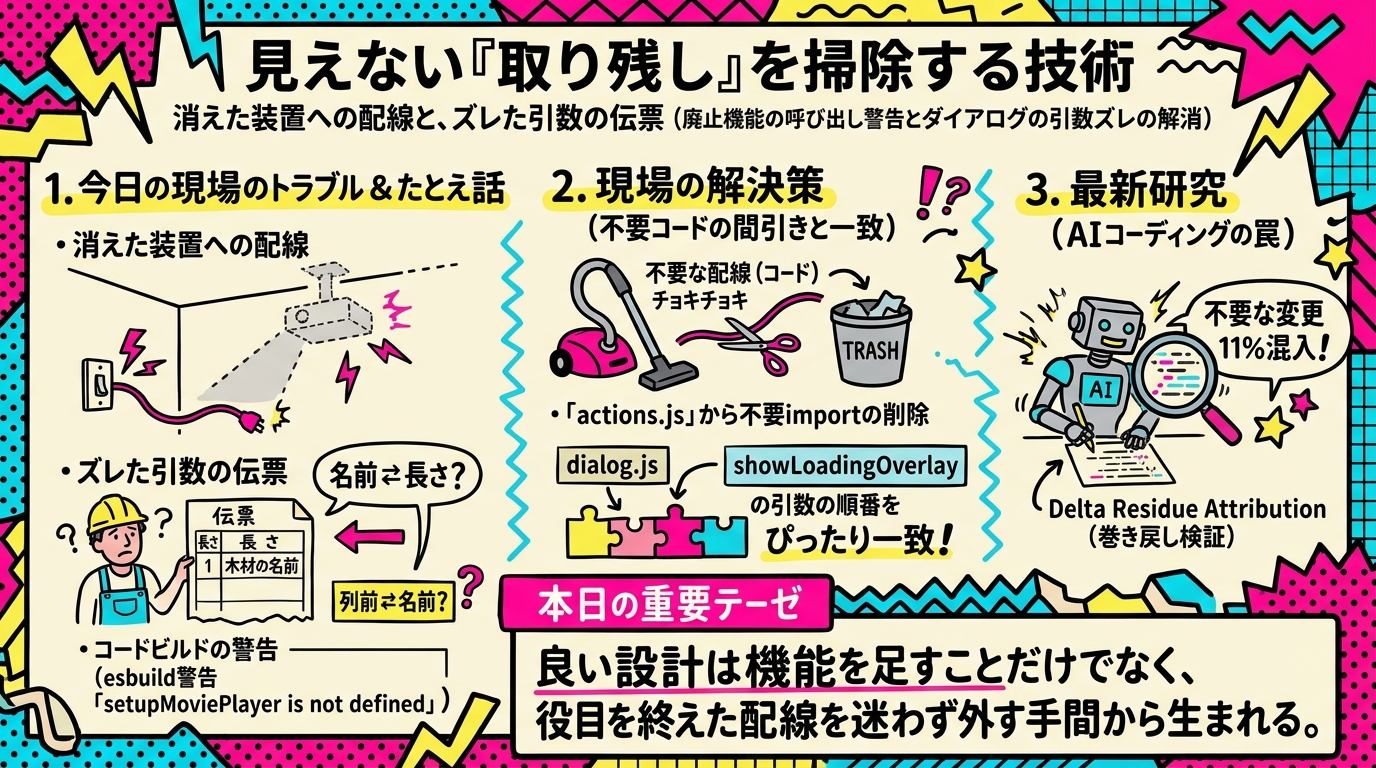
Wiring to a Vanished Device and Misaligned Argument Slips: The Craft of Clearing Invisible Leftovers
Resolving deprecated function call warnings and dialog argument mismatches to restore the health of the development foundation
The moment the build ran, an ominous warning surfaced on the terminal screen. An analytics processing file was still trying to invoke "setupMoviePlayer," a loading video playback feature that had supposedly retired from the codebase. Digging deeper revealed another quiet discrepancy: at the handoff where a dialog triggers the loading screen, the order of the passed data was shifted by one slot. On the surface, these looked like minor snags—yet left unchecked, they were silent hazards capable of freezing the UI or causing unexpected malfunctions.
Why do discrepancies like this happen? Picture a home renovation site, and the structure becomes immediately clear. If you remove a ceiling projector but leave its wall switch wiring connected, the safety breaker sounds an alarm every time power flows through. That is the exact nature of an "undefined reference"—continuing to call a function that no longer exists. Similarly, imagine adding a new item on the far left of a work-order slip handed to a carpenter; if the carpenter still reads it using the old column dividers, the name of the timber ends up in the "length" column. When passing data between functions in code, a shift in argument order occurs through the exact same column-slip mechanism, leading to unintended display glitches.
On the engineering floor, we first carefully removed the lingering obsolete call inside actions.js, completely eliminating the warnings emitted by the build tool esbuild. Next, we cross-checked every argument handed off from dialog.js to the loading overlay renderer showLoadingOverlay, aligning them one by one to match the receiver's definition and sequence. In modern development environments where AI assists with rapid code rewrites, "leftover wiring" and "subtle column shifts" like these can quietly slip in after features are swapped out. Just as vital as the ability to build new capabilities is the steady habit of pruning retired code and inspecting the handoff interfaces between components—this discipline forms the true bedrock of system reliability.
"Good design comes not only from adding features, but from the deliberate care of disconnecting wiring whose work is done."Key Takeaway
📖 1-Minute Lexicon
An error or warning triggered when one part of a program attempts to call a component or function by name that has already been removed and can no longer be found.
A piece of data or value handed over alongside a request when asking a function or procedure to carry out a task—much like details written on an order slip.
Removing Leftover Wiring & Aligning Handoff Slip Columns
Live Frontier Pulse: Real-World AI Trends
AI Act Amendment to Mandate Safety Obligations for Advanced AI Providers, with Penalties for Non-Compliance
The Japanese government has finalized plans to submit an amendment to the AI Act during next year's ordinary Diet session, requiring providers of advanced AI services to ensure safety and report to the state. With penalties planned for violating official orders, efforts are accelerating to institutionalize safety and transparency for rapidly proliferating high-performance AI.
[AI-Driven Modernization] Introducing "Reverse Spec Flow": Generating AI-Ready Specifications from Legacy Code
AWS has unveiled "Reverse Spec Flow," a methodology that parses existing source code to automatically generate specifications easily understood by AI agents. The initiative aims to establish a reliable foundation so AI can safely modernize systems whose original design documents are outdated or lost.
How Does This Connect to Global Frontier Research?
The issue of "unnecessary changes and leftovers" creeping into code modifications is also drawing attention in cutting-edge academic research. In this paper, researchers analyzed 7,660 patch histories generated by AI coding agents, rolling them back block by block using a method called "Delta Residue Attribution." Their findings revealed that even among patches that passed tests, roughly 11% of the code units written by AI were actually unnecessary—and 89% of those extraneous edits altered the program's behavior. Research into having AI review its own diffs and automatically prune unneeded edits connects directly to the everyday engineering work of clearing away leftover wiring.
After rewriting part of a program, what does an "argument mismatch" between two connected components actually look like?
Past School Paper Backnumbers
Enter "1.5 Hours" or "90 Minutes" As-Is: Unifying Revenue and AI Memory as Workstyles Evolve
Current
Wiring to a Vanished Device and Misaligned Argument Slips: The Craft of Clearing Invisible Leftovers

AI Evolves from a 'Consultant in Another Tab' to a 'Partner at the Same Desk': A Blueprint for Human-Machine Unity Beyond Fragmented Tools

Letting Go of 'Number-Checking' to See the Big Picture: How a Weekly Strategy Sync Unleashes AI's True Potential

A Few Lines Supporting a Massive App: The Craft of 'Waiting and Bypasses' Keeping Mobile AI Memory Intact

How Stripping Away Invisible Padding and Caching Dramatically Sharpened Our AI Design Canvas

Why an AI Narrator Reads 'Stage Directions' Aloud—and the Art of Scrubbing the Script Clean
Balancing 'This Year's Certainty' with 'Next Year's Foresight': System Design That Reserves the Future Without Mixing Schedules
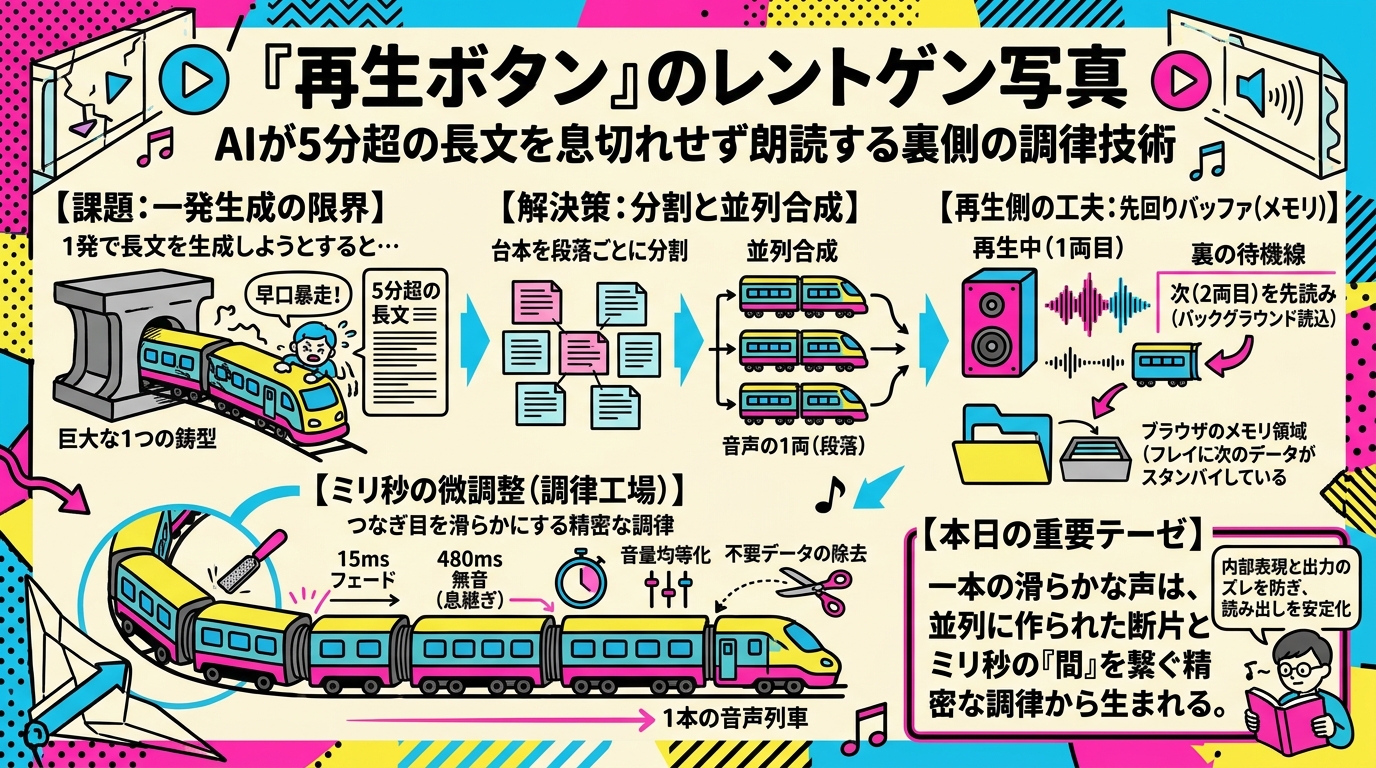
An X-Ray of the Play Button: The Precision Tuning Behind Unhurried Five-Minute AI Narration

Stop the AI, and the Archive Lives On: Designing for Completion at Zero Maintenance Cost

What Appeared When We Removed the Neon and Technical Gauges: Crafting Effortless Wayfinding Across 11 WebGPU Works

20,000 Characters Distilled into a Single Four-Quadrant Diagram: Where Long-Form Summarization Stands Today with the Latest Image Model, Nano Banana 2.1

Why Can't AI Keep Drawing the Same Object? A Visual Anchor to Prevent Structural Drift in 5-Panel Sketches