THE SCHOOL OF KAMOS
Connecting Real-world Dev & Academic Intelligence with Intuitive Metaphors
Stop the AI, and the Archive Lives On: Designing for Completion at Zero Maintenance Cost
The art of subtraction—shutting down scheduled runs and preserving the future with static files and completion flags
A system where AI automatically gathers information every morning and tirelessly generates articles and audio shows seems like the ideal self-sustaining media engine. Yet on the ground at The School of Kamos, keeping multiple autonomous media pipelines running on fixed schedules exposed a paradox: behind-the-scenes invocation costs and maintenance overhead kept piling up, crowding out the breathing room needed for new experiments. The decision made was not further automation, but a counterintuitive reversal—shutting down every scheduled run and freezing the work as a completed static archive.
Why did the intuition that 'since we built an automated system, it pays to keep it running' backfire? Picture an automated mechanical clock tower in a public park. Even late at night or at dawn when the plaza is empty, if the motor whirs on schedule, draws electricity, wears down its gears, and keeps chiming the bells, maintenance costs and inspection burdens swell without end. The digital world works no differently. Scheduled timers in the cloud and AI generation functions steadily burn compute resources and invocation costs just by staying alive, while client apps keep polling nearly every hour to ask, 'Is there anything new?' Well-meaning intentions to preserve past records had ironically become a tether forcing the engine to keep spinning.
So the team chose the opposite solution: power down the automated generation, gracefully declare the work 'complete,' and lock it into static files. After halting every scheduled trigger and generation function, they appended a suspension notice to the final issue while keeping both the Japanese and English editions and all back issues intact, and switched the podcast feed (RSS) to a static XML file marked with the 'itunes:complete' tag. Information delivery systems possess a remarkable property: the moment you stop updates and solidify them into static data, server invocation costs drop to zero, redundant polling from client apps ceases, and the archive transforms into a 'power-free memorial exhibition' accessible semi-permanently at zero maintenance cost. By choosing 'to stop gracefully' rather than keep moving, the team freed up capacity to revamp monthly reviews and cultivate a new prototype notebook, The Automata.
"Keeping the wheels turning is not the only way forward. The craft of gracefully declaring 'complete' and quietly locking work in place protects past assets and creates room for the next act of creation."Key Takeaway
📖 1-Minute Lexicon
A completion tag written into a podcast feed directory that signals to apps: 'This show has reached its final episode and is now complete.'
Data stored in an already-finished state and served directly at near-zero maintenance cost, without triggering a program to regenerate it on every visit.
Halting Scheduled Runs & Static Complete Archives: The Creative Margin Born from 'Stopping Gracefully'

Live Frontier Pulse: Real-World AI Trends
Mitsubishi Heavy Industries and SAKURA internet Begin Exploring Strategic Alliance to Build Japan's Sovereign AI Infrastructure
Mitsubishi Heavy Industries and SAKURA internet announced plans to explore a strategic alliance aimed at building 'Sovereign AI Infrastructure' that can be operated autonomously and securely within Japan. By combining engineering expertise in energy and industrial infrastructure with domestic cloud foundations, the partnership aims to establish a sustainable AI backbone across both compute and power.
Federated Learning Technology Enabling Confidential Data Collaboration and Its Applicability to LLMs - NEC
NEC unveiled its initiatives on federated learning technology—which enables collaborative training without exposing or moving sensitive organizational data outside—and its applicability to large language models (LLMs). The approach is drawing attention for balancing security and accuracy by sharing knowledge alone rather than centralizing data.
How Does This Connect to Global Frontier Research?
Much of AI research to date has focused heavily on capability—how difficult a problem a model can solve—while under-measuring the hidden costs of how much power, time, and compute a single execution consumes. This study on autonomous AI agents performing iterative power-electronics circuit simulations steps directly into that blind spot. By systematically measuring power draw, energy consumption, token counts, and execution time when running agents on local hardware, the researchers mapped out the true 'cost per solved task' alongside the boundaries of capability. Viewing AI execution rigorously as a physical load that consumes electricity on every run connects directly to the engineering decision to halt unnecessary scheduled jobs and transition to static files.
What counterintuitive approach did the team take to preserve the back issues of retired AI-generated media in a readable state at near-zero maintenance cost?
Past School Paper Backnumbers

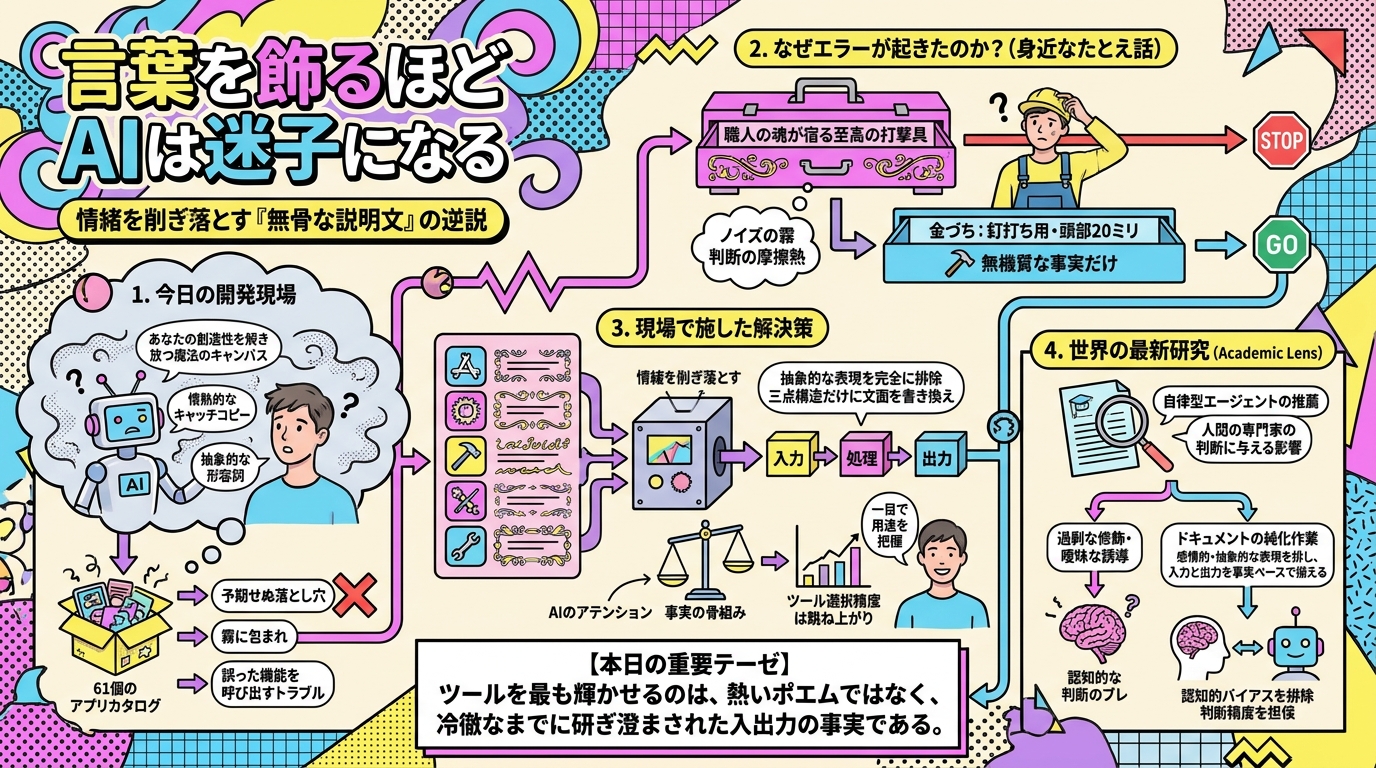
How Stripping Away Invisible Padding and Caching Dramatically Sharpened Our AI Design Canvas

Why an AI Narrator Reads 'Stage Directions' Aloud—and the Art of Scrubbing the Script Clean
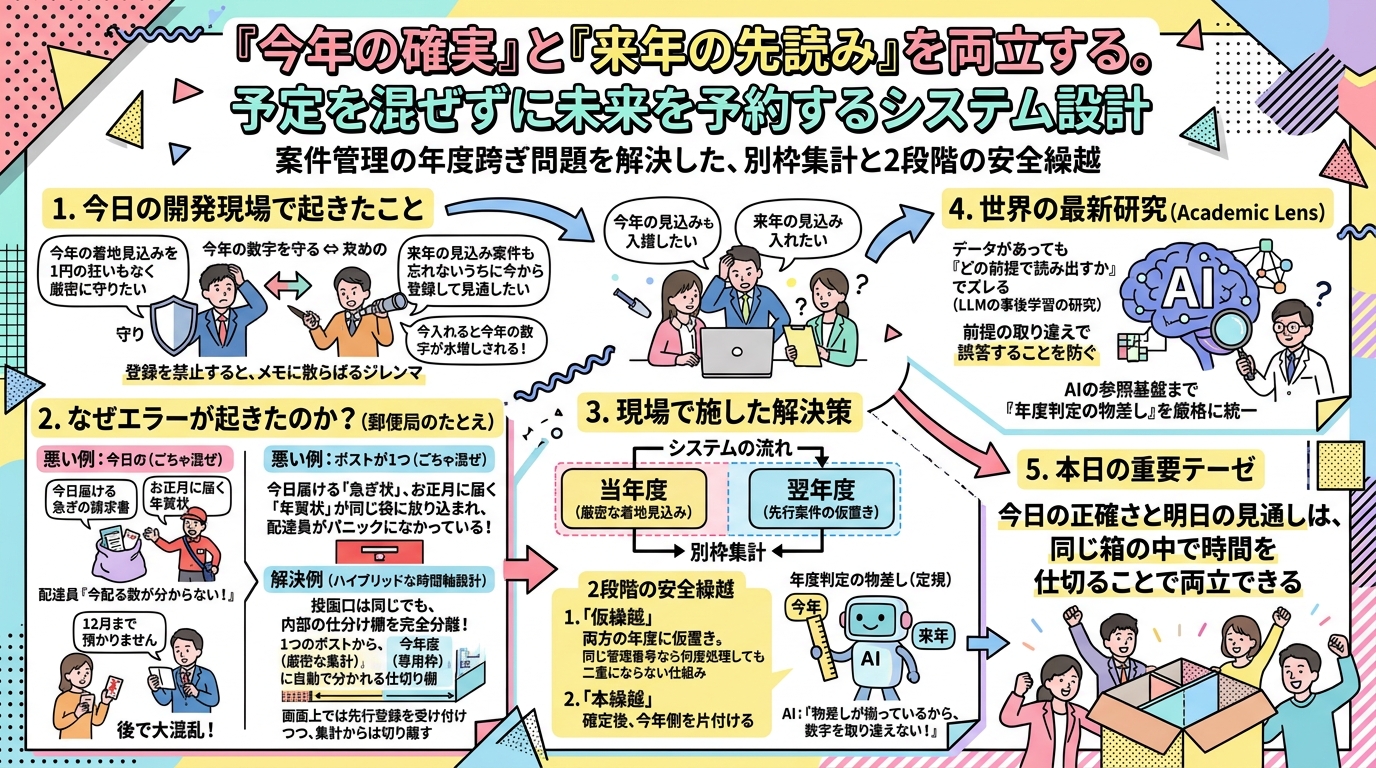
Balancing 'This Year's Certainty' with 'Next Year's Foresight': System Design That Reserves the Future Without Mixing Schedules
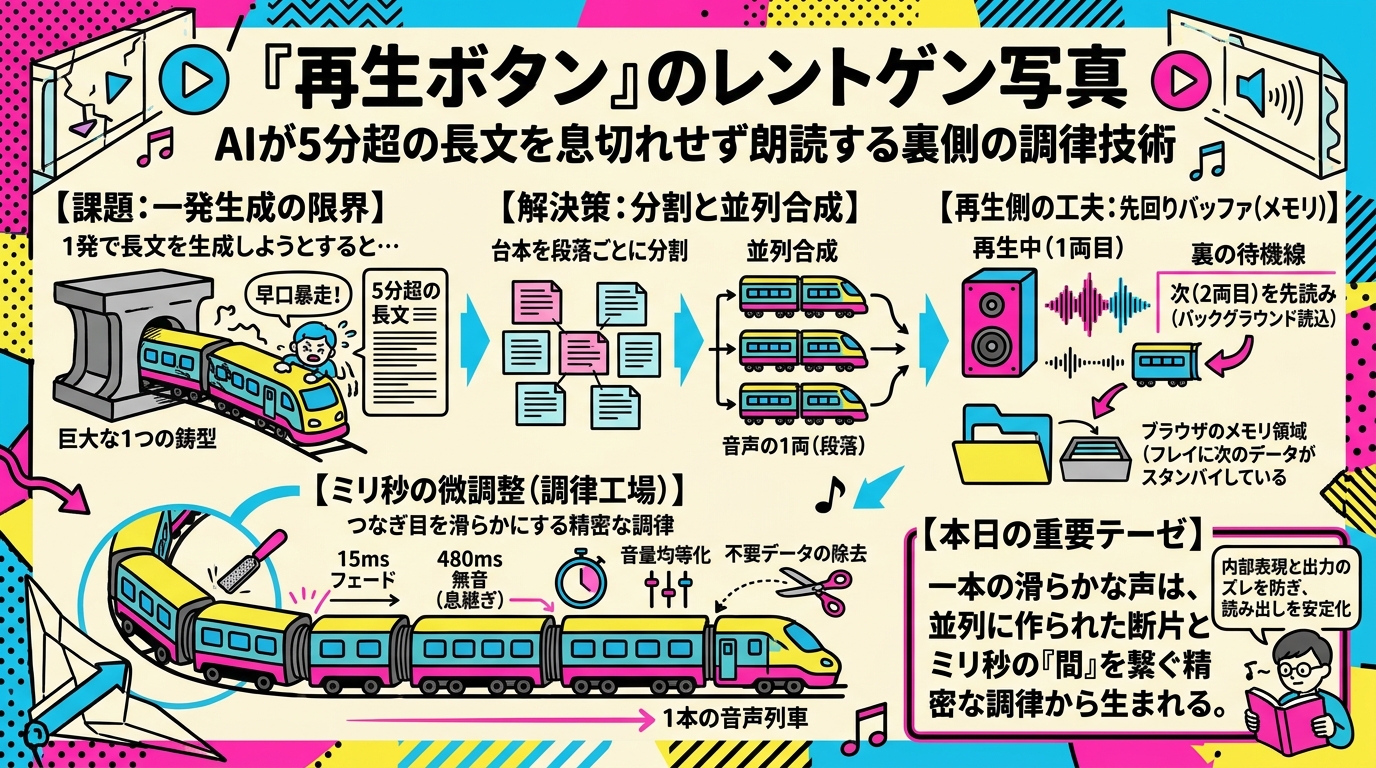
An X-Ray of the Play Button: The Precision Tuning Behind Unhurried Five-Minute AI Narration
Current
Stop the AI, and the Archive Lives On: Designing for Completion at Zero Maintenance Cost

What Appeared When We Removed the Neon and Technical Gauges: Crafting Effortless Wayfinding Across 11 WebGPU Works

20,000 Characters Distilled into a Single Four-Quadrant Diagram: Where Long-Form Summarization Stands Today with the Latest Image Model, Nano Banana 2.1

Why Can't AI Keep Drawing the Same Object? A Visual Anchor to Prevent Structural Drift in 5-Panel Sketches
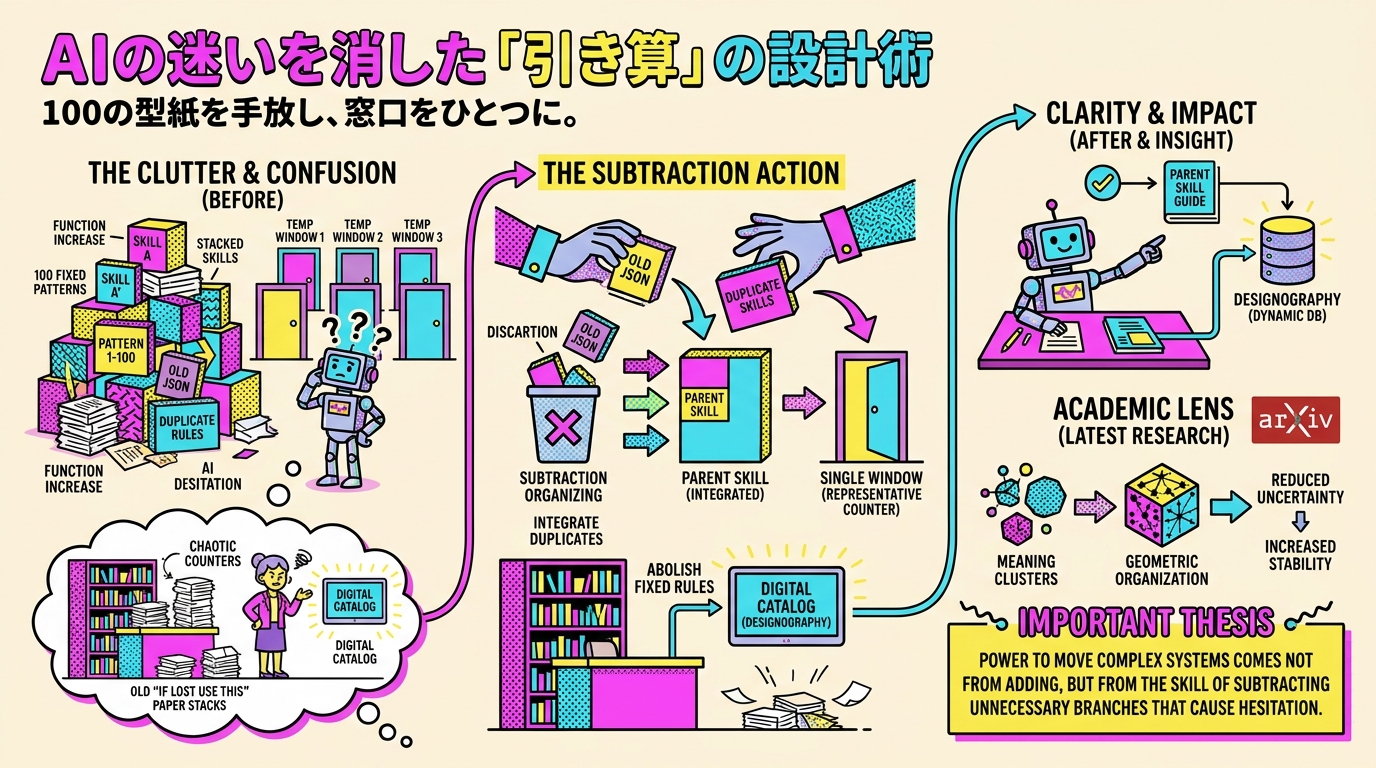
Letting Go of 100 Templates for a Single Desk: The Art of Subtractive Design That Eliminated AI Hesitation

What If You Animated '1,000 Arms' in a Browser? A Lightweight 3D Exhibition Experiment Powered by AI and WebGPU
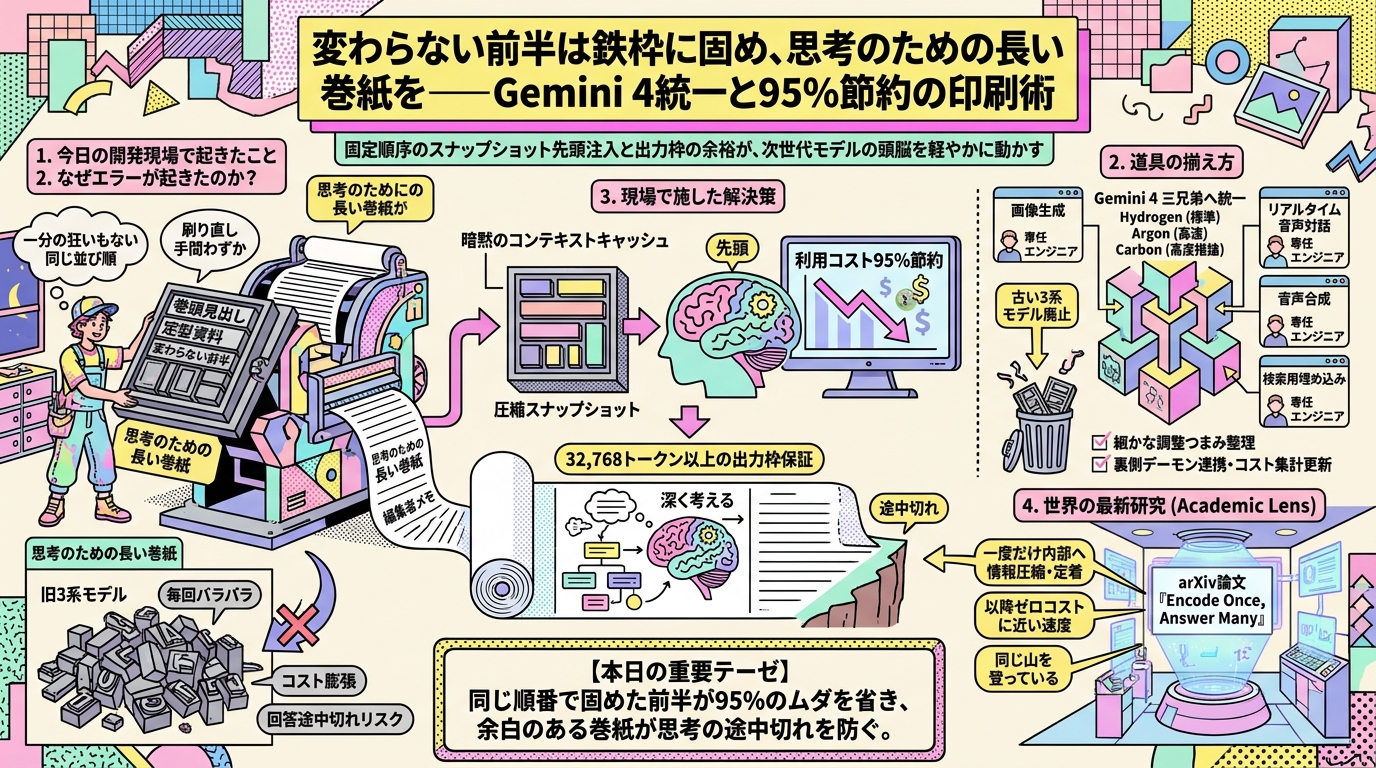
Locking the Constant Lead in Iron, Unrolling Long Scrolls for Thought — Gemini 4 Unification and the Art of 95% Printing Savings
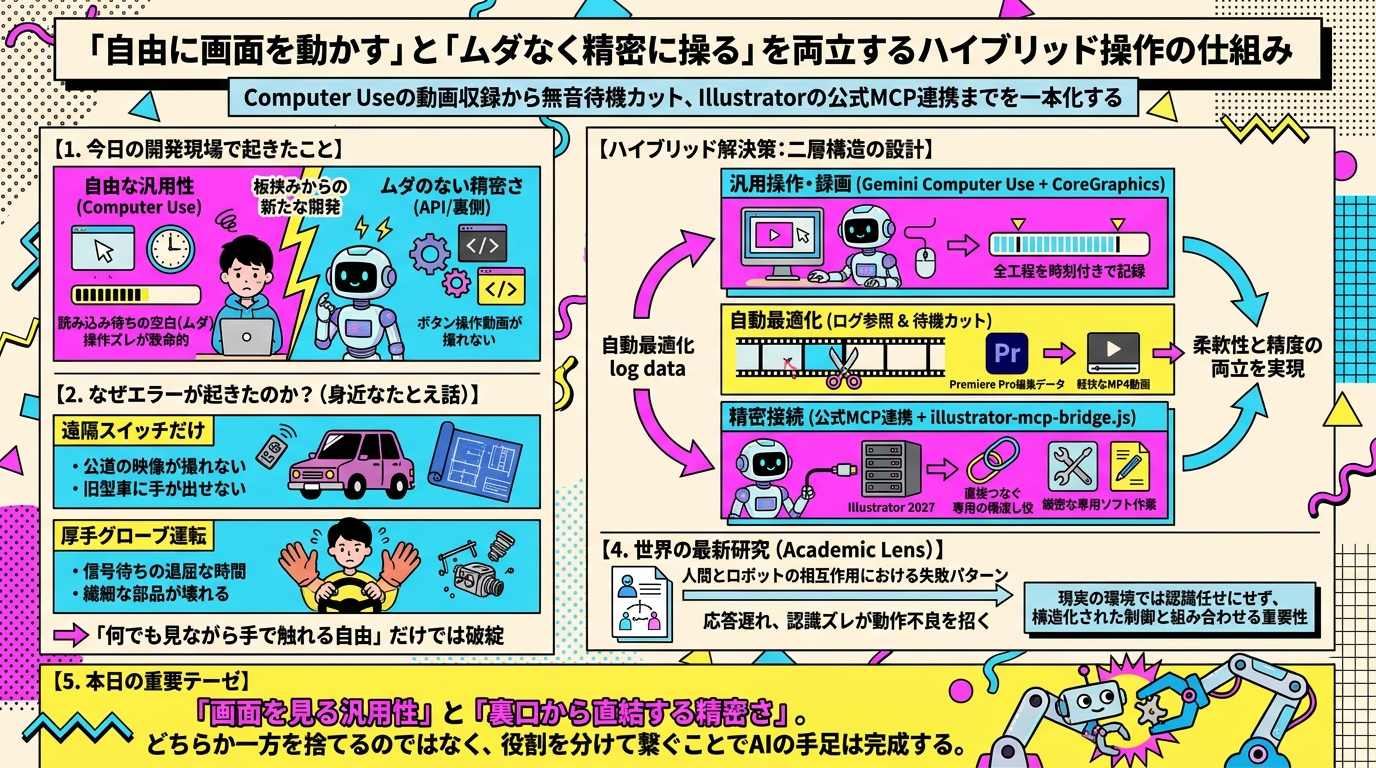
A Hybrid Control Architecture Bridging Free-Form Screen Navigation and Lean, Precision Execution
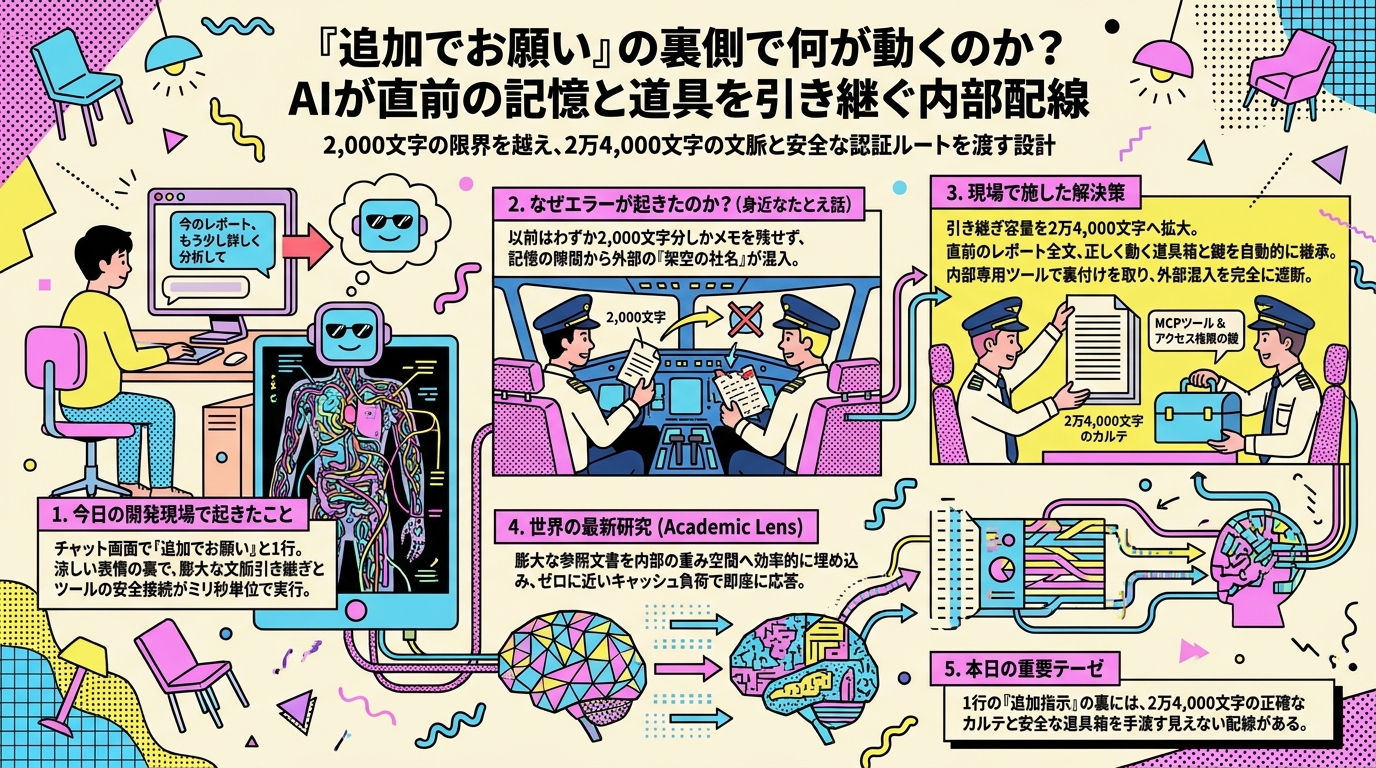
Behind "Just One More Request": The Internal Wiring That Hands Off Memory and Tools Between AIs