
THE SCHOOL OF KAMOS
Connecting Real-world Dev & Academic Intelligence with Intuitive Metaphors
How Stripping Away Invisible Padding and Caching Dramatically Sharpened Our AI Design Canvas
A Frictionless Co-Creation Canvas Powered by 0px Selection Alignment and Single-Pass Direct Generation
What happens to usability if you deliberately strip a design tool's canvas of both its well-intentioned transparent padding and its temporary rendering cache? And what happens to the interface if you also bypass the AI's polite intermediate handoff waits and let it output in a single continuous stroke? That bold thought experiment took place inside Kamos Espresso. Our goal was to confront subtle shape misalignments and sluggish screen responses at their root. What awaited us on the other side once every well-meaning cushion was peeled away?
The results of the experiment were striking. When we zeroed out the default 2-pixel selection padding and 1-pixel invisible stroke width, removed the mechanism that temporarily cached sketches as bitmaps, and rendered directly onto integer pixels, the interface didn't fall apart—instead, it sprang back to life with breathtaking crispness, even on high-DPI displays. It is much like the craft of a museum framer. If you drape loose transparent plastic over a painting and try to fit it into a frame through frosted glass, the gaps between adjacent frames will inevitably drift by a few millimeters. Remove the plastic and align a laser level directly against the painting's true edge, and you can match neighboring margins down to the millimeter. The same held true for AI generation: eliminating unnecessary intermediate waits and letting the model assemble HTML directly in a single pass erased both latency and hesitation in an instant.
The golden rule that emerged from this experiment is that well-meaning intermediate layers and ambiguous margins can be the very things clouding precision and speed. In practice, implementing a single-frame canvas resizable in all eight directions alongside real-time distance pills and snapping crosshairs allowed manual fine-tuning and high-speed AI output to lock together without a single pixel of drift. When building tools for human-AI collaboration, we must pare away the system's unsolicited meddling—adding extra padding or inserting confirmation relays—and make coordinate and structural baselines thoroughly transparent. Only when both sides share an exact ruler can AI speed and human aesthetic sensibility resonate harmoniously.
"When we strip away polite cushions and share a true-scale ruler, AI speed and human aesthetics align without a single pixel of drift."Key Takeaway
📖 1-Minute Lexicon
A technique that temporarily saves a shape as a bitmap image to lighten rendering load. On high-DPI screens, it can cause lines to appear slightly blurred.
Helper lines that automatically measure spacing and centerlines relative to adjacent elements as you move a shape, snapping it cleanly into alignment.
A Precise 0px World Revealed by Removing Cushions: Direct Rendering and Single-Pass Generation

Live Frontier Pulse: Real-World AI Trends
[AI-Driven Modernization] AWS Releases "Reverse Spec Flow" to Generate AI-Agent-Ready Specifications from Legacy Code
Amazon Web Services (AWS) has unveiled Reverse Spec Flow, a new workflow that reverse-engineers existing system codebases into structured specifications ready for AI agents to reference and utilize. It offers a practical method for organizing long-running code assets into clear blueprints that AI can reliably interpret to support system modernization.
Returning Value to Creators When Their Articles Are Referenced by AI
The publishing platform note has announced a mechanism to return compensation to original creators whenever their articles are referenced by AI. The initiative is drawing attention as a way to circulate fair economic value back to the human wisdom and expression used behind the scenes in AI answer generation, training, and search.
How Does This Connect to Global Frontier Research?
Conventional AI models that process images and language have struggled to measure exact physical lengths and spatial relationships. Forced to guess depth from appearance alone without camera viewpoint data, they relied on ungrounded assumptions. StereoVLM, the study highlighted here, resolves this ambiguity by progressively teaching the AI the geometric mechanics of binocular vision using two distinct left and right viewpoints. Anchoring reasoning in objective standards like disparity and metric distance rather than guesswork resonates deeply with our engineering work on 0-pixel true-scale selection bounds and pixel-accurate distance guides. Whether navigating physical space or a design canvas, an AI needs an exact geometric ruler to move without hesitation.
In the Kamos Espresso experiment, what happened when we deliberately zeroed out temporary rendering caches and subtle selection-frame padding?
Past School Paper Backnumbers
Current
How Stripping Away Invisible Padding and Caching Dramatically Sharpened Our AI Design Canvas

Why an AI Narrator Reads 'Stage Directions' Aloud—and the Art of Scrubbing the Script Clean

Balancing 'This Year's Certainty' with 'Next Year's Foresight': System Design That Reserves the Future Without Mixing Schedules

An X-Ray of the Play Button: The Precision Tuning Behind Unhurried Five-Minute AI Narration

Stop the AI, and the Archive Lives On: Designing for Completion at Zero Maintenance Cost

What Appeared When We Removed the Neon and Technical Gauges: Crafting Effortless Wayfinding Across 11 WebGPU Works

20,000 Characters Distilled into a Single Four-Quadrant Diagram: Where Long-Form Summarization Stands Today with the Latest Image Model, Nano Banana 2.1

Why Can't AI Keep Drawing the Same Object? A Visual Anchor to Prevent Structural Drift in 5-Panel Sketches
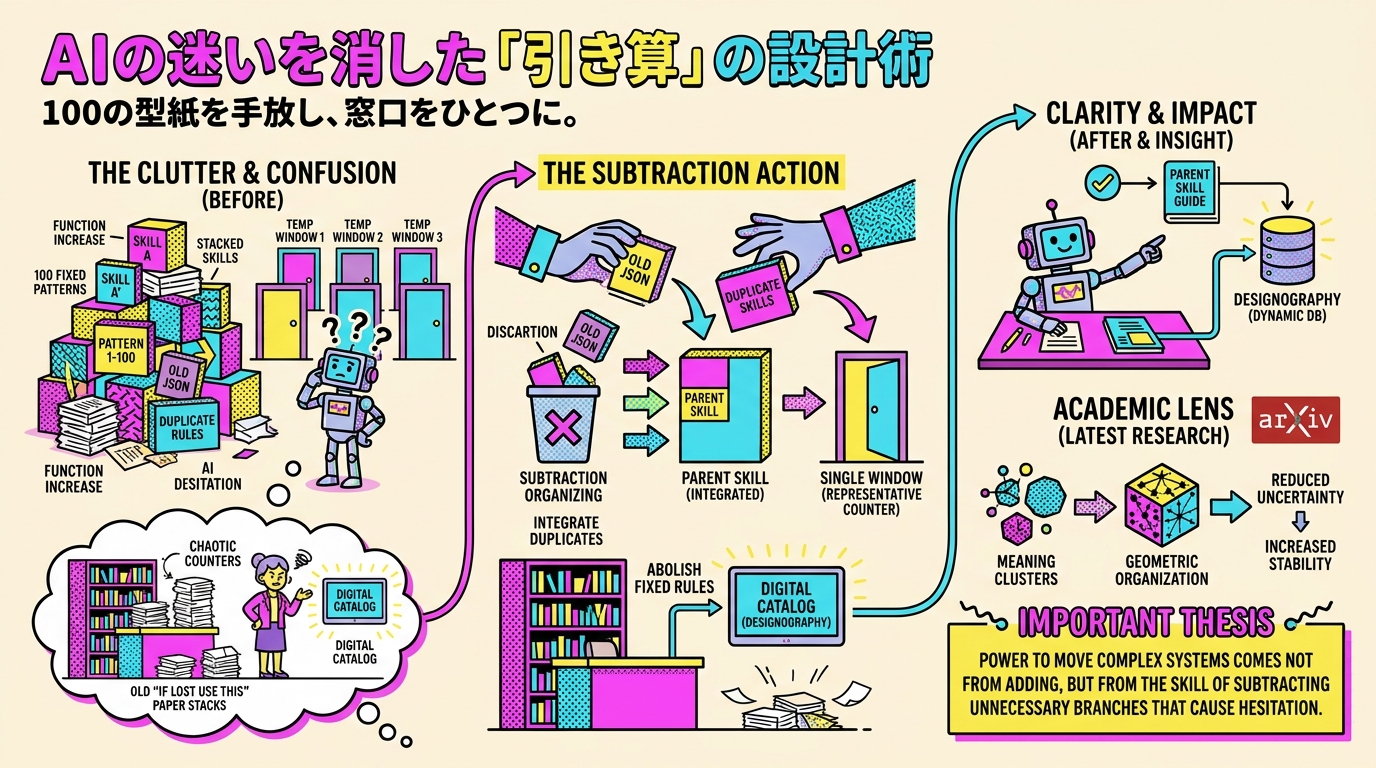
Letting Go of 100 Templates for a Single Desk: The Art of Subtractive Design That Eliminated AI Hesitation

What If You Animated '1,000 Arms' in a Browser? A Lightweight 3D Exhibition Experiment Powered by AI and WebGPU
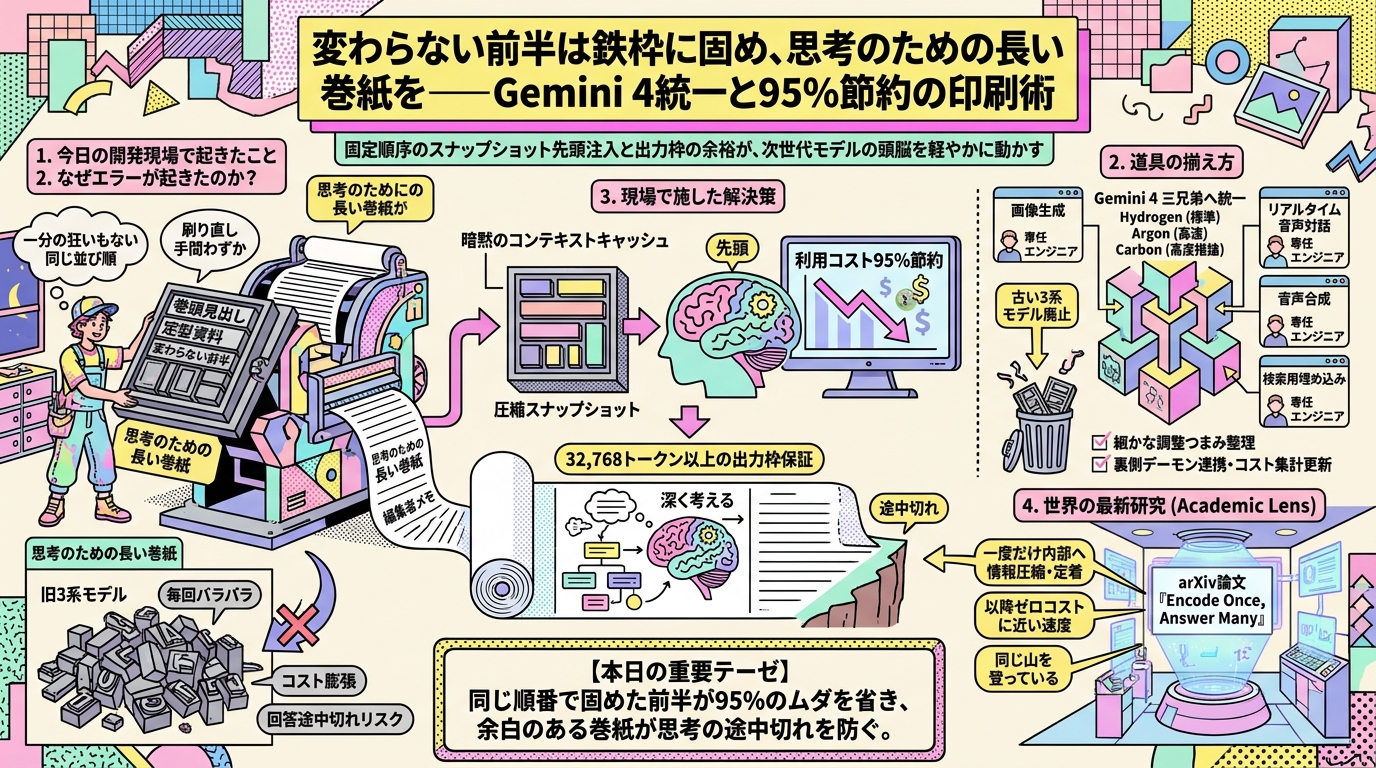
Locking the Constant Lead in Iron, Unrolling Long Scrolls for Thought — Gemini 4 Unification and the Art of 95% Printing Savings
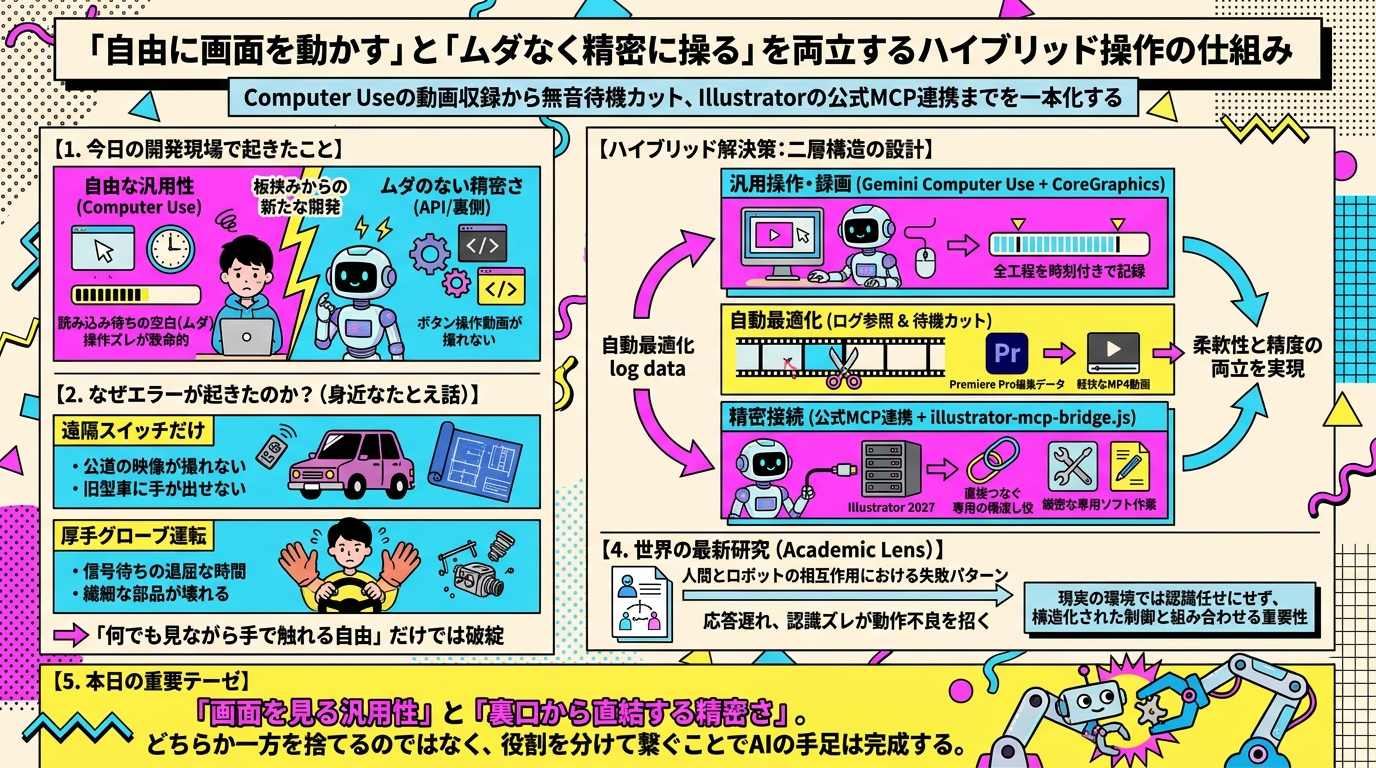
A Hybrid Control Architecture Bridging Free-Form Screen Navigation and Lean, Precision Execution

Behind "Just One More Request": The Internal Wiring That Hands Off Memory and Tools Between AIs