
THE SCHOOL OF KAMOS
Connecting Real-world Dev & Academic Intelligence with Intuitive Metaphors
An X-Ray of the Play Button: The Precision Tuning Behind Unhurried Five-Minute AI Narration
Preventing single-pass 'runaway pacing' through parallel synthesis and millisecond waveform engineering for a seamless listening experience
A single tap on our secretary app's play button prompts the AI to read through briefings lasting over five minutes in a calm, measured voice. On the surface, it looks as though one continuous audio file is playing. Under the hood, however, trying to convert a long passage into speech all at once had a critical flaw: halfway through, the voice would abruptly rush ahead, or playback would stall and stutter on a choked buffer. What kind of precision craft is unfolding behind that effortless listening experience? Let's peel back the skin of the play button and take an X-ray look inside.
Forcing an AI to narrate a long text in a single pass is like trying to cast a ten-car express train in one giant mold. The longer the train, the more the rear cars warp—and in speech synthesis, the tempo uncontrollably accelerates toward the back half. So on the front lines, we switched to slicing the script by paragraph, synthesizing them simultaneously across parallel lines, and attaching delivery-style tags so each car is crafted with precision one by one. Next, an audio processing program—our editing factory—inspects every piece down to the millisecond. It levels each paragraph's volume to a uniform baseline, applies a 15-millisecond fade to smooth out the seams, and inserts 480 milliseconds of silence for a natural breath. Finally, by stripping away trailing digital signature data that interferes with concatenation, the train glides out of the station as a single, seamless composition to the listener's ear.
Even when the audio components are immaculately prepared, conversation will still hitch if the browser leaves the 'next car' waiting down the line. To solve this, the playback screen introduces a mechanism that pulls upcoming audio data onto a background standby track ahead of time. While the first paragraph plays after the user hits the button, subsequent audio files are prefetched in the background into the browser's memory, waiting ready on deck. Rather than entrusting everything to one monolithic process, the architecture breaks the workload into fine-grained parallel tasks and standardizes only the boundaries where they join. A few milliseconds of hidden calibration and proactive wiring behind the scenes are what sustain a stable listening experience that never fatigues the ear, even over long stretches.
"A single, effortless voice is born from parallel fragments precisely tuned across millisecond pauses."Key Takeaway
📖 1-Minute Lexicon
An audio calibration technique that calculates the average perceived loudness of separately recorded or synthesized clips and aligns every paragraph to the same comfortable listening level.
A mechanism that preloads upcoming audio data into the browser's memory as a temporary file so playback can transition instantaneously with zero wait time.
Parallel Paragraph TTS Synthesis and Millisecond Audio Stitching Architecture

Live Frontier Pulse: Real-World AI Trends
Federated Learning Enables Confidential Cross-Site Collaboration, Showing Promise for LLMs
NEC has published insights on federated learning—a technique that allows multiple sites to collaboratively train models without ever moving confidential raw data off-premises—and its applicability to large language models (LLMs). The approach is drawing attention as a way to boost AI performance while safeguarding privacy and corporate secrets.
Anthropic Goes Public in Historic First for a Pure-Play AI Firm, Spotlight on Investment and Tech Trajectory
The BBC reports that major AI developer Anthropic has become the first pure-play AI company to list on the stock market. Amid an intense development race requiring massive infrastructure investments, global attention is focused on its public capital raise and future technological direction.
How Does This Connect to Global Frontier Research?
This engineering challenge resonates deeply with recent language model research uncovering the gap between internal representations and outward output. Using signal detection theory to compare open foundation models with post-trained models, the paper demonstrates that even when a model accurately captures facts and features internally, how it 'reads out' that knowledge into final responses shifts dramatically depending on training conditions—sometimes even reversing completely. In long-form speech synthesis as well, a model's grasp of context and its ability to read that context aloud coherently without breaking down are two distinct challenges. Partitioning input by paragraph to keep output conditions uniform is a practical technique for stabilizing how a model 'reads out' what it knows.
When having an AI read a long report aloud, why do we synthesize paragraphs in parallel, equalize their volume, and stitch them together with brief silences instead of generating everything in a single pass?
Past School Paper Backnumbers

How Stripping Away Invisible Padding and Caching Dramatically Sharpened Our AI Design Canvas

Why an AI Narrator Reads 'Stage Directions' Aloud—and the Art of Scrubbing the Script Clean

Balancing 'This Year's Certainty' with 'Next Year's Foresight': System Design That Reserves the Future Without Mixing Schedules
Current
An X-Ray of the Play Button: The Precision Tuning Behind Unhurried Five-Minute AI Narration

Stop the AI, and the Archive Lives On: Designing for Completion at Zero Maintenance Cost

What Appeared When We Removed the Neon and Technical Gauges: Crafting Effortless Wayfinding Across 11 WebGPU Works

20,000 Characters Distilled into a Single Four-Quadrant Diagram: Where Long-Form Summarization Stands Today with the Latest Image Model, Nano Banana 2.1

Why Can't AI Keep Drawing the Same Object? A Visual Anchor to Prevent Structural Drift in 5-Panel Sketches
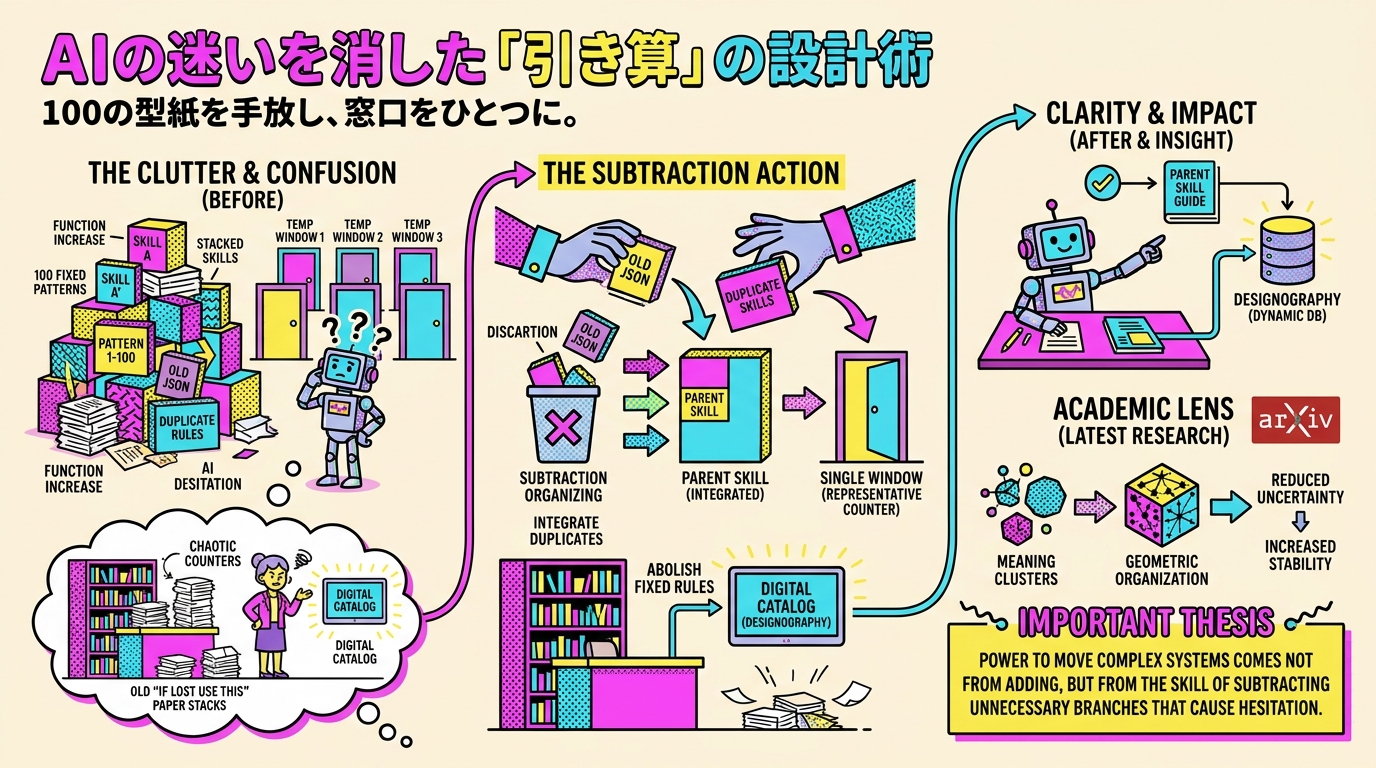
Letting Go of 100 Templates for a Single Desk: The Art of Subtractive Design That Eliminated AI Hesitation

What If You Animated '1,000 Arms' in a Browser? A Lightweight 3D Exhibition Experiment Powered by AI and WebGPU
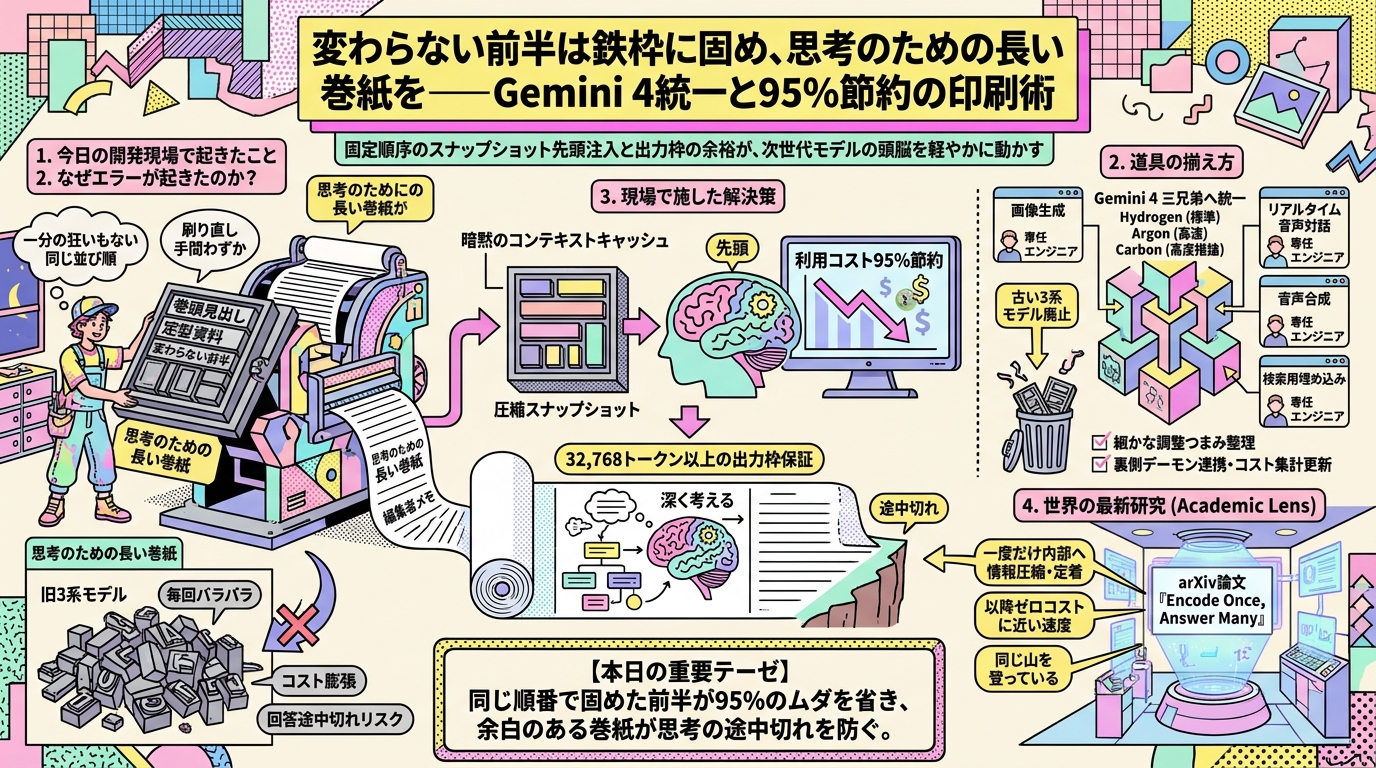
Locking the Constant Lead in Iron, Unrolling Long Scrolls for Thought — Gemini 4 Unification and the Art of 95% Printing Savings
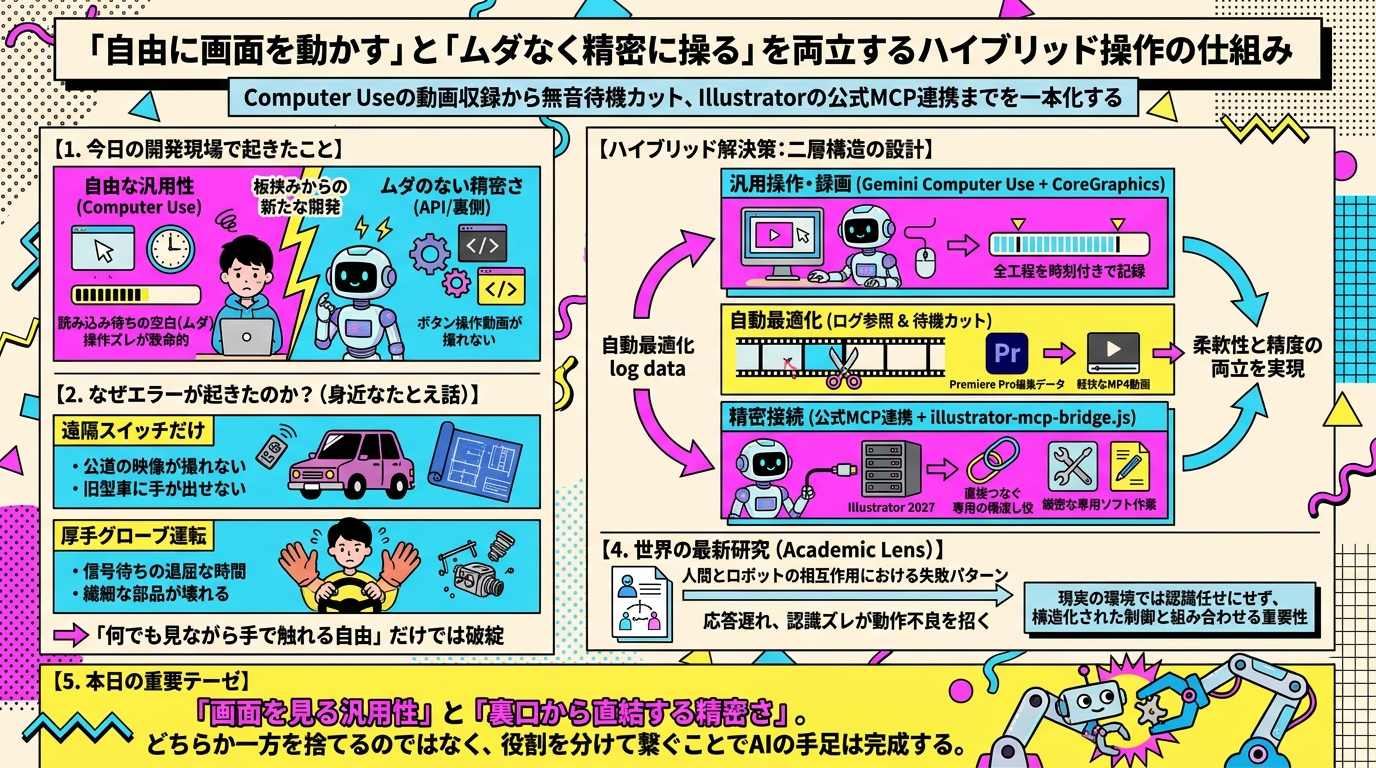
A Hybrid Control Architecture Bridging Free-Form Screen Navigation and Lean, Precision Execution

Behind "Just One More Request": The Internal Wiring That Hands Off Memory and Tools Between AIs