The Physical Floor Strikes Back at the Nanoscale Limit: Mega-Capital Gravitates to Japan's Precision Chemistry and Tacit Calibration
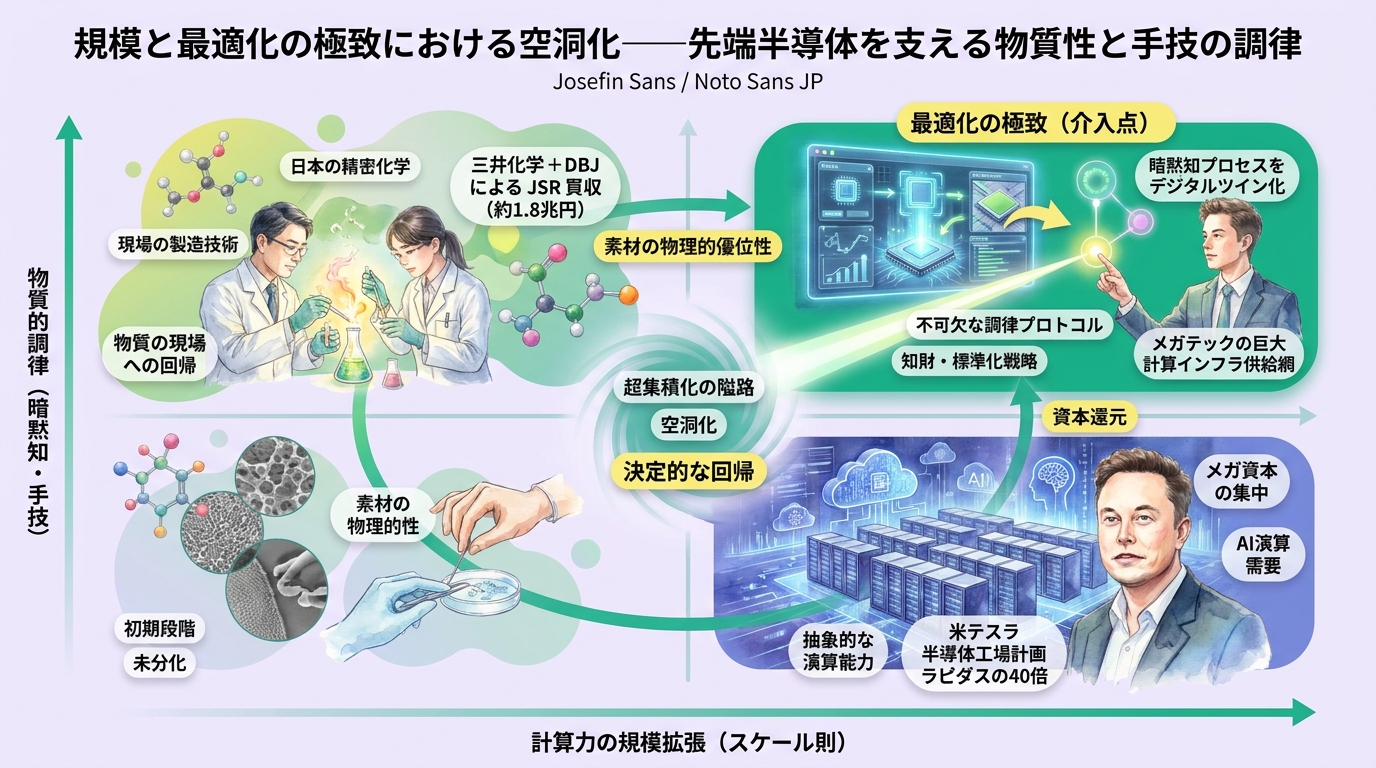
Covert Japan mission by Musk's procurement operatives and Mitsui Chemicals' ¥1.8T buyout of JSR reveal the enduring supremacy of material control over abstract compute
In the sub-2-nanometer frontier of advanced silicon, the immaculate logic models drafted by electronic design automation (EDA) tools and routing algorithms are repeatedly colliding with hard physical boundaries. The strategic imperative driving Musk's megafab planners to quietly court Japanese suppliers is grounded in an unsparing engineering reality: even if billions in capital are deployed to build pristine, fully automated fabrication lines, not a single wafer yields functional dies without foundational consumables such as cutting-edge photoresists and ultra-high-purity process gases. Silicon architectures perfected inside computational simulations immediately confront the 'resistance of matter'—thermal expansion, stochastic molecular variations, and sub-nanometer contamination. The relentless chase for compute density has opened an ironic chasm between design elegance and the gritty realities of chemical synthesis, perversely magnifying global dependence on the specialized factory floors where physical matter is directly tamed.
The true wellspring of Japan's competitive moat in semiconductor materials lies in formulation nuances that resist complete mathematical codification: thermal gradients during agitation, specialized distillation windows, and the subtle margins of error that veteran technicians fine-tune through sensory intuition and accumulated experience. Mitsui Chemicals and the DBJ committed a staggering ¥1.8 trillion to acquire JSR precisely because photosensitive chemistries are not commoditized bulk outputs, but the crystallization of institutional craftsmanship. In extreme ultraviolet (EUV) lithography operating below the wavelength of light, mitigating photon shot noise and the random spatial fluctuations of polymer chains to coat defect-free films cannot be achieved through algorithmic calculation alone. It is the repository of tacit knowledge—the diagnostic instinct to detect fractional shifts in chemical viscosity or optimize distillation curves to the outer limits of purity—that preserves systemic yield rates across the global semiconductor complex.
The critical imperative is neither to retreat into Luddite skepticism nor to defer unconditionally to the synthetic outputs of AI models, but rather to cultivate an artisanal aesthetic that rigorously orchestrates advanced machine intelligence with human somatic perception. Within Japanese fine-chemical plants, researchers deploy materials informatics and predictive modeling to winnow down candidate molecules, yet the final stabilization of complex polymerization reactions and the tuning required for industrial mass production demand the total experiential memory of shop-floor chemists and master technicians. The gap separating the pristine abstractions of digital simulation from the stubborn physical behaviors dictated by viscosity and thermodynamics is bridged by human sensibility—the intuitive ear attuned to a pump's micro-vibrations or the tactile recognition of anomalous thermal exhaust. This intimate symbiosis constitutes an insurmountable barrier to entry that foreign capital cannot clone through brute-force expenditure.
Stepping back from a war of attrition waged purely over transistor counts, clock frequencies, and capital expenditure, the deliberate practice of nurturing technology through continuous dialogue with physical matter assumes profound urgency for our industrial civilization. The reality that global tech behemoths like Tesla must ultimately solicit the cooperation of Japanese chemical and tooling houses demonstrates that no matter how elevated cloud-based intelligence becomes, the terminal grounding pin of civilization remains anchored in material reality. If the pursuit of short-term capital efficiency discards the granular wisdom of the chemical laboratory—the patient craft of balancing precursors and calibrating chambers—even the most exalted artificial intelligence will find itself suspended without bedrock. Underneath the dizzying expansion of mega-capital stands the quiet, unquantifiable tuning power of artisans and chemists who confront matter day after day in tranquil cleanrooms.