Cracks in Compute Supply Chains and Capital: Illicit China Export Probes and AI Stock Corrections Expose Structural Fragility
Malaysia investigates Megaspeed affiliates over alleged chip smuggling as market jitters around Nvidia and Anthropic test economic security
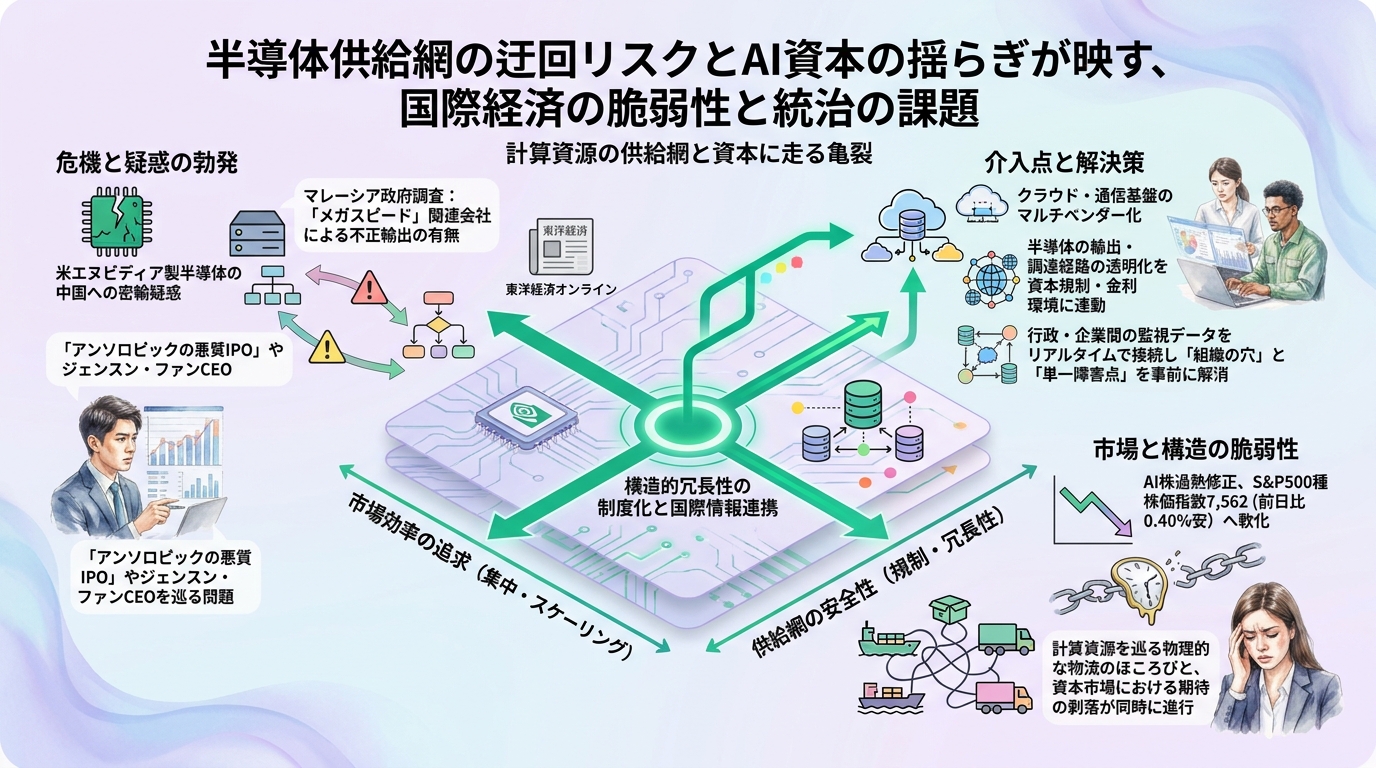
While headline equity indices across global financial markets remain elevated, investor discrimination against risk assets is visibly sharpening. Although the Nikkei 225 rose 0.53% to 61,142 and the yen hovered near 159.79 to the dollar (down 0.03%), the pullback in the S&P 500—alongside a 3.58% drop in bitcoin to $68,789—signals shifting tides in the excess liquidity that has fueled speculative capital. Against this backdrop, allegations of advanced semiconductor diversion through South-East Asian transit hubs have surfaced. According to TBS NEWS DIG, Malaysian authorities are auditing the commercial transactions of Megaspeed affiliates following suspicions that Nvidia processors were smuggled into China. Concerns over decelerating capital expenditure and disruptions to physical procurement networks are now converging around the compute capacity required for AI model training and inference.
The prevailing supply architecture of the AI industry rests on a narrow foundation: the near-monopolistic chip supply of select designers, matched by vast sums of venture capital and public equity raised to acquire them. Criticisms leveled by Toyo Keizai Online—pointing to questionable capital policies at private firms and executive controversies as potential catalysts for an "AI and semiconductor bubble burst"—reflect a growing insistence among investors on scrutinizing returns on invested capital. On the physical side, as Washington tightens export controls on China, policing re-exports and diversions via third-country data centre operators and intermediaries has become a critical chokepoint. Across multi-tiered commercial chains stretching from fabrication to final deployment, maintaining end-to-end visibility over ultimate users and computational workloads remains daunting, turning regulatory arbitrage into systemic credit risk for the entire sector.
National policymaking around semiconductors has decisively pivoted from efficiency-driven free trade toward state-directed controls anchored in national security. South-East Asian nations have recently courted multinational investment as hubs for data centres and back-end chip assembly, yet they now find themselves on the front lines of US-China rivalry, tasked with proving the rigor of their export enforcement. Kuala Lumpur's decision to investigate Megaspeed affiliates underscores an acute fear: should domestic infrastructure be perceived as a conduit for sanctions evasion, access to advanced US silicon and foreign capital could itself be curtailed. Corporate boards are consequently being forced to redesign procurement networks, factoring in regulatory audit risks and reputational fallout alongside traditional cost-optimization.
Overcoming the twin vulnerabilities exposed in compute supply chains and capital circulation will require more than technological velocity; it demands the restoration of transactional transparency and financial discipline. On the physical front, rigorous serial-number tracking, stringent know-your-customer (KYC) protocols extending from chip shipment to data centre rack installation and compute-leasing contracts, and joint audits with transit-state regulators are imperative. In capital markets, normalized scrutiny over private valuations, IPO integrity, and executive governance is needed to redirect funding toward capital expenditure backed by genuine end-demand. Only enterprises and jurisdictions capable of withstanding regulatory tightening and demonstrating verifiable accountability will earn the license to operate the next generation of computational infrastructure.