A 'Quiet Paralysis' at the End of Efficiency: Simultaneous Gridlock in Data and Skies Exposes the Fragility of a Redundancy-Free Society
Following Microsoft's recovery from a massive outage and 16,000 US flight delays and cancellations, a systemic failure without an external foe reveals the contours of the 'margin' we gave away
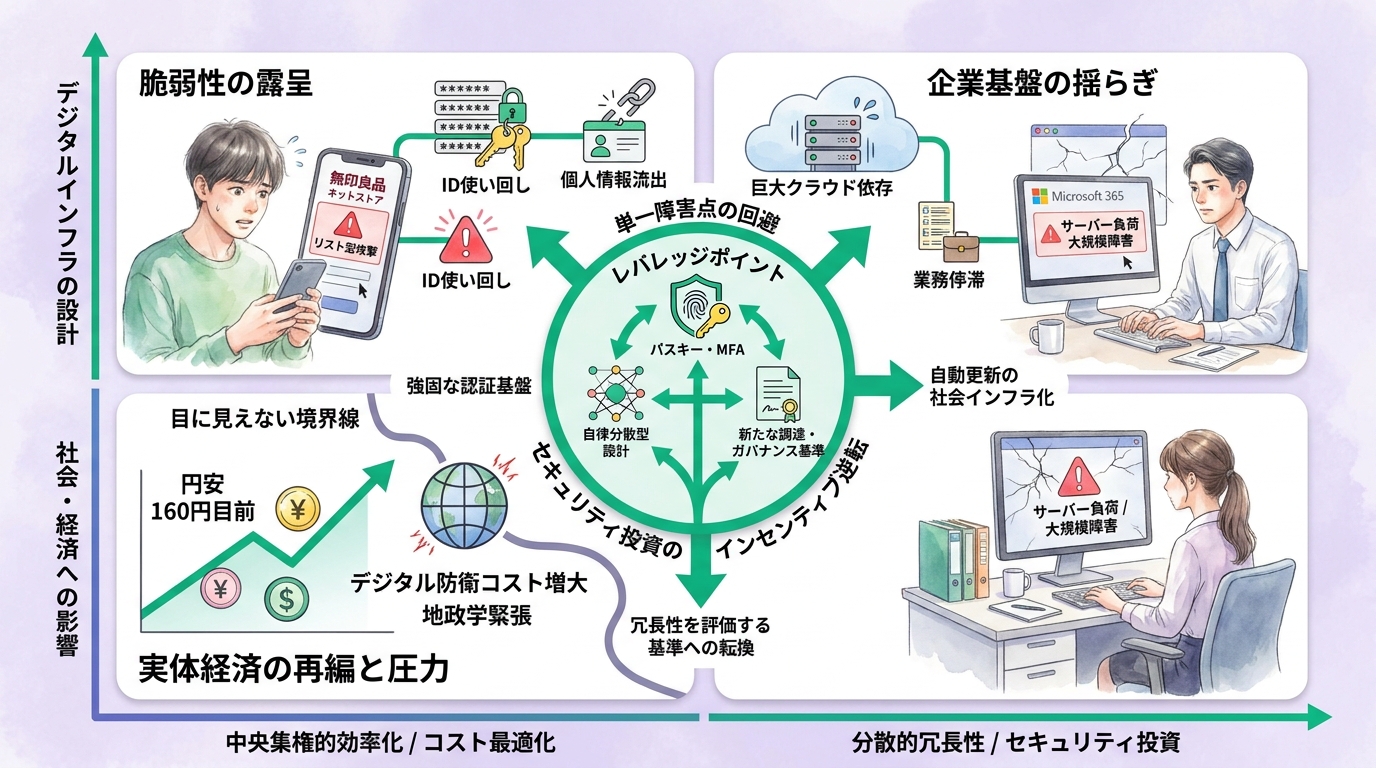
What this twin shutdown leaves behind is not mere irritation at inconvenience, but a subtler, harder-to-place unease. Historically, infrastructure paralysis carried visible causes: severe weather, physical damage, or deliberate attack by a discernible adversary. This time, however, as the DHS Secretary's denial of cyberattack evidence underscores, what closed the skies and silenced communications was an internal rupture lurking inside ordinary, peaceful routine. Once the 'full recovery' bulletin arrives, cities resume motion as though nothing occurred. Yet confronted by the peril of a world consolidated into monolithic clouds and integrated networks—where a single stumble silences an entire continent—are we merely taking comfort in the speed of recovery rather than interrogating the architecture itself?
To decipher this structural fragility, sociologist Charles Perrow's theory of 'Normal Accidents' proves instructive. The more tightly coupled a complex technological system becomes, the less room remains for buffers; minor anomalies cascade unchecked until failure ceases to be an aberration and becomes built-in inevitability. One might also recall Zhuangzi's teaching on the 'usefulness of the useless,' or philosopher Hans Jonas's ethics of responsibility toward the future. Modern rationalism expanded by shearing away 'waste'—duplication, standby capacity, idle backup circuits. Yet an engineering creed that links every process along the shortest path and banishes slack strips a system of its capacity to self-heal. What looks inefficient at first glance—redundancy—emerges in sharp relief as the seawall holding back systemic collapse.
To be sure, integration and optimization have delivered immeasurable gains. Consolidating workflows onto cloud platforms such as Outlook enables instantaneous cross-border collaboration, while sophisticated air-traffic control networks sustain safety and punctuality across congested airspace. Even as we reap the apex of that convenience, however, what we have quietly surrendered is the assurance of decentralization—the certainty that if one circuit snaps, another route stays open, and that individuals retain room to improvise autonomously. When central servers fall silent, we lose the means to reach one another; when control networks freeze, 16,000 flights lose the sky at once. In a thoroughly synchronized world, peacetime velocity is purchased at the cost of emergency resilience. We have gained a frictionless everyday life, only to forfeit the supple durability of 'breaking in part while surviving as a whole.'
In a society engineered on the premise of perpetual uptime, how ought we confront the act of stopping? Before exhaling at news of full restoration and slipping back into routine, we bear a responsibility to step back from blind delegation to technology and reimagine designs and habits built around imperfection. No matter how intricate the mesh we weave, human enterprise cannot eradicate unforeseen error. If so, ought we not embed into our metrics of efficiency the wisdom to tolerate deliberate duplication and preserve the 'slowness' of alternative pathways? Both the stranded traveler's hours on the tarmac and the sudden hush of disconnected offices are the exact price of entrusting everything to the shortest circuit. Can we slacken our pursuit of pure efficiency just enough to reclaim the 'margin' to pause in a crisis and find another way? Technological maturity hinges on how faithfully we bind an imagination for fragility back into ethics.