The 2036 Crossroads Reflected in 'Chappy' Reliance: Outsourcing Thought and the Question of Human Agency
Cognitive hollowing bred by AI dependency, or intellectual augmentation through designing better questions? Decoding the labour market a decade hence through classroom dilemmas.
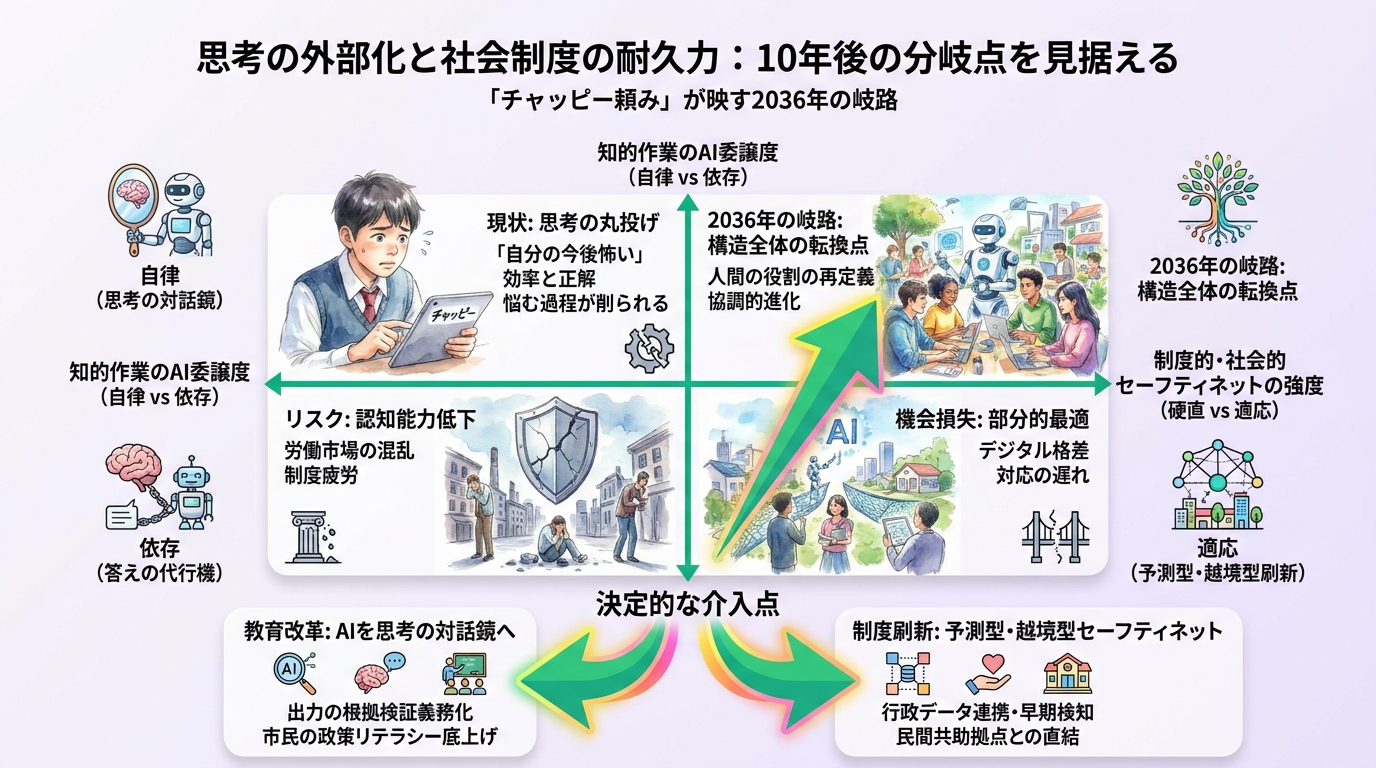
Just as the spread of pocket calculators reduced opportunities for mental arithmetic, technological tools have always rewritten how human faculties are deployed. Yet the permeation of generative AI—capable of summarising texts, structuring arguments, and completing assignments—differs in kind from earlier instruments. When a system begins functioning not as training wheels for thought, but as a substitute for thought itself, the brain loses the very friction and cognitive load required to grow. The struggle of not knowing, and the trial and error that ensues during learning, are indispensable steps that bind fragmented knowledge together and build the foundational stamina to confront unfamiliar problems. Should the habit of delegating this process from youth become entrenched across society, the erosion of autonomous thinking may prove irreversible.
The labour market awaiting us in 2036 will diverge sharply depending on how we engage with AI. One path leads to intellectual augmentation: individuals anchored by solid foundational knowledge wield AI as an advanced research assistant, dramatically elevating personal productivity and creative output. On the opposite path, if outsourcing thought becomes routine in education, a severe hollowing-out of basic reasoning will take hold, swelling the ranks of those who defer uncritically to automated outputs without the discernment to judge their accuracy or validity. Should a technically fluent elite monopolise decision-making while an undertrained majority is relegated to auxiliary tasks, income inequality risks hardening around disparities in cognitive capacity. Conversely, swinging toward blanket bans on devices in the classroom would delay the acquisition of practical skills and invite broader societal stagnation.
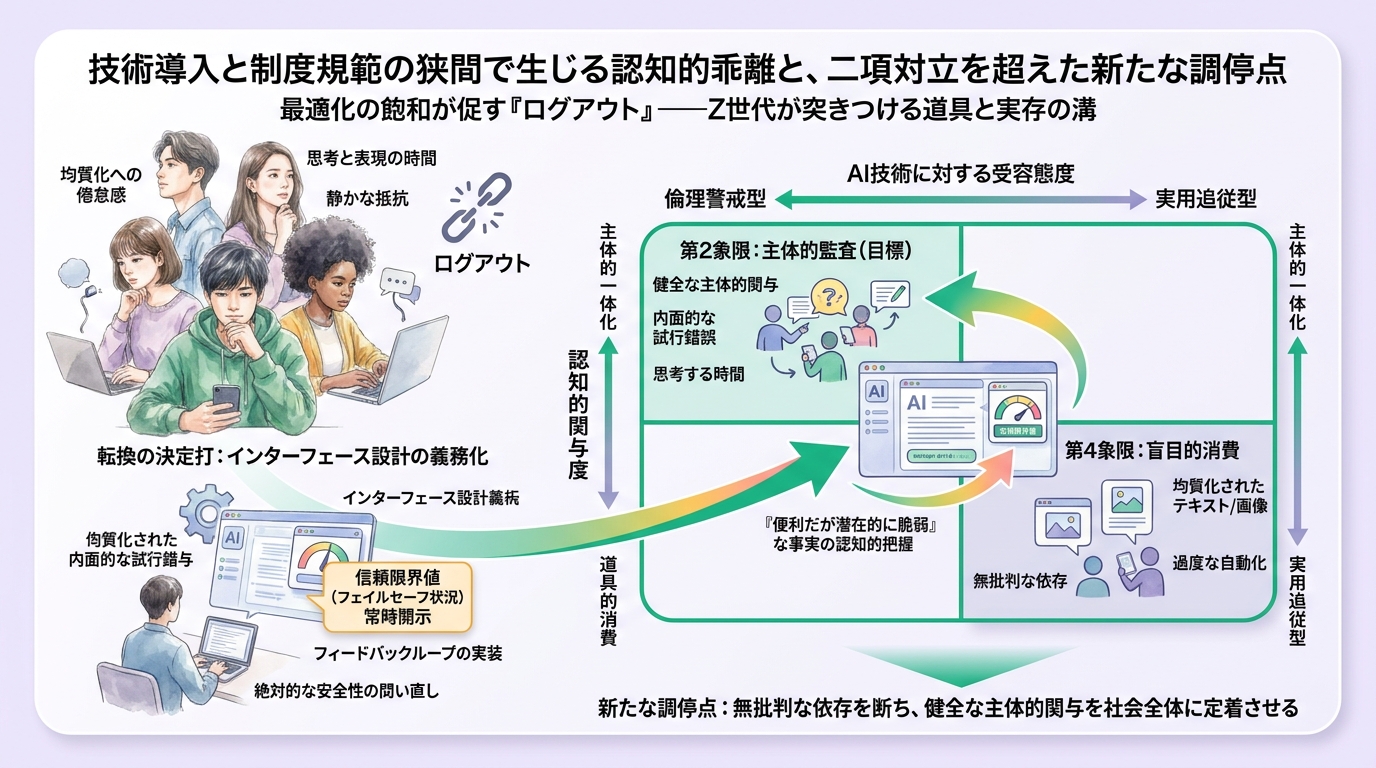
Between unguarded dependency and heavy-handed prohibition lies a third path we must pursue: redefining the human role from "rapidly generating right answers" to "designing questions and auditing outputs". While AI excels at assembling probabilistically plausible responses from vast datasets, only humans can bear responsibility for framing what truly needs solving, exercising ethical judgement grounded in real-world context, and spotting the errors or biases lurking within an answer. Cultivating this capacity as an auditor requires deliberate training in AI-free environments—rigorous classical reading, logical construction, and internalising the bedrock of a discipline. Only when education is redesigned as a dialogue in which learners test their own hypotheses against AI and critically interrogate its replies can technology and human intellect constructively complement one another.
The candid anxiety voiced by students who say they "fear for their future" is also a healthy warning sign that their own mental muscles are beginning to atrophy. The compass that educators and society must choose at this juncture is clear: move away from assignments that reward mere speed or superficial polish, and steer toward frameworks that rigorously evaluate the process of reasoning—why a question was posed, and on what evidence a conclusion rests. Those who truly reap the dividends of technology in 2036 will be neither those who shunned the tool nor those who surrendered to it uncritically, but the generation that safeguarded the foundational strength to stand on its own feet while continually posing sharper questions to AI. Today's quiet struggles at the classroom desk will decide the intellectual independence of society ten years hence.