From the Printing Revolution to the Autonomous Agent Society: Civilization at the Crossroads of Outsourcing Judgment and Consensus
AI adoption moves beyond workflow automation into the 'protocolization of thought'—How will humanity redefine its right to decide?
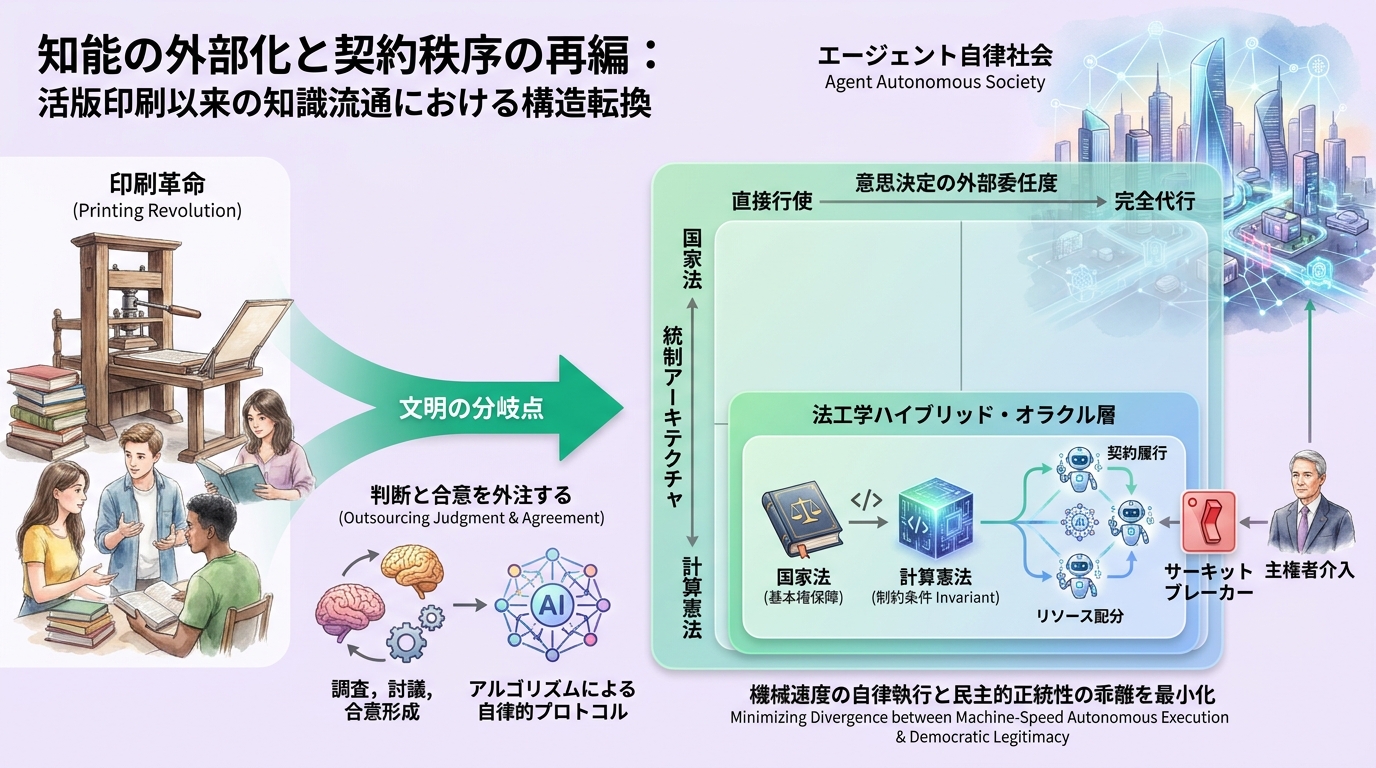
Operating across enterprise core systems and communications networks, autonomous agents execute everything from market data collection and supplier selection to contract clause matching in accordance with predefined objective functions. While legacy automation technology shouldered the burden of repetitive routine tasks, these new agent ecosystems are fundamentally designed on the premise of delegating contextual reasoning and judgment. As the standardization of protocols advances—allowing multiple autonomous programs to negotiate and derive optimal solutions—human intervention is stepping backward from the frontline of decision-making, shifting toward the role of an auditor who merely approves final outcomes. The modern organizational framework of operations, long dependent on on-the-ground discretion and empirical rules of thumb, is quietly beginning to lose its contours.
As a historical precedent for a fundamental rewrite of knowledge transmission, one is reminded of Gutenberg's mid-15th-century practical application of moveable type. Liberated from the manual labor of scribes, printed books dramatically lowered the cost of reproducing knowledge, dismantled the privileged class's monopoly on information, and served as the cradle for the Reformation and modern science. At the same time, fierce criticism erupted back then, arguing that the widespread dissemination of fixed text would erode human memory and dialogic modes of thought. The transformation wrought by modern agent technology goes even further than mere information delivery; by outsourcing the logical development of thought and judgment itself to external machinery, it deepens the profound questions that print technology once forced upon individuals and society.
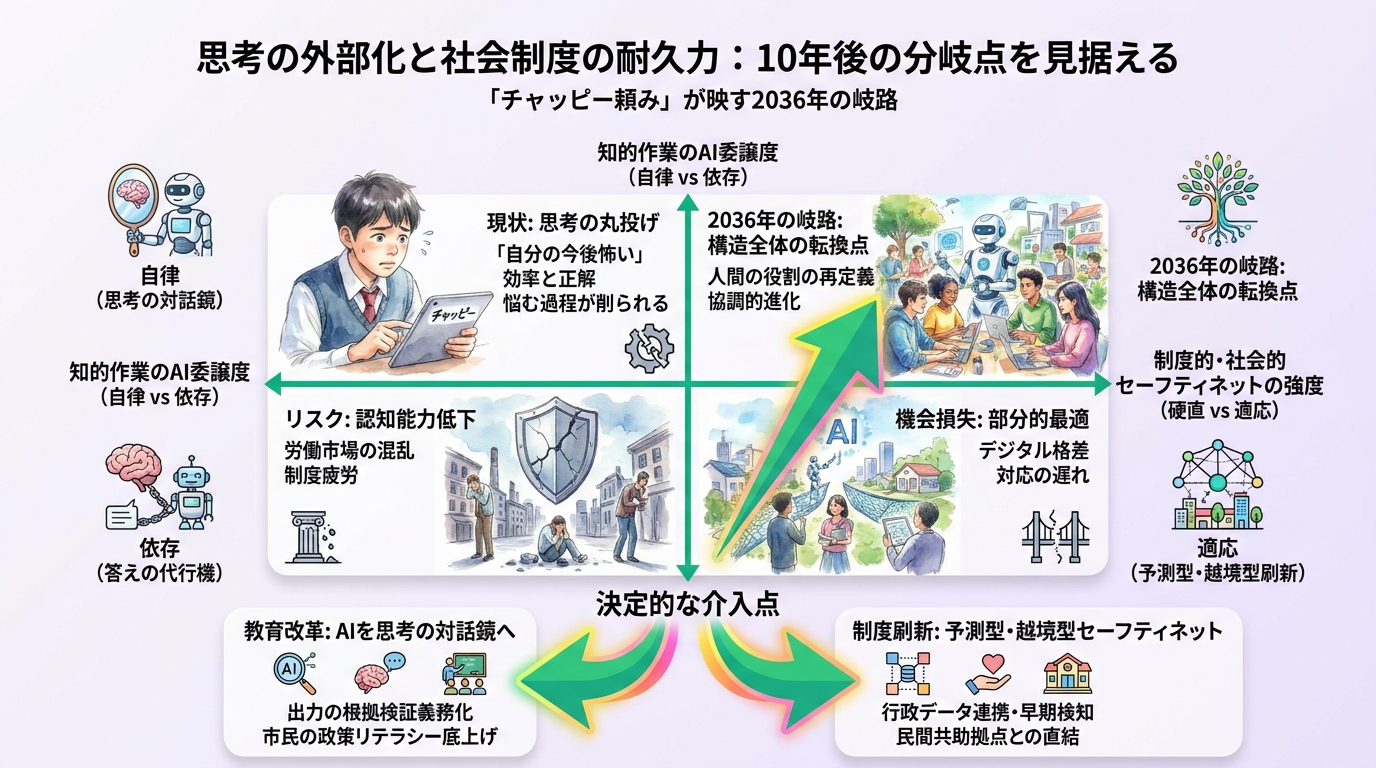
This shift is irreversible because economic rationality and cognitive constraints are inextricably intertwined. The vast, high-speed data flows of the global economy already far exceed the processing capacity of unaided human cognition, making it difficult to render competitive judgments without algorithmic mediation. An organization that has once adapted to the speed of instant market analysis and consensus-building by agents can no longer revert to legacy decision-making models built on time-consuming meetings. When technological convenience becomes entrenched as a substitute for human cognitive capacity, the baseline speed of entire social systems is elevated into the non-human realm, forging an irreversible dependency.
As the outsourcing of thought and consensus-building advances, where should human labor and creativity find their grounding? If machines assume the burden of logical consistency and optimal resource allocation, the domains left to humanity will be narrowed to establishing the objectives—defining what questions ought to be solved—and accepting ethical responsibility for the resulting outcomes. How can we harmonize human emotions and historical contexts, which may at times appear irrational, with the rational conclusions presented by agents? Amid systems striving for the limits of efficiency, whether humans can maintain the heavy weight of autonomous decision-making will serve as the litmus test for future institutional design and societal configuration.