The End of the Binary Debate Over the 'National OS': Moving Beyond Symbolism and Literalism Toward Constitutionalism as a Dynamic Infrastructure
The Realism of Institutional Design as Prompted by the 'Meiji Day' Controversy and Constitutional Amendment Debates
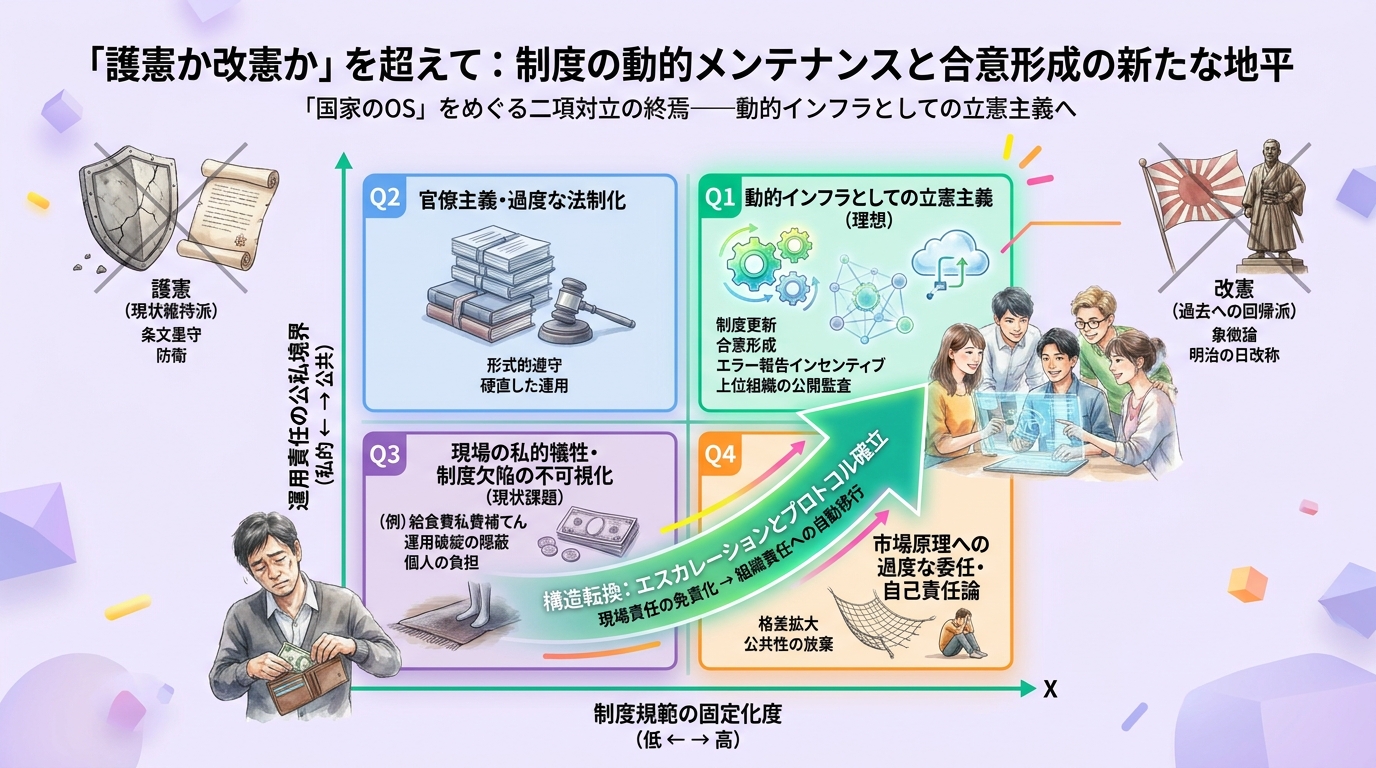
The axis of the current dispute lies in an intense tug-of-war over the historical origins and symbolic value of the state. Behind the push to rebrand November 3rd as 'Meiji Day'—referencing the birth date of Emperor Meiji—lies an assertion to re-inscribe the trajectory of modern Japan and the memories of national integration onto the public calendar. Mainichi Shimbun reports that historians have openly expressed unease and caution, warning that such revisionist moves signal an approach toward pre-war nationalism. Meanwhile, in the constitutional arena, criticism has erupted over the Takaichi administration's rush to strengthen state sovereignty and explicitly enshrine the Self-Defense Forces. As Professor Kobayashi notes in the Tokyo Shimbun, these moves risk undermining the fundamental essence of constitutionalism: that constitutions exist to bind state power and protect individual rights. Both camps are deepening their confrontation behind competing ideological banners.
Yet, this binary opposition suffers from a profound oversight. Proponents of restoring tradition and national prestige downplay the foundational premise that the legal systems of a modern state are fundamentally functional tools designed to prevent the abuse of power, risking the imposition of emotional rhetoric over institutional design. Positioning the mere inscription of past memories into holiday titles or constitutional articles as an end in itself risks diluting the law's role as a safeguard against administrative overreach. On the other hand, cautious opponents and constitutional preservationists tend to treat current phrasing and frameworks as inviolable absolutes, avoiding the necessary updates required to address rapidly shifting technological environments, geopolitical realities, and the ballooning of executive power. As both sides transform institutions into battlegrounds for ideological spoils, rigorous practical verification of how to guarantee the quality of governance is left by the wayside.
Transcending this sterile war of attrition requires reframing constitutionalism and public institutions not as monuments to fixed ideals, but as 'dynamic governance infrastructure' subject to continuous adjustment in response to societal shifts. The true essence of constitutionalism is neither to force a specific historical narrative upon citizens nor to slavishly guard decades-old clauses without changing a single character. Rather, it is an open framework designed to maintain transparency in the exercise of power, protect the rights of minorities, and guarantee procedural legitimacy even amidst unexpected crises. Rather than fixating on superficial symbolic maneuvers such as holiday renaming or article amendments, discourse must pivot toward redesigning governance norms to genuinely protect citizens from contemporary threats, such as safeguarding privacy in a digital surveillance society and reinforcing checks on executive power.
Positioning institutional updates as the preservation of dynamic infrastructure fundamentally alters the quality of dialogue in future legislation and policymaking. For policymakers, it provides an opportunity to dispense with mere displays of worldview and fulfill a rational burden of proof regarding which governance architecture can most sustainably secure citizens' freedom and safety. For civil society and the legal community, it demands an active stance—moving beyond the defensive walls of the status quo to proactively propose the redesign of norms for urgent challenges, including freedom of expression in digital spaces and the streamlining of administrative procedures. Ending the nostalgic scramble for symbols and transitioning to robust rule-making that effectively supports daily civic life is the pragmatic path of institutional renewal for a mature democratic nation.