The Ethics of Hacking Metabolism
How Reports of Rapid Weight Loss on Mounjaro Highlight the Pitfalls of Strict Regulation Versus Body Optimization
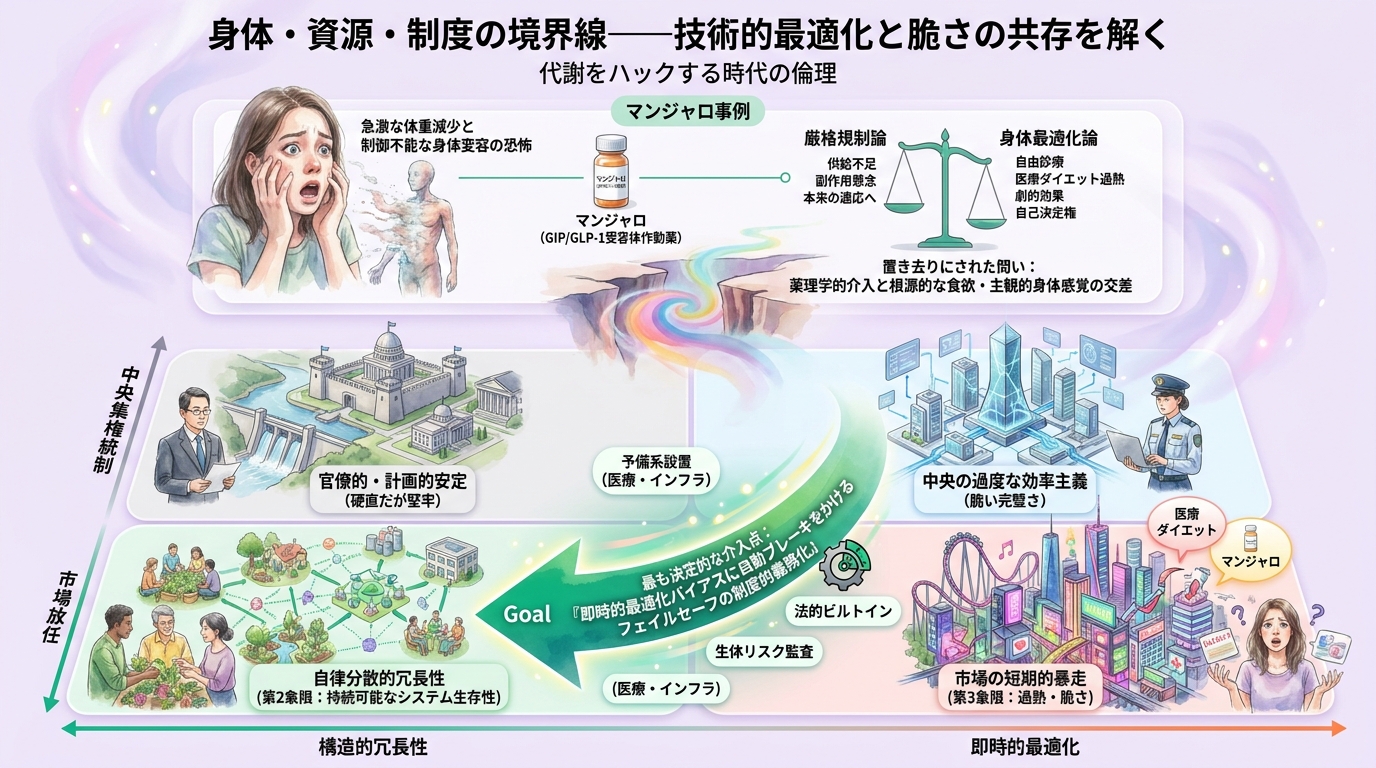
At one pole of the debate stands the regulatory faction, which prioritizes public health order and appropriate drug usage. Therapeutics such as Mounjaro (generic name: tirzepatide) are advanced medical drugs designed for type 2 diabetes patients who require glycemic control; critics argue that casual prescriptions for aesthetic purposes distort the fair distribution of medical resources. Amid the expansion of telehealth, the Japan Diabetes Society and other bodies have urged strict self-restraint regarding off-label use, citing instances where private-pay prescriptions are issued with little regard for in-person consultations. Conversely, proponents of beauty and health optimization cite the prevention of lifestyle diseases caused by obesity and individual self-determination regarding appearance. They contend that in an era where technology can enhance bodily function, excessive restrictions on free adult choice and access represent a step backward.
However, a blind spot shared equally by both camps exists. The regulatory faction tends to condemn individuals seeking weight loss as 'morally deficient consumers,' failing to grasp the structural factors at play: the deep-seated societal norms behind weight-loss desires and the psychological distress caused by body complexes. Simply tightening regulations risks expanding underground markets, such as gray-market channels and overseas personal imports. Meanwhile, the blind spot of the optimization faction is even more severe. They view the body as a 'biochemical machine that yields corresponding outputs when given specific inputs.' Yet pharmacological agents that act directly on the central nervous system to suppress emotional appetite do not merely trim numbers on a scale; they fundamentally alter the desires and vitality required to sustain life, inflicting unexpected feelings of self-alienation upon the user.
What is urgently needed is a new framework that liberates biological intervention from the reductive binary of 'total prohibition versus market deregulation,' restoring the integration of subjective bodily sensation with metabolic signals. Appetite is not merely an error in metabolic engineering; it is a signal of life maintenance, an experience inextricably linked to an individual's life history and cultural practices. The terror confronted by the woman whose appetite center was forcibly blocked by pharmacology is nothing less than a defense reaction of the organism—an existential crisis arising from the divergence between numerical success and subjective life. The axis for evaluating pharmacological intervention must shift from mere numerical weight fluctuations to qualitative indicators, such as whether an individual can maintain a sustainable and harmonious relationship with their own body.
This integrative perspective provides concrete guidelines for future institutional design and individual health practices. Rather than a blanket ban on prescriptions, administrative bodies and medical institutions should establish comprehensive protocols that mandate thorough explanations of side effects and psychological assessments, even in private-pay practices, while supporting lifestyle restructuring. There is no need to reject the power of pharmacology, but it must be repositioned not as a shortcut that strips away an individual's foundation of living, but as a temporary scaffolding to recover autonomous metabolic function. Listening closely to the subtle whispers of the body and maintaining a dialogue with complex in-vivo systems, rather than hacking one's biology as a mere object of optimization, constitutes the intelligence required to survive an era where bioengineering permeates daily life.