The Codification of Somatic Knowledge: How 'Physical AI' is Transforming the Factory Floor
Toyota’s entry into robotics underscores the disembodiment of skill and the horizon of computability
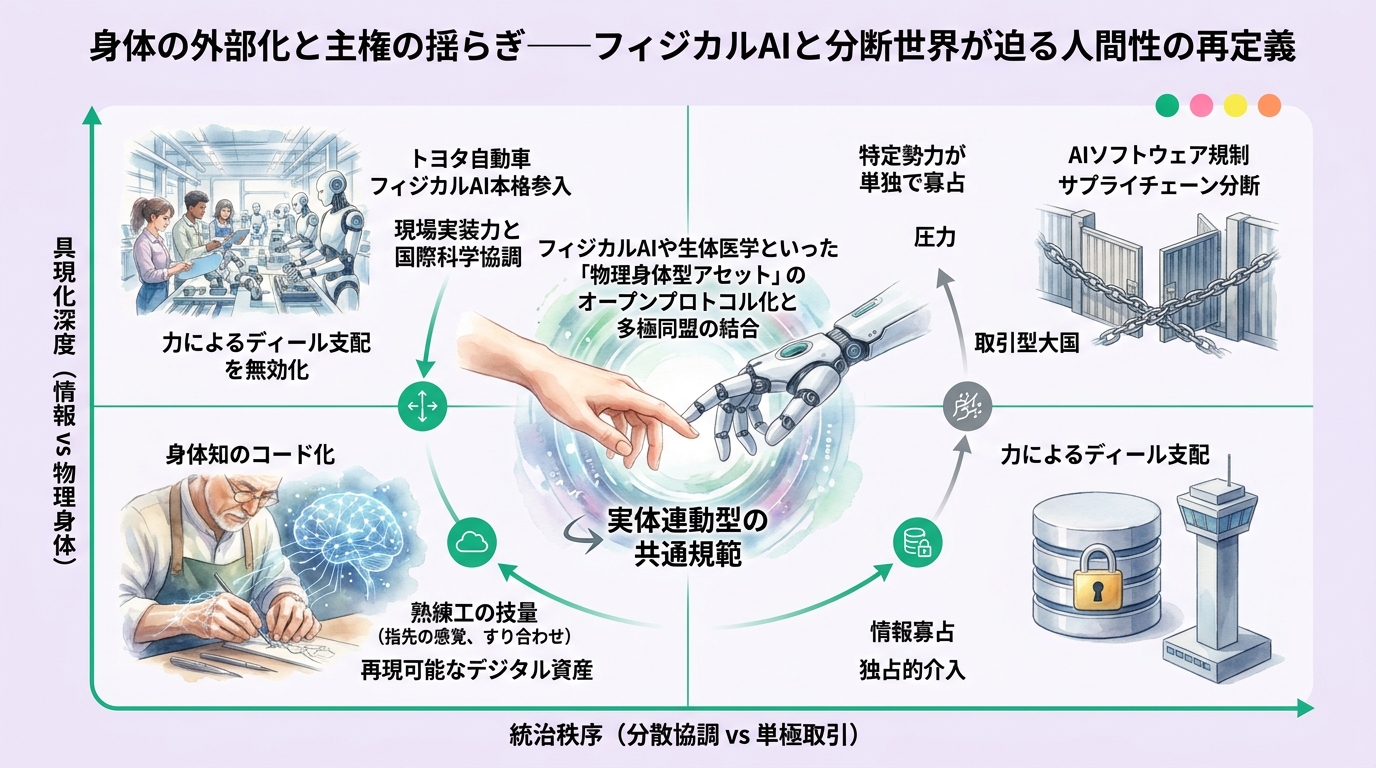
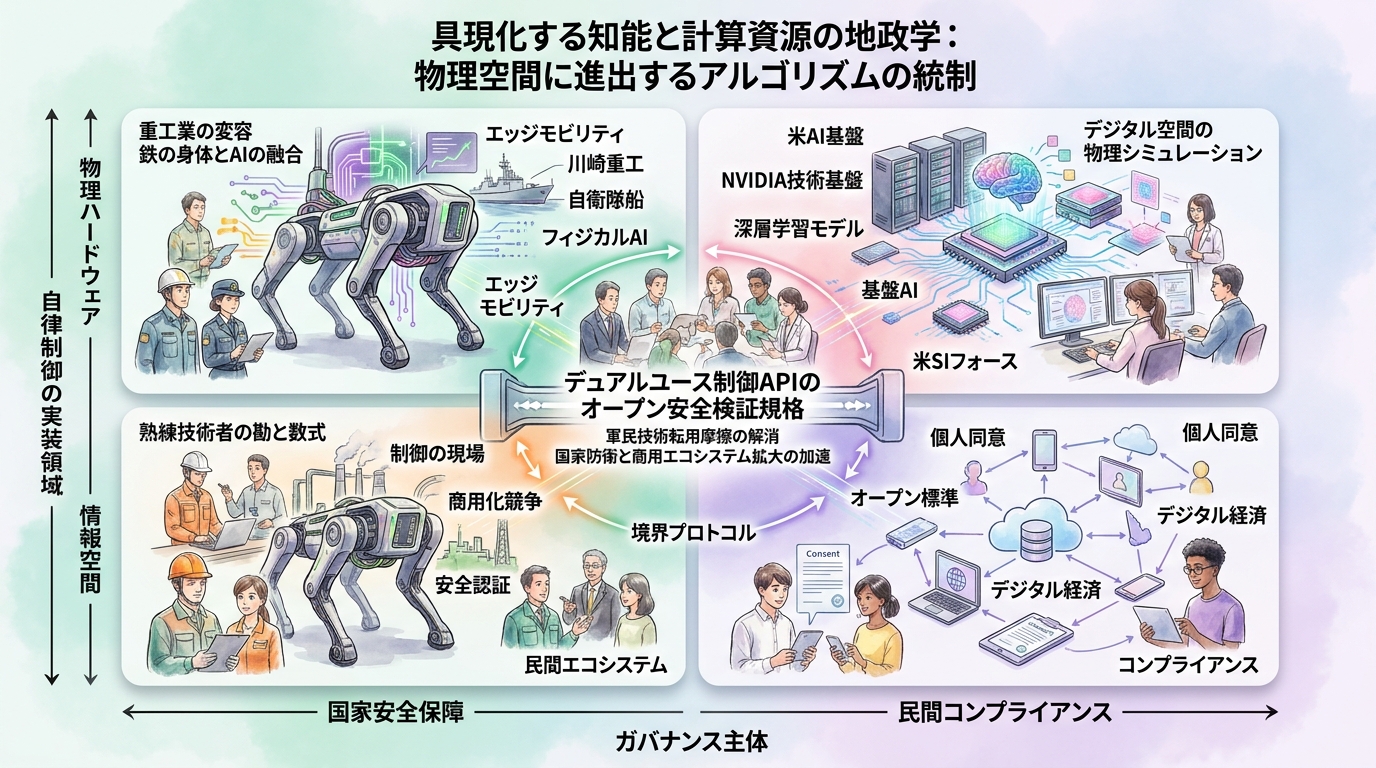
Until now, industrial automation meant the repetitive motion of industrial arms precisely tracing predetermined trajectories. What Physical AI brings, however, is the adaptive capacity to respond flexibly to unknown environments and minute individual variations in workpieces. Toyota's initiative, reported by the Yomiuri Shimbun, is an attempt to model its core strengths—'Kaizen' and the intuition of veteran craftspeople—through cameras and tactile sensors, breathing them into autonomously moving entities. The engagement of components and the exertion of force that floor operators unconsciously executed are converted into algorithms through thousands of hours of data learning. That scene carries a strange sense of incongruity, as the artisan breathing familiar for years quietly dissolves into an inorganic, smooth optimization process.
Philosopher Michael Polanyi stated that 'we can know more than we can tell,' emphasizing the importance of inarticulable somatic knowledge. Furthermore, as Merleau-Ponty pointed out, the human body forms its own cognitive space by directly interacting with the world and becoming one with tools. Once, the wrists of workers tightening bolts on automobile assembly lines harbored a specialized sense capable of detecting metal creaks or minute shifts in torque. The extraction of skill by Physical AI is nothing less than an enterprise reducing such body-rooted tacit knowledge into probabilistic predictive models and arrays of multi-dimensional tensors. The 'craft' that supposedly could only be acquired through the accumulation of experience and reflection is stripped of the constraints of the physical body, being objectified as a pure target of computation.
The efficiency and resilience brought by this transition are beyond doubt. For an industrial society facing the aging of skilled workers and population decline, the algorithmization of skill is a rational conclusion for business continuity. Once a model is completed, it knows no fatigue, is instantaneously replicated across factories worldwide, and guarantees uniform quality. Yet, in exchange for acquiring computability, what are we stripping away from the floor? The improvisational nature possessed by artisan bodies and the creative flashes that accidentally emerge in the process of failure are difficult to accommodate within the reinforcement learning framework whose objective function is efficiency. In the process of pursuing rationality to the extreme, the concern that the fulfillment once given to work itself by labor and the circuit of self-transformation through the body are irreversibly emaciated cannot be dispelled.
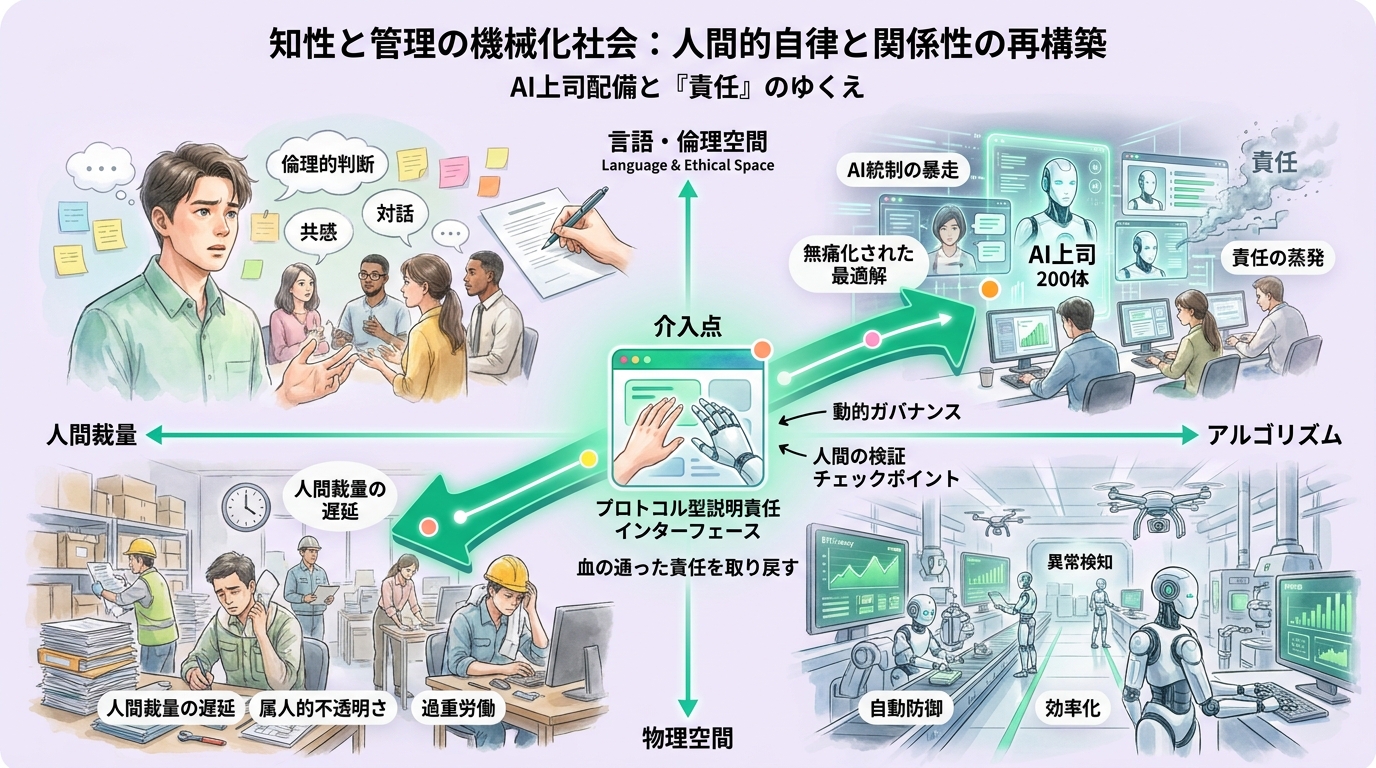
In an era where machines perform tasks as flexibly as humans, what is the role of humans remaining on the floor? Are they merely subordinate beings who monitor AI judgments and handle exceptional events, or are they designers who question value criteria outside the algorithm? In a future where skills are distilled into code and traded as modules, finding where the dignity of labor lies is a challenge posed to society as a whole. At the end of the history where humans evolved by using tools, now that tools have appeared as autonomous subjects, we must fundamentally redefine anew the meaning of humans continuing to engage with the world through physicality, transcending the single metric of the pursuit of efficiency.