"The QR Code Is Right There": How Automated Ordering Alters Human Relations
The Alienation of the Izakaya: A Critique of How Efficiency-Driven UIs Strip Away Hospitality and Physicality
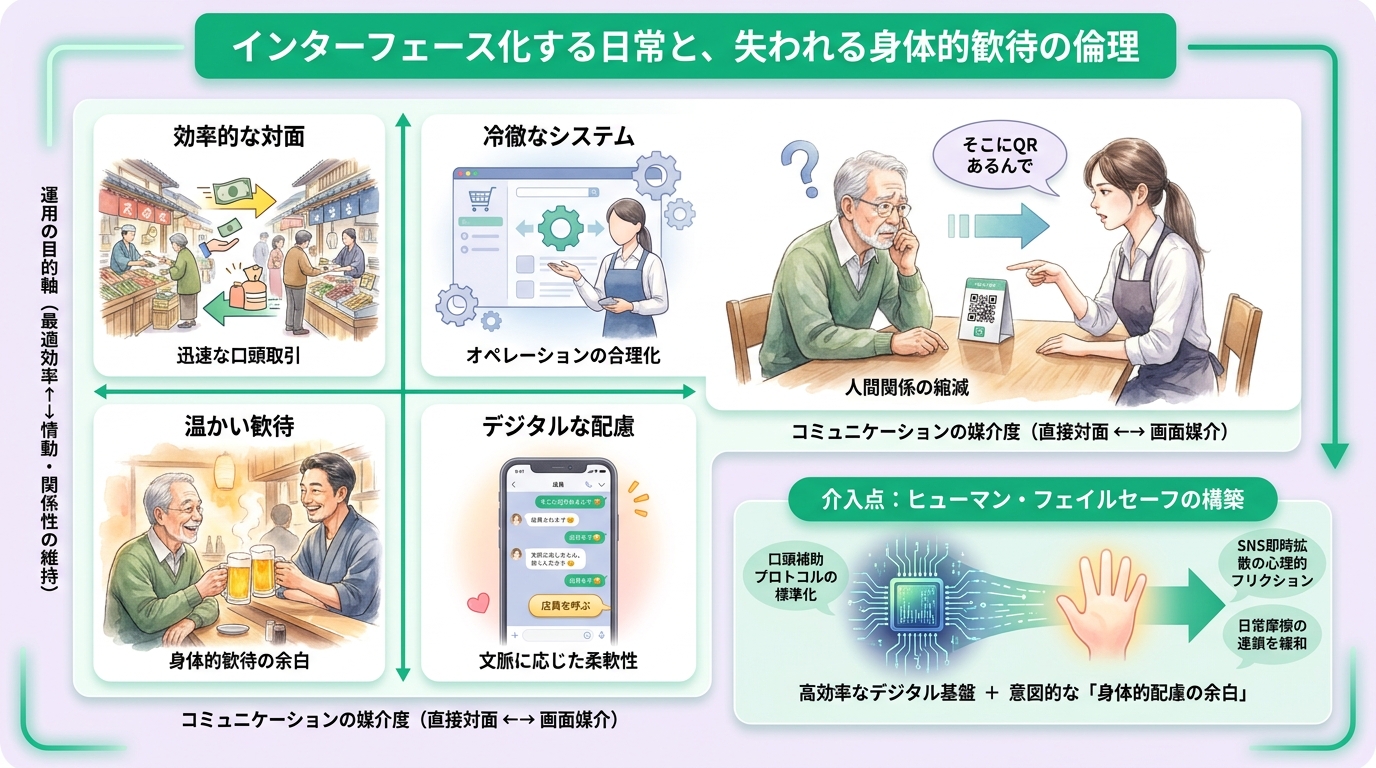
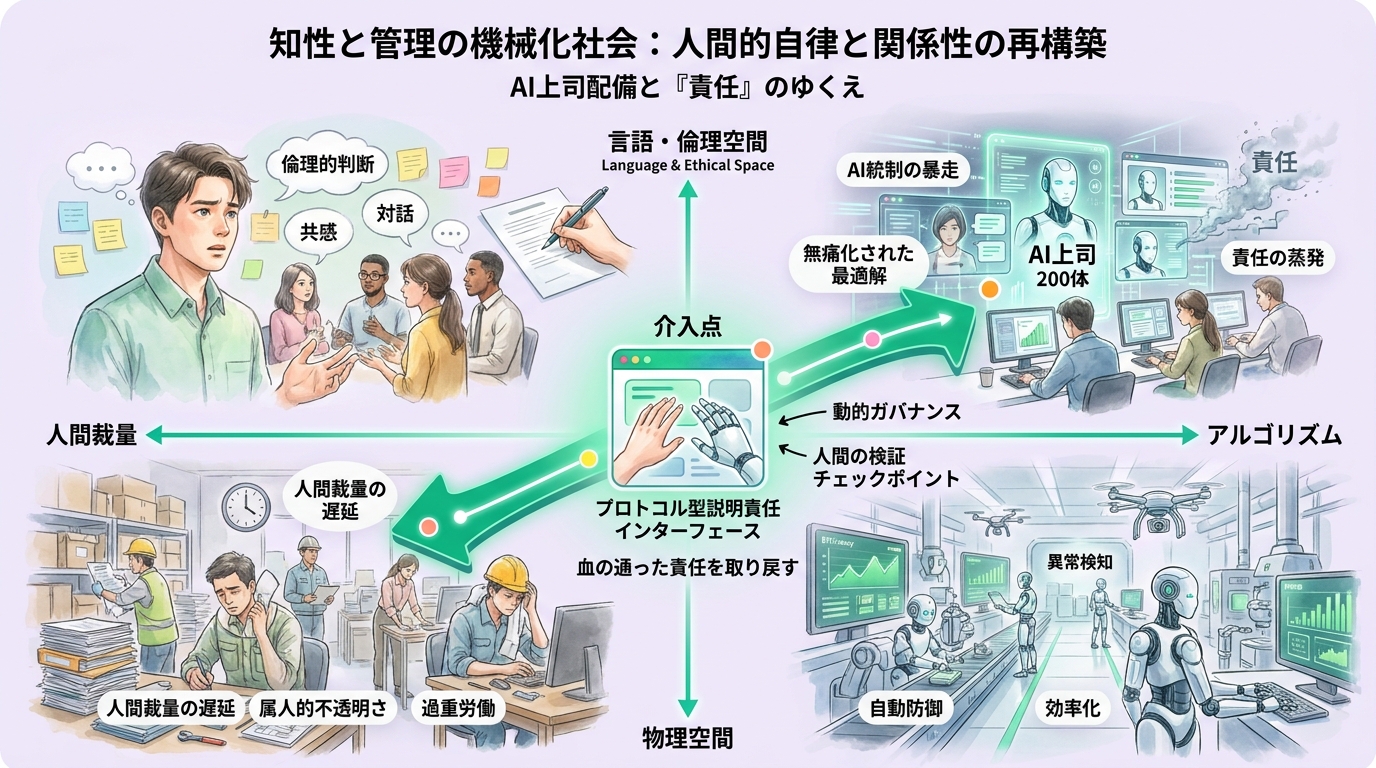
The traditional izakaya has long functioned as a sanctuary—an asylum where daily tensions ease and strangers share a common, unpretentious space. The call of "just a beer for now" was more than a commercial signal; it was a ritual greeting that allowed staff and patrons to tune into the atmosphere of the room. Today, however, the customer's gaze is directed not at the server's face, but at a small liquid-crystal screen in their hand. The ritual of flipping through a menu and asking the server for the daily special has vanished, replaced by the mechanical task of scanning a printed dot-matrix square on the table. If a customer fumbles with the interface, they are treated as an "error" disrupting the smooth execution of the system. This reversal—where an interface introduced in the name of convenience turns humans into intermediaries for the machinery—is quietly taking root in the corners of everyday life.
This scene evokes the fading of the ethics of the "face of the other," as articulated by the French philosopher Emmanuel Levinas. For Levinas, ethics begins with an encounter with the vulnerable expression of the other, an unyielding responsibility that transcends our own calculations and frameworks. Yet the QR code sitting between customer and employee acts as a filter, blocking the raw physicality of the other person. To the staff, the customer becomes a bundle of table numbers and order data; to the customer, the server is reduced to a delivery mechanism for finished plates. Even pausing to notice a patron's confusion or plea is discarded as an "unnecessary cost" within optimized operational protocols. A design philosophy that eliminates spontaneous human contact in pursuit of predictability and speed is fundamentally transforming underlying interpersonal relations.
Given the severe labor shortages and productivity stagnation confronting the food service industry, a wholesale rejection of digital transformation is unrealistic. The utility of technology in preventing order errors, automating billing, and reducing the heavy burdens on workers is undeniable. Yet we must not overlook the magnitude of what we are trading away. True hospitality inherently resides in improvisational departures from uniform manuals—specifically, in flexible considerations tailored to a person's age and circumstances. Forcing customers into standardized operations to serve the logic of the UI does not democratize service; rather, it creates a new structure of exclusion based on digital literacy. The result of pursuing a frictionless, smooth experience is a sterile, aseptic consumption space where no one gets hurt, but no one's heart is moved either.
The evolution of technology should aim to augment human vulnerability and enrich daily life. Yet, does current system design not compel humans to subordinate themselves to machine logic? Who truly benefits from a rationalization that cannot accommodate a modest vocal plea for "just a beer"? The redundancies of a clumsy bow or idle small talk across an izakaya counter served as vital buffers for humanities worn thin by urban life. If we continue to delegate all physical engagement to systems out of an absolute obsession with efficiency, we risk forgetting the very etiquette of coexisting with others. As we stare down at our hands illuminated by the glow of a screen, our will to reclaim human hospitality is being put to the test.