A Distributed Architecture of Care to End Classroom Isolation: The Limits of Mainstream Classrooms and the Redesign of Inclusive Education
Transcending Tragedies Born from the Fallacy of School Self-Containment: Toward a Multilayered Coalition of Welfare, Community, and Digital Infrastructure
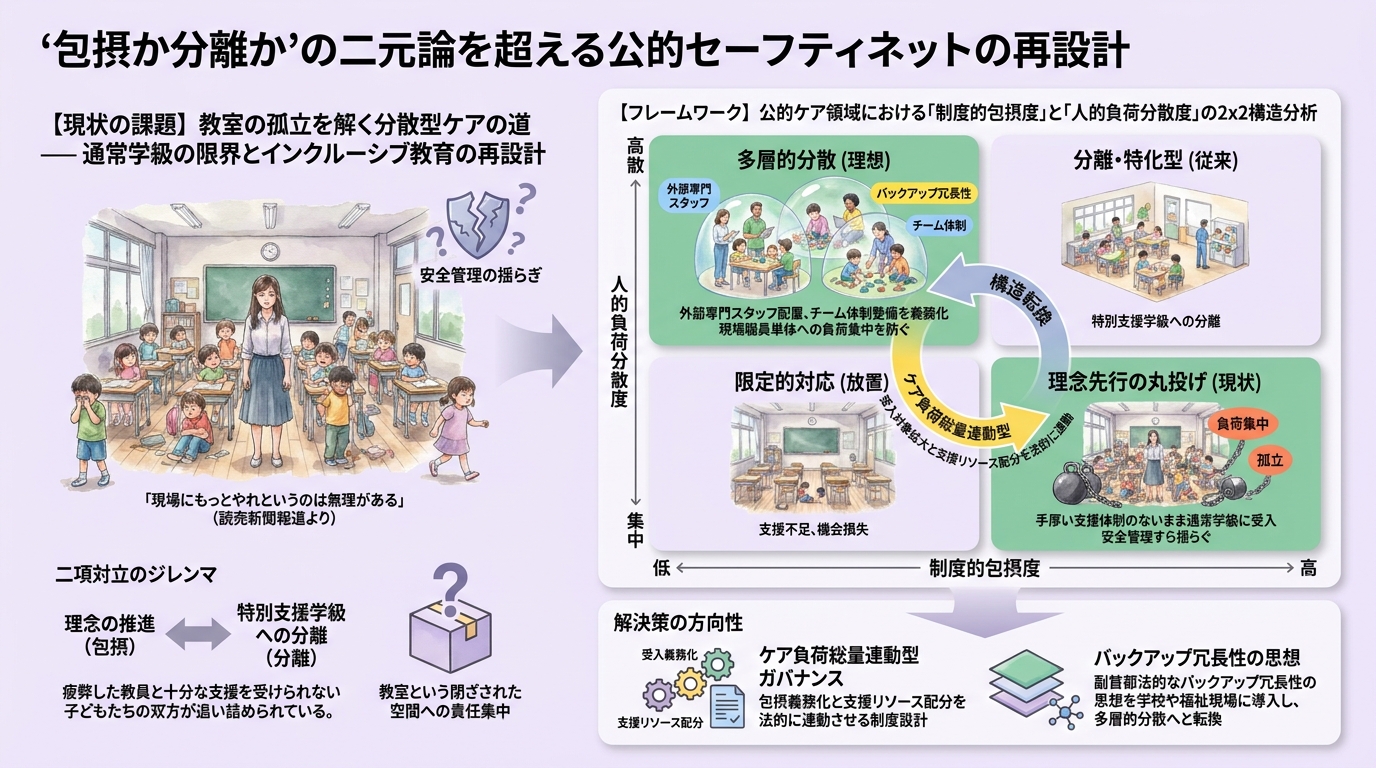
The ongoing debate over inclusive education remains trapped in an intractable standoff between ideologues demanding total mainstream integration and pragmatists calling for segregated placements to protect baseline safety and academic rigor. Proponents invoke the spirit of the UN Convention on the Rights of Persons with Disabilities, arguing that co-education from an early age is foundational to an open, tolerant society. Conversely, rank-and-file teachers and parents assert that expecting a single homeroom instructor managing over thirty pupils to safely handle violent outbursts or sensory meltdowns is a physical impossibility. The fatal incident reported by The Yomiuri Shimbun lays bare the reality that mainstreaming without specialized resources invites catastrophic lapses in oversight. Mutual accusations of dogmatism and institutional indifference only obfuscate the structural contradictions left unaddressed for decades.
Crucially, both poles share a foundational blind spot: neither questions the self-contained paradigm of schooling—the implicit doctrine that all instructional, behavioral, and custodial responsibilities must be concentrated within school grounds and borne by the personal dedication of individual teachers. Integration advocates demand more effort and marginal additions of auxiliary staff, while cautious factions merely debate placement thresholds within the existing school apparatus. Modern developmental profiles span a nuanced spectrum requiring clinical expertise—from sensory integration therapy to psychiatric counseling. Entrusting these demands to generalist teachers armed with brief seminars and expecting them to maintain safe supervision from morning to late afternoon is a recipe for institutional collapse.
Breaking this deadlock requires dismantling the self-contained school model in favor of a "distributed support society" where community-wide networks reweave safety nets. The archaic premise of locking children in a single room all day under one teacher's surveillance must be discarded. Specialists from after-school day-care facilities and developmental support centers should rotate and maintain a daily presence in standard classrooms. Low-stimulus "cooling spaces" must be coordinated across adjacent public facilities, while non-intrusive ambient tracking—such as spatial sensors and discreet locating devices—should be deployed as civic infrastructure. Relieving teachers from the relentless strain of unblinking physical oversight through institutional and spatial integration beyond school grounds is no longer optional.
The true mandate of public education is not to confine every child to a standardized desk, but to serve as a civic hub connecting families to a wider web of care infrastructure. Educators must be liberated from the role of omnipotent caretakers and restored as facilitators of learning. Municipalities must dissolve the bureaucratic silos separating boards of education from social welfare departments, deploying multidisciplinary teams of occupational therapists and clinical psychologists directly to schools. Tragic failures cannot be reduced to personal lapses in vigilance by individual staff. Only when society dismantles the heavy walls of the classroom and extends multilayered hands of care will inclusive education transform from a lethal formalism into a resilient, sustainable reality.