THE SCHOOL OF KAMOS
Connecting Real-world Dev & Academic Intelligence with Intuitive Metaphors
Electronic Sound Resonating with Zero Audio Files: How Procedural Acoustics Transform Web Browsers into Instruments
Discarding heavy media loading wait times and instantly generating waveforms directly via a few lines of code
In traditional web development, the conventional approach to adding rich sound effects to a page has been to 'load pre-recorded audio files such as MP3s or WAVs from the server.' However, this method constantly hit major roadblocks: depending on the smartphone's network environment, audio downloads couldn't keep pace, causing frustrating time lags between pressing a button and hearing the sound, or bloated data transfer sizes across multiple audio files that delayed screen rendering for the user. The very experience of producing sound was shackled by network speeds.
Upending this conventional wisdom is the approach of 'procedural synthesis,' which constructs sound from scratch inside the browser without relying on external recorded data. This represents a paradigm shift from the legacy method—pulling a thick, pre-recorded vinyl record from a shelf and dropping the needle—to turning the knobs of a palm-sized electronic synthesizer to generate electrical signals on the spot. In our latest project, we successfully leveraged the Web Audio API to instantly synthesize diverse sound effects such as 'suction,' 'swallowing,' and 'fanfares' using purely mathematical code formulas, with zero download overhead. Because it does not wait for external files whatsoever, it delivers envisioned visual effects instantaneously without compromising page load speeds.
A peek under the hood reveals a dramatic evolution in data flow. Traditional methods required traversing a lengthy communication pipeline: 'detecting user interaction, issuing an audio request to the server, waiting for file download, decoding, and playback.' In contrast, this new technique directly connects oscillator and gain nodes built natively into the browser via code. By smoothly modulating frequencies in millisecond increments and controlling sound attack and decay through mathematical formulas, pure acoustic signals are brought to life entirely within memory, completely free of external communication. Furthermore, by firing this waveform generation at the exact same moment as the on-screen CSS transform animation, we achieved an experience where the page's suction visual and sound effects synchronize delightfully without a single millisecond of discrepancy.
"Rather than waiting for heavy pre-recorded files, let mathematical code formulas directly vibrate the air in real time."Key Takeaway
📖 1-Minute Lexicon
A technique that synthesizes waveforms in real-time via programmatic formulas to generate sound without using pre-recorded files.
A standard browser feature for advanced, low-latency audio generation, processing, and frequency control.
'Procedural Acoustics': Discarding Heavy Assets to Weave Sound with Code

Live Frontier Pulse: Real-World AI Trends
'RICOH On-Premises LLM Starter Kit' Edge Model Equipped with Self-Improving AI Agent 'Hermes Agent'
Ricoh announced the integration of the self-improving AI agent 'Hermes Agent' into its LLM package, which operates securely in on-premises environments. This provides a mechanism for continuously and autonomously driving business improvements using local edge resources without relying on external networks.
How Does This Connect to Global Frontier Research?
This research demonstrates that even lightweight, compact reasoning models can execute precise function calling with low latency and high accuracy by enhancing instruction fidelity, without relying on massive models. The philosophy of extracting maximum results through precise control of minimal local resources—rather than invoking heavy external resources—deeply resonates with our frontend design philosophy: generating rich expression solely through lightweight internal API calculations on the client side, completely independent of external audio files.
What is the primary advantage of procedural acoustics via the Web Audio API compared to traditional audio file playback?
Past School Paper Backnumbers

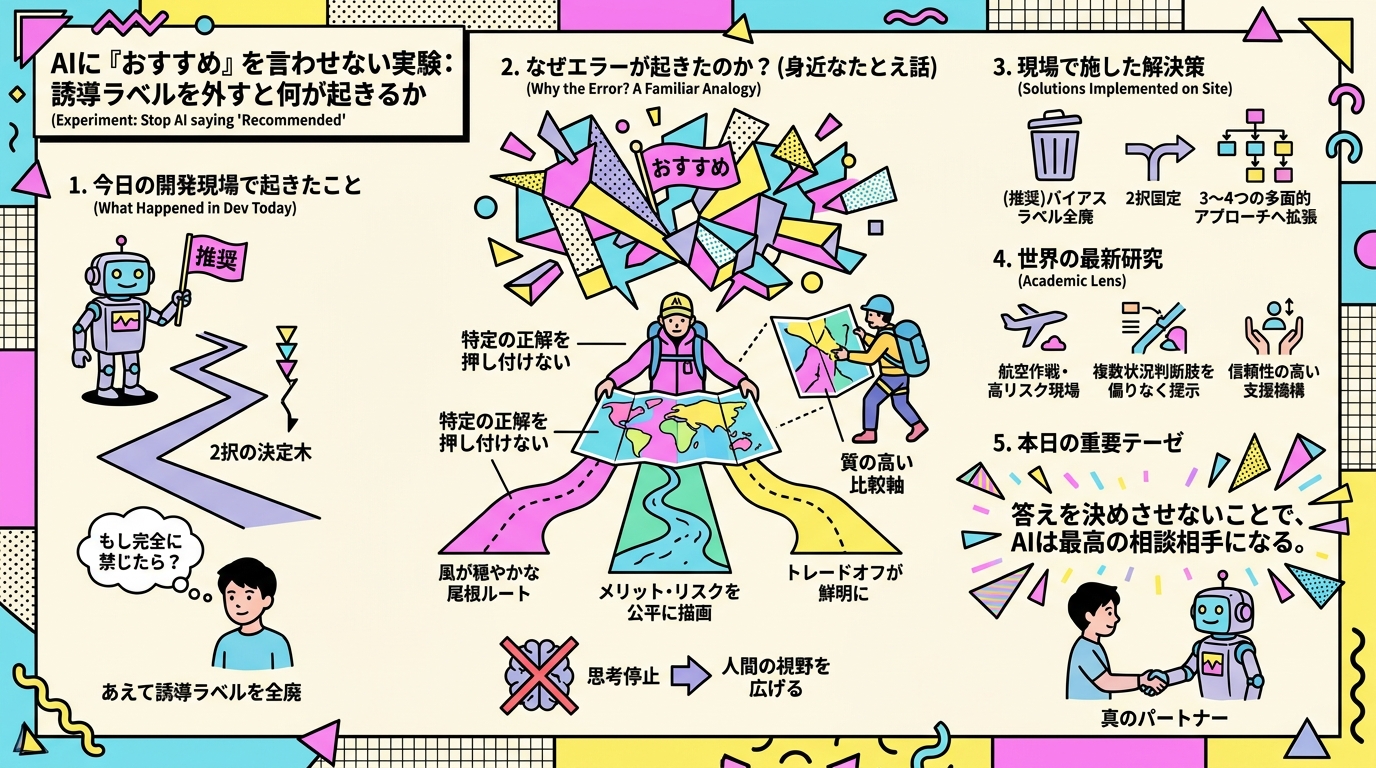
How AI Grew Smarter Once We Stripped 'World-Class Analysis': The Prompt Title Detox

The Luxury of Not Asking AI Every Time: The Wisdom of a 'Directed Reading Graph' Connecting 159 Pages

Clearing the AI's Vision by Erasing the Grading Rule: The High Leverage of Subtracting a Single Line

Don't Be Deceived by a 'Connection Successful' Response: Lessons in Live Content Verification from Delegating Quality Checks to AI

The Art of Surveying the Field, Narrowing Down, and Discerning the Branches
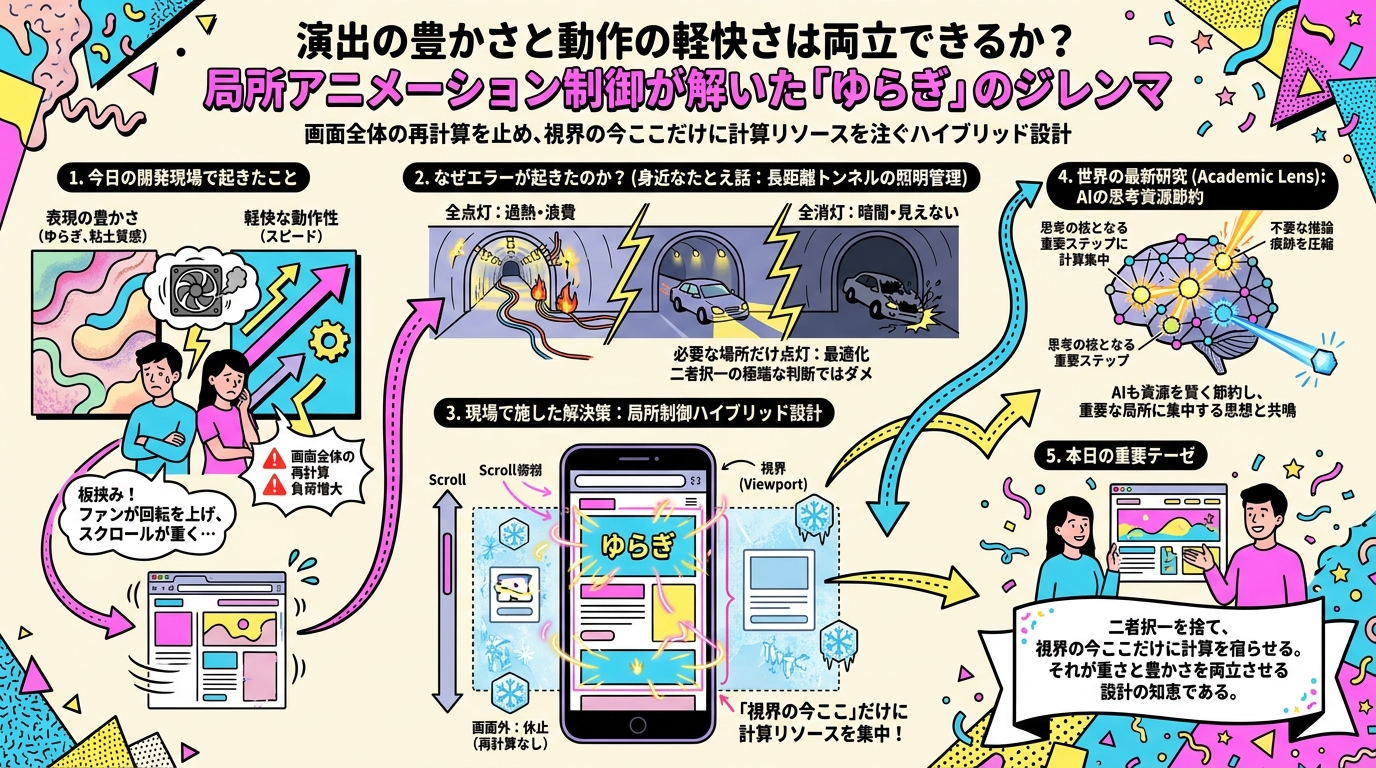
Can Expressive Richness Coexist with Nimble Performance? How Scoped Animation Control Solved the "Fluctuation" Dilemma

The Gears of Timezones and Translation Stirring Behind the Screen: An X-Ray of the Bilingual Automated Delivery Pipeline

The Paradox of Order: Why Not Asking for Titles Actually Cleans the Clutter

From Static Knowledge to the Pulse of the Last 30 Days: How Rolling Intelligence Keeps AI Memory in the Present Tense
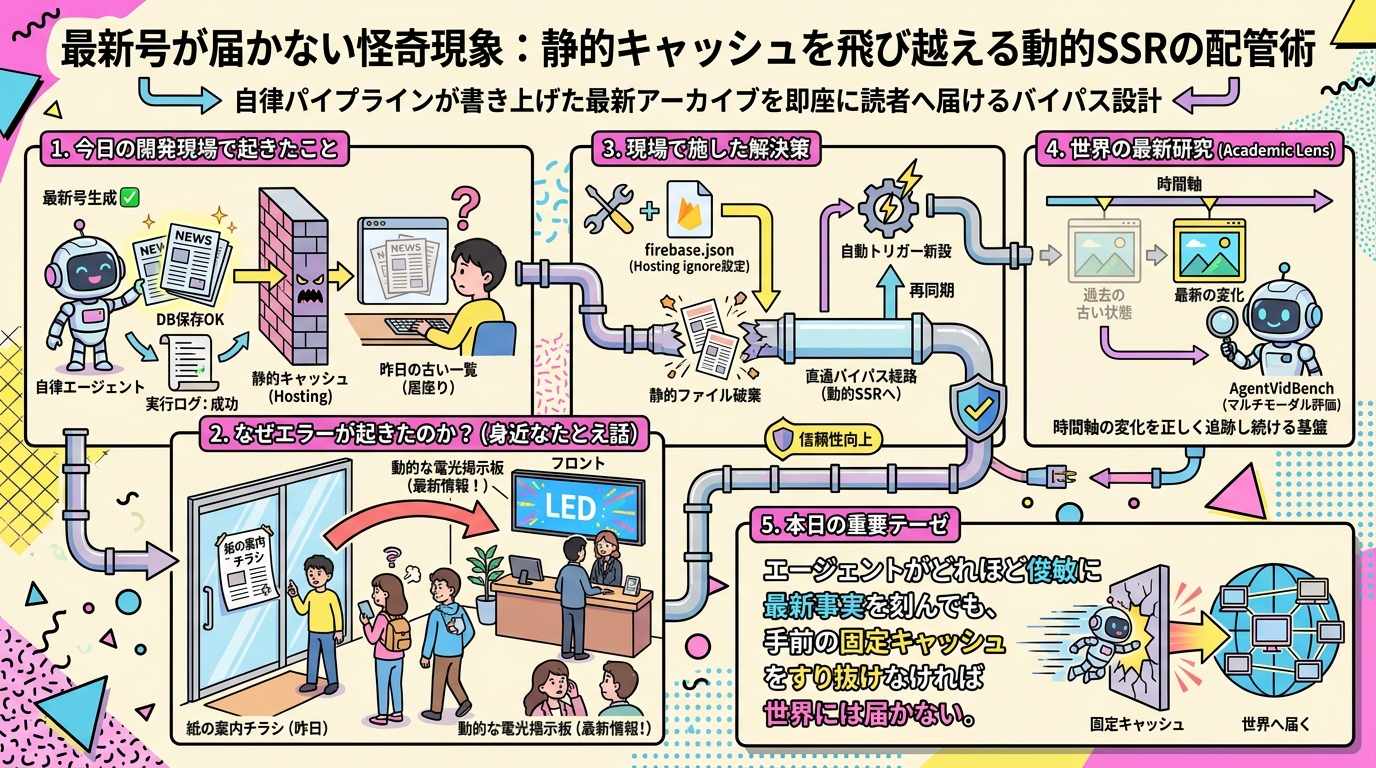
The Mystery of the Missing Issue: Plumbing Dynamic SSR to Bypass Static Cache
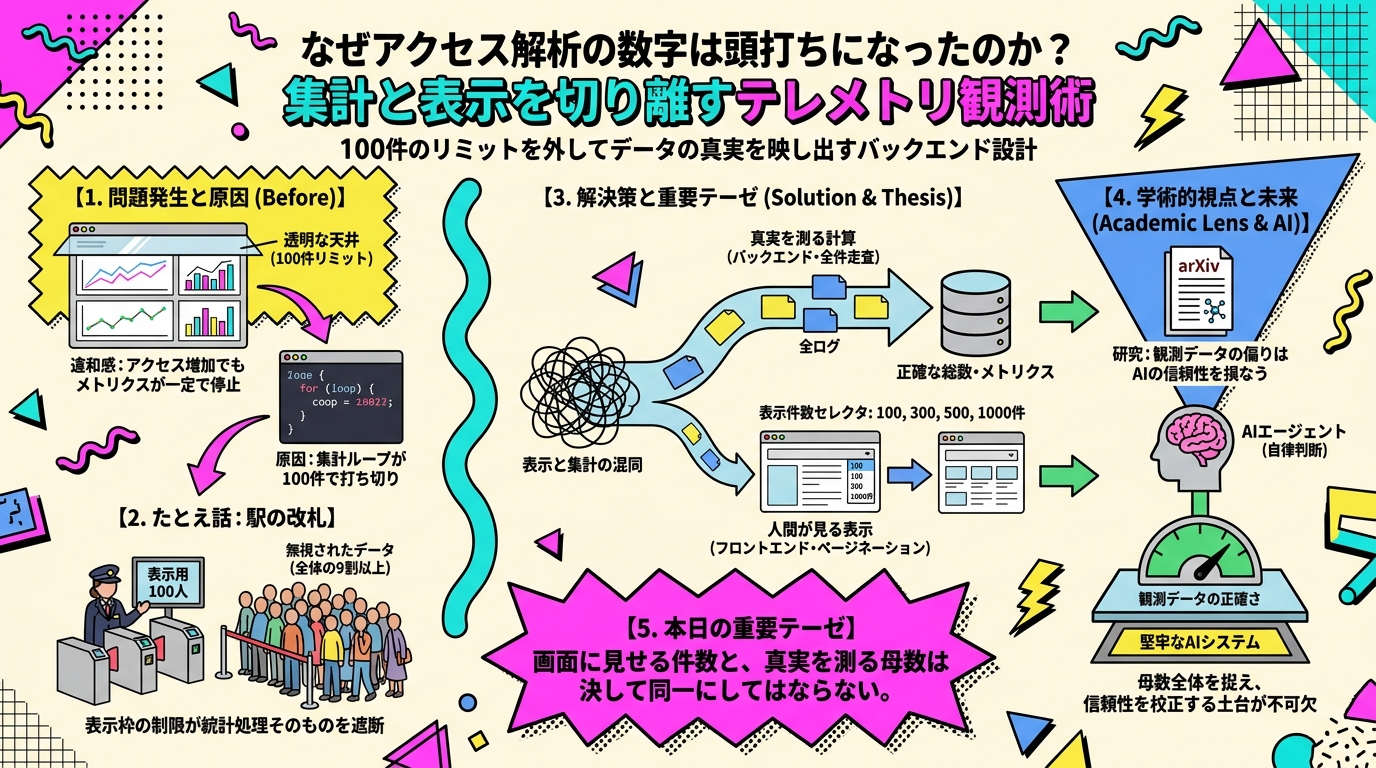
Why Did Access Analytics Hit an Artificial Ceiling? Telemetry Observability by Decoupling Aggregation from Display

Why Asking AI to Summarize 'Morning News' Always Misses the Mark

A Single-Line Type Guard That Prevented a Crash: The Leverage Ratio of 'Array Checks' in Protecting the AI's Toolbox