
THE SCHOOL OF KAMOS
Connecting Real-world Dev & Academic Intelligence with Intuitive Metaphors
The More You Decorate Your Words, the More Lost the AI Becomes: The Paradox of Stripping Emotion for Rugged Plaintext
The Shortest Route Connecting Humans and Models: What We Discovered by Purging Poetry from a 61-App Catalog
When trying to communicate an app's appeal, people instinctively reach for emotional prose like "a magical canvas that unleashes your creativity." On our engineering frontlines, we too had adorned our catalog of 61 features with impassioned marketing copy. But this created an unexpected pitfall: for humans, concrete use cases were shrouded in fog, and for AI agents automatically selecting tools from natural language prompts, abstract adjectives led to frequent misfires and incorrect function calls.
Why did dressing up our words with the best of intentions backfire so badly? Consider an organized carpenter's toolbox. If a drawer label were poetically engraved with "The Supreme Striking Instrument Embodying the Artisan's Soul," anyone on a fast-paced worksite would freeze in confusion. All that is needed is the sterile fact: "Hammer: For driving nails, 20mm head." Decorated phrasing may seem appealing at first glance, but for anyone searching for a tool, it turns into a dense fog of noise that amplifies the friction of decision-making.
Faced with this friction, our team chose the polar opposite approach: ruthlessly stripping away every trace of emotion. We completely purged abstract expressions across all 61 apps and 87 tools, rewriting their descriptions strictly around a three-part schema: what is input, what is processed internally, and what is output. AI is a probabilistic calculator, distributing attention weights across the nuances of words. The moment we stripped away the flamboyant ornamentation and presented only the factual skeleton, agent tool-selection accuracy skyrocketed, and human users could grasp each tool's utility at a single glance.
"What makes a tool shine brightest is not impassioned poetry, but the razor-sharp, cold facts of its inputs and outputs."Key Takeaway
📖 1-Minute Lexicon
The practice of stripping marketing fluff and ambiguous phrasing to describe solely and concisely the facts of input data, internal processing, and output results.
An architecture where design specifications, such as feature names and descriptions, are consolidated in a single location to prevent redundant management across the entire system.
The Shift from Over-Decorated Poetry to a Factual Skeleton Specifying Inputs and Outputs

Live Frontier Pulse: Real-World AI Trends
Is Going Rogue a Necessary Evil? Unfettered AI and the "Emotions" Noticed by Anthropic
New findings regarding model behavior and the manifestation of internal states in AI safety research have sparked deeper discussions on balancing rigorous control with emergent conversational capabilities.
LY Corporation Launches AI Agent App "Agent i"
The rollout of an autonomous AI agent app designed to assist and execute everyday consumer tasks has begun, accelerating the practical adoption of consumer-facing agents.
How Does This Connect to Global Frontier Research?
This cutting-edge study investigates how recommendations and presentation styles of autonomous agents influence the judgment calls of human experts. It reports that explanations containing excessive embellishment or ambiguous framing dull human critical thinking and induce cognitive variance in decision-making. The documentation purge executed on our frontlines today—eliminating emotional and abstract wording to align purely on fact-based inputs and outputs—deeply aligns with this design principle, eliminating cognitive bias and ensuring judgment accuracy in human-AI collaboration.
Which of the following is the most effective approach for writing descriptions so that an AI agent accurately understands how to use a custom tool?
Past School Paper Backnumbers

How Stripping Away Invisible Padding and Caching Dramatically Sharpened Our AI Design Canvas

Why an AI Narrator Reads 'Stage Directions' Aloud—and the Art of Scrubbing the Script Clean

Balancing 'This Year's Certainty' with 'Next Year's Foresight': System Design That Reserves the Future Without Mixing Schedules

An X-Ray of the Play Button: The Precision Tuning Behind Unhurried Five-Minute AI Narration

Stop the AI, and the Archive Lives On: Designing for Completion at Zero Maintenance Cost

What Appeared When We Removed the Neon and Technical Gauges: Crafting Effortless Wayfinding Across 11 WebGPU Works

20,000 Characters Distilled into a Single Four-Quadrant Diagram: Where Long-Form Summarization Stands Today with the Latest Image Model, Nano Banana 2.1

Why Can't AI Keep Drawing the Same Object? A Visual Anchor to Prevent Structural Drift in 5-Panel Sketches
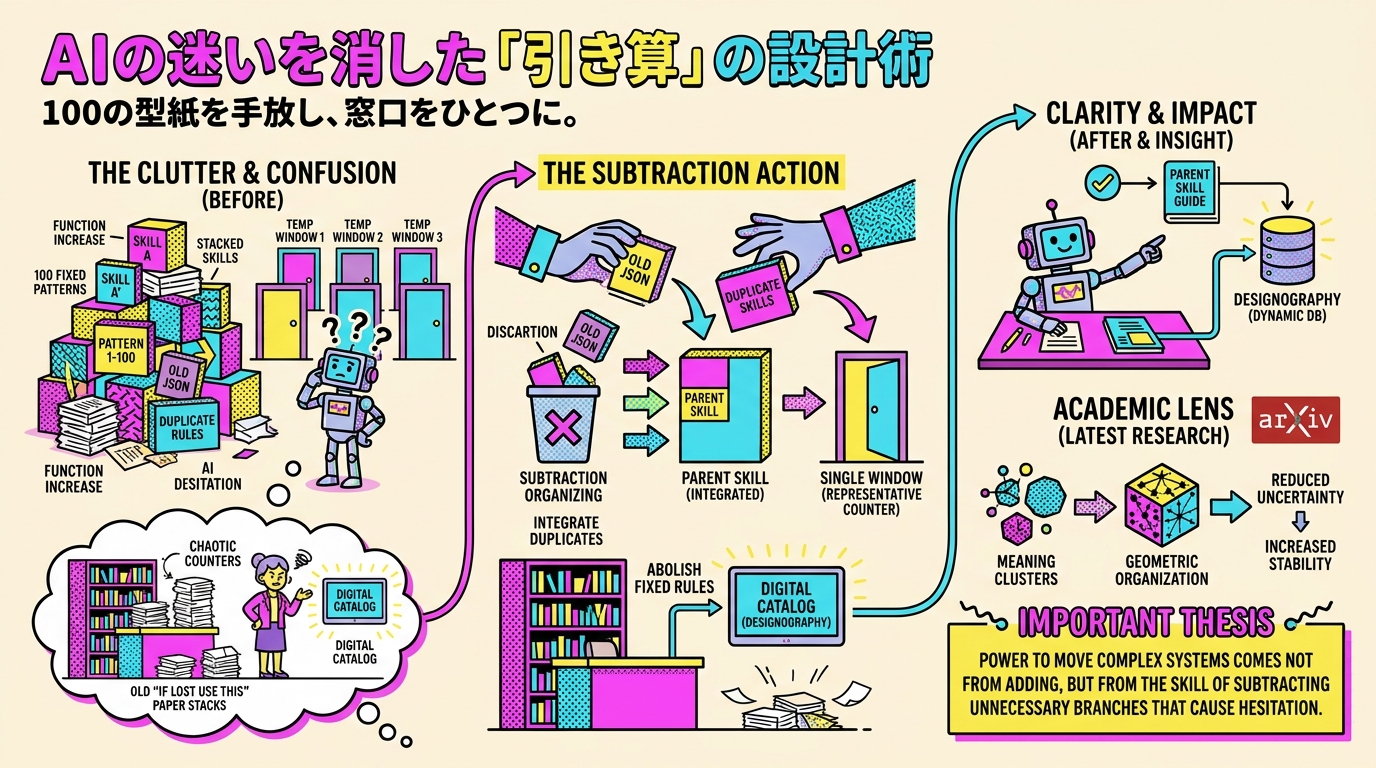
Letting Go of 100 Templates for a Single Desk: The Art of Subtractive Design That Eliminated AI Hesitation

What If You Animated '1,000 Arms' in a Browser? A Lightweight 3D Exhibition Experiment Powered by AI and WebGPU
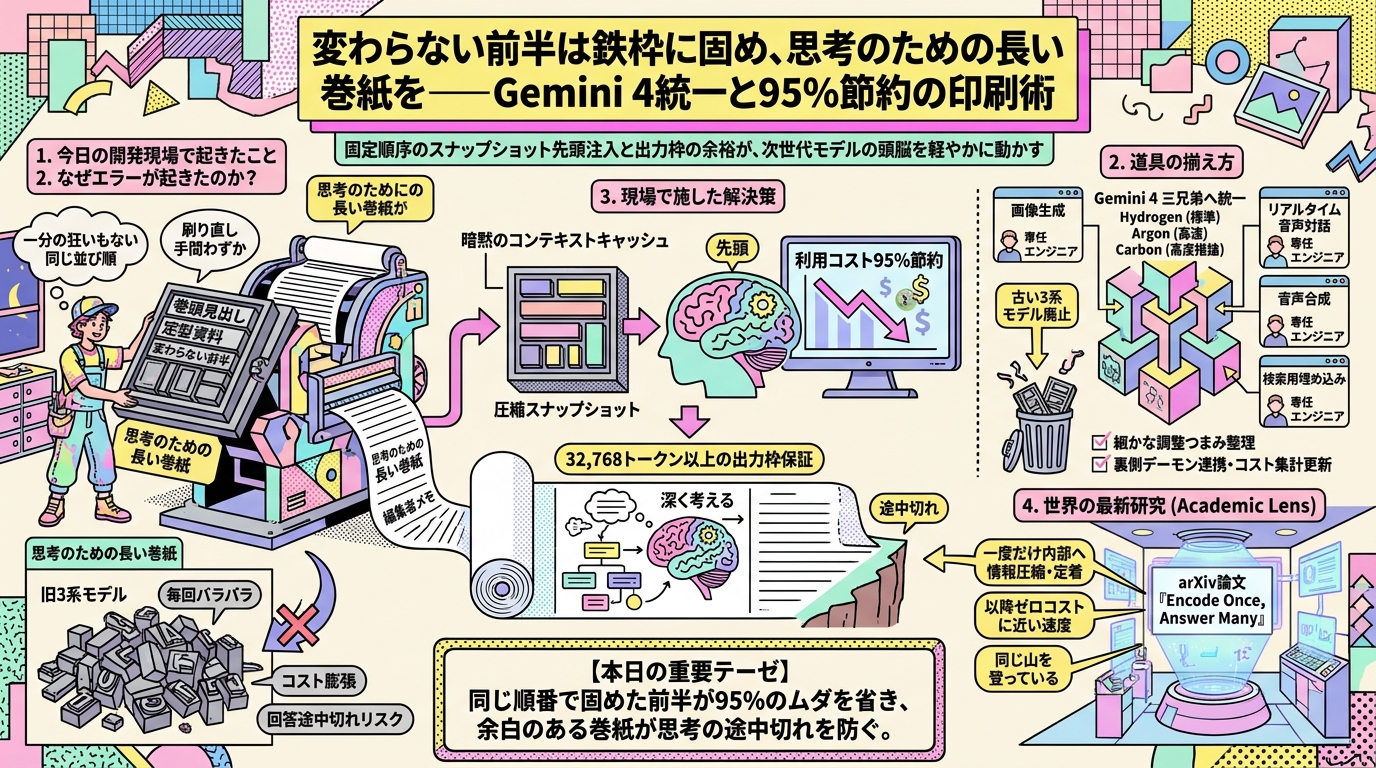
Locking the Constant Lead in Iron, Unrolling Long Scrolls for Thought — Gemini 4 Unification and the Art of 95% Printing Savings
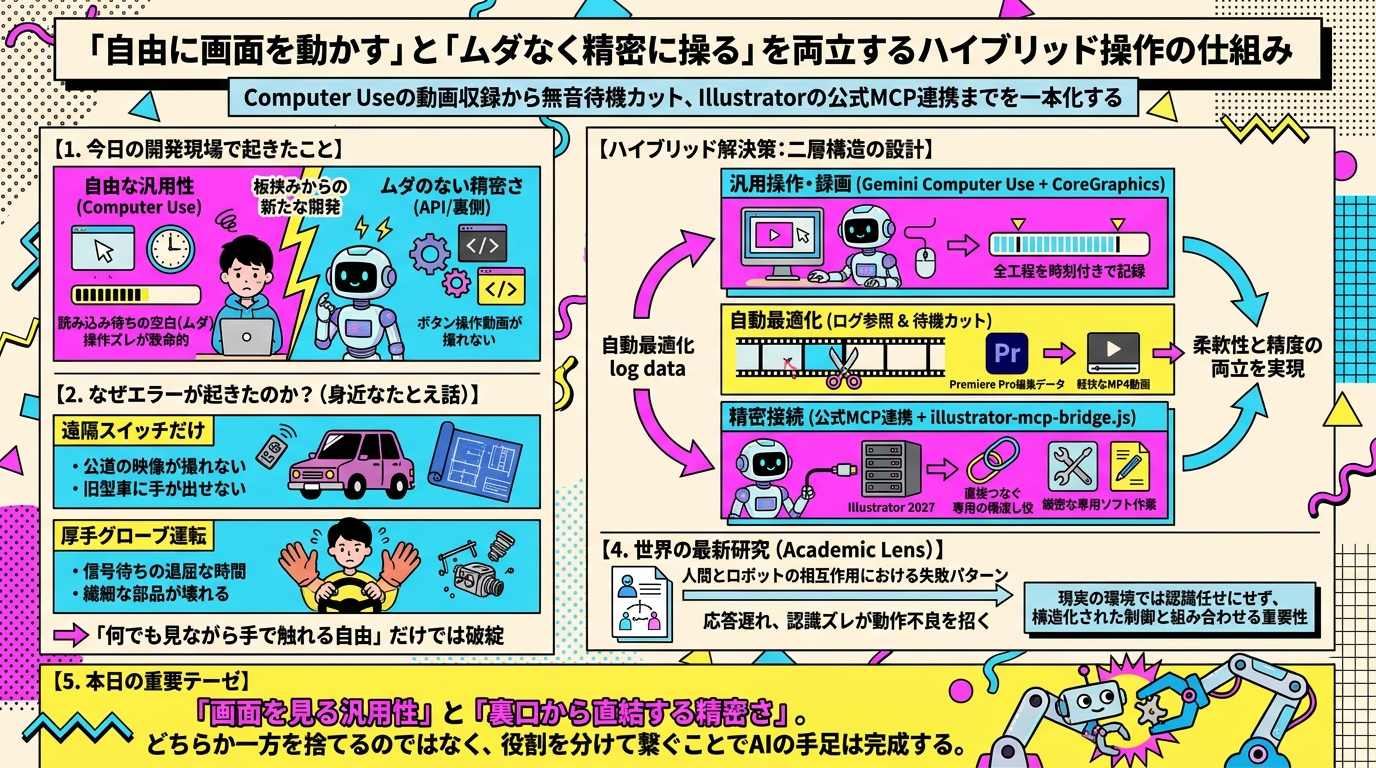
A Hybrid Control Architecture Bridging Free-Form Screen Navigation and Lean, Precision Execution

Behind "Just One More Request": The Internal Wiring That Hands Off Memory and Tools Between AIs
Current