
THE SCHOOL OF KAMOS
Connecting Real-world Dev & Academic Intelligence with Intuitive Metaphors
What If You Animated '1,000 Arms' in a Browser? A Lightweight 3D Exhibition Experiment Powered by AI and WebGPU
The art of 'compress and expand': folding massive 3D data small and unfurling it instantaneously through parallel rendering
"What would happen if we used the latest Gemini 4 Carbon AI alongside the 3D creation suite Blender to render a 'Thousand-Armed Kannon' statue in real time inside a standard web browser—without any dedicated app?" That was the bold thought experiment our team took on in the field. A finely detailed Buddhist statue with countless overlapping parts easily balloons in data size, risking frozen screens if dropped straight onto a webpage. Even so, to test just how fluidly AI-driven spatial design and next-generation rendering can perform together, we set out to build a bilingual Japanese-English exhibition page.
Early in the experiment, trying to bring a high-definition statue with 1,000 arms directly onto the web hit an immediate wall of sheer data weight. What broke through that barrier was the pairing of Draco Compression and WebGPU. Imagine transporting a colossal dome tent for a major event venue. Instead of hauling the inflated frame onto a truck, you let the air out and fold it neatly into the size of carry-on luggage—that is the role of Draco Compression. The moment it arrives at the venue—the browser—WebGPU (with WebGL as a compatible fallback) acts like a bank of electric pumps driving hundreds of hoses in parallel, raising all 1,000 arms into a smooth, three-dimensional form. The synergy between AI and 3D tools only truly came alive in the browser when paired with the ingenuity to travel light.
Moreover, the experiment did not stop at merely displaying a 3D model on screen. The finished bilingual exhibition page was seamlessly synchronized not only with the site-wide header, footer, and sitemap, but also with 'llms.txt'—the guidebook that helps AI agents read and understand site architecture. No matter how exquisite a sculptural work may be, without clear signposts for human visitors and a proper catalog for external AI to discover it, it remains a statue hidden deep in the forest, unseen by anyone. The field lesson from this experiment was unmistakable: the bolder an expressive endeavor becomes, the more essential it is to architect three elements together from the very start—a design that folds data small for delivery, a mechanism that expands it in parallel on screen, and clear pathways easily discoverable by both humans and AI.
"What kept a thousand arms moving effortlessly in the browser was an audacious way of 'folding' data—paired with honest architecture that keeps the signposts clear."Key Takeaway
📖 1-Minute Lexicon
A technique that efficiently folds vertex and surface information in 3D data, dramatically shrinking file size while preserving visual fidelity.
A next-generation web standard that unlocks the computational power of a computer or smartphone's graphics processor (GPU) directly from the browser for high-speed, advanced 3D rendering.
A Lightweight 3D Exhibition of 1,000 Arms Powered by AI and WebGPU

Live Frontier Pulse: Real-World AI Trends
Sakana AI Targets IPO as Early as Fall 2027—Set to Be Japan's First Generative AI Listing and Among Its Largest Startup Debuts
According to Nikkei, generative AI developer Sakana AI is aiming to go public as early as autumn 2027. It is drawing widespread attention as potentially the first generative AI company to list in Japan, and one of the largest domestic startup IPOs in scale.
Inside NEC's Internal AI Adoption: Advancing DX and AX Through a 'Client Zero' Strategy
NEC unveiled case studies of its internal AI initiatives, detailing how it drives DX and AX (AI Transformation) under a 'Client Zero' strategy. The report highlights how the company treats itself as the primary proving ground to transform operations ahead of delivering solutions to clients.
How Does This Connect to Global Frontier Research?
In this experiment, we intelligently organized a complex 3D 'form (geometric structure)' using Draco Compression to reproduce it cleanly while keeping browser load low. Remarkably, cutting-edge AI research worldwide is also spotlighting ways to dramatically slash heavy computation by leveraging 'geometric arrangement.' An arXiv paper proposes a method for detecting whether an AI response contains errors (hallucinations) without relying on computationally expensive sentence-by-sentence cross-checking (NLI). Instead, it evaluates clusters of meaning through spatial distances and groupings (geometry-aware clustering). Reinterpreting complex objects as spatial regularities to lower computational cost is a vital shared key—both for 3D exhibitions and for advancing AI reliability.
Which combination of techniques was used to animate a complex, 1,000-armed 3D Thousand-Armed Kannon statue smoothly in a web browser without bogging down performance?
Past School Paper Backnumbers

How Stripping Away Invisible Padding and Caching Dramatically Sharpened Our AI Design Canvas

Why an AI Narrator Reads 'Stage Directions' Aloud—and the Art of Scrubbing the Script Clean

Balancing 'This Year's Certainty' with 'Next Year's Foresight': System Design That Reserves the Future Without Mixing Schedules

An X-Ray of the Play Button: The Precision Tuning Behind Unhurried Five-Minute AI Narration

Stop the AI, and the Archive Lives On: Designing for Completion at Zero Maintenance Cost

What Appeared When We Removed the Neon and Technical Gauges: Crafting Effortless Wayfinding Across 11 WebGPU Works

20,000 Characters Distilled into a Single Four-Quadrant Diagram: Where Long-Form Summarization Stands Today with the Latest Image Model, Nano Banana 2.1

Why Can't AI Keep Drawing the Same Object? A Visual Anchor to Prevent Structural Drift in 5-Panel Sketches
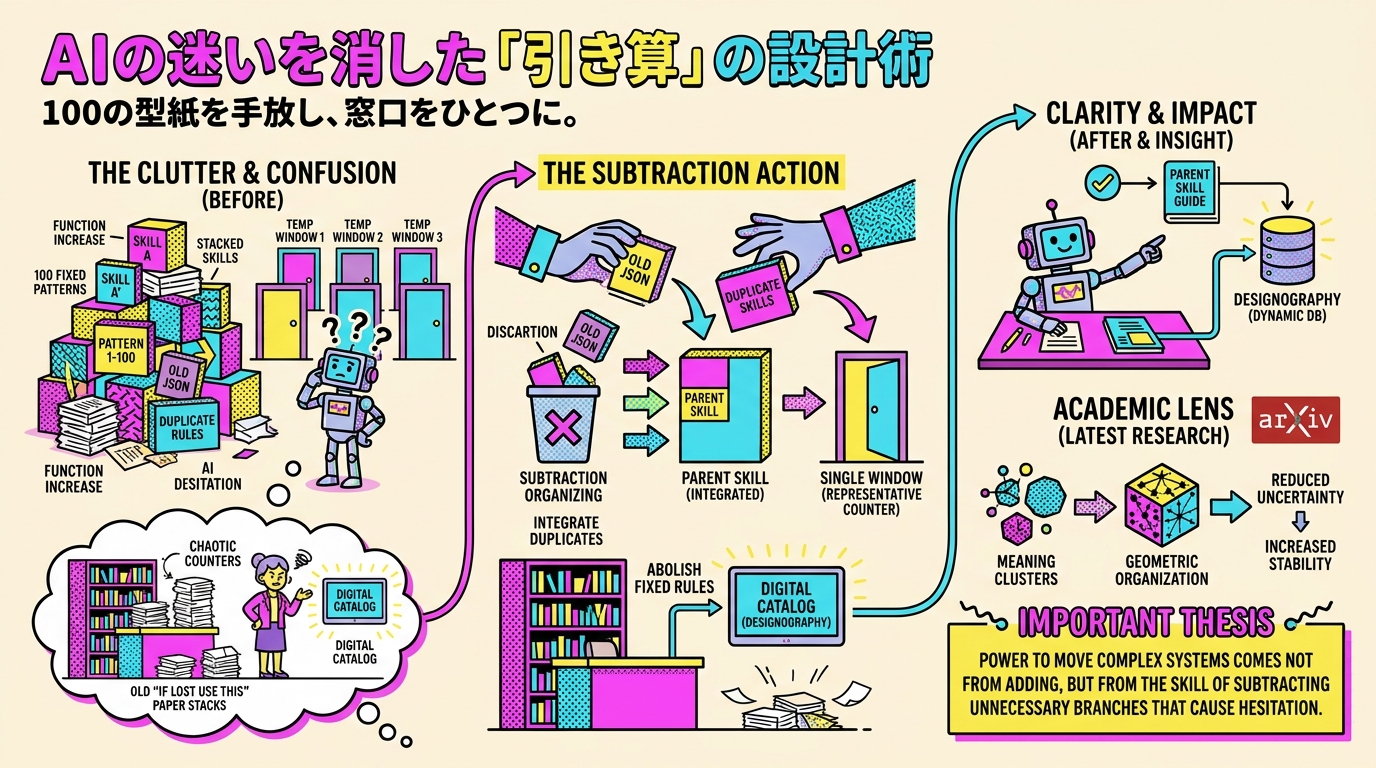
Letting Go of 100 Templates for a Single Desk: The Art of Subtractive Design That Eliminated AI Hesitation
Current
What If You Animated '1,000 Arms' in a Browser? A Lightweight 3D Exhibition Experiment Powered by AI and WebGPU
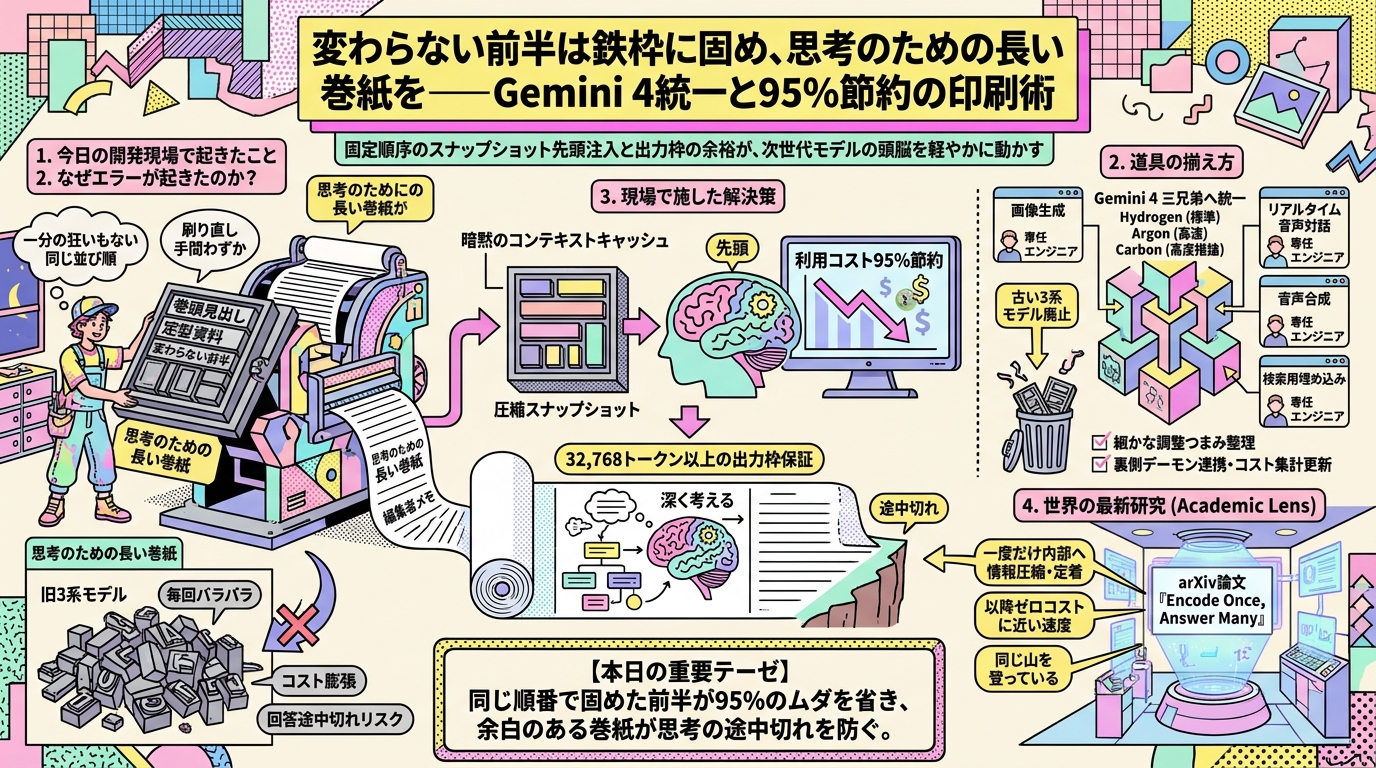
Locking the Constant Lead in Iron, Unrolling Long Scrolls for Thought — Gemini 4 Unification and the Art of 95% Printing Savings
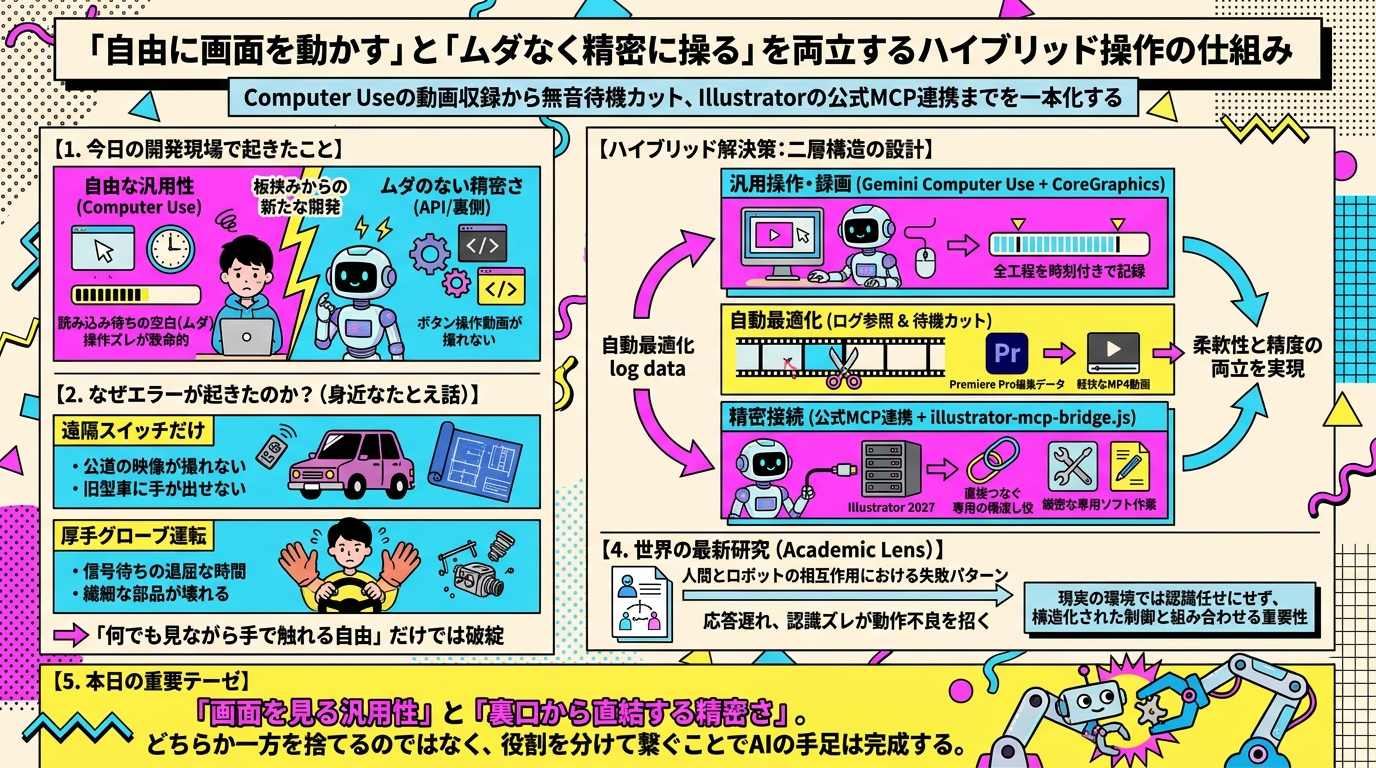
A Hybrid Control Architecture Bridging Free-Form Screen Navigation and Lean, Precision Execution
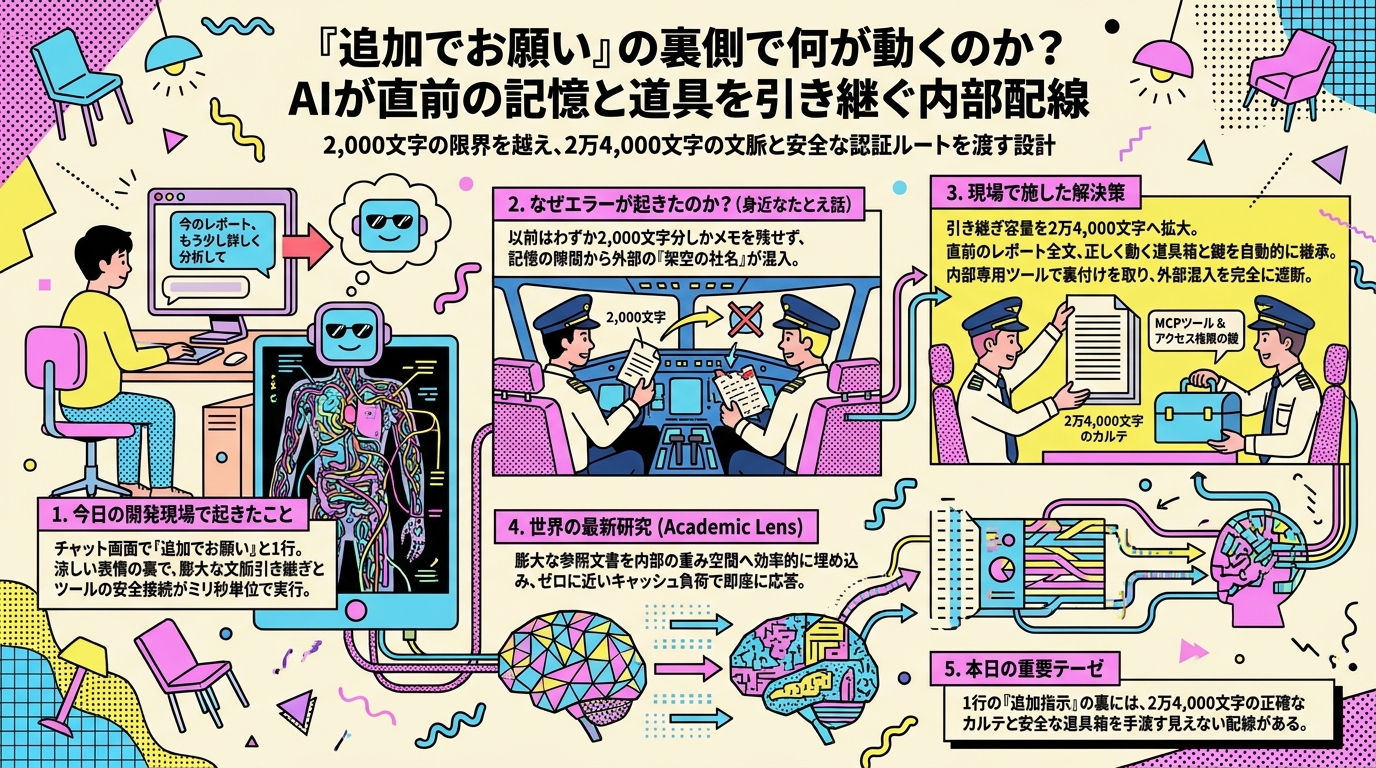
Behind "Just One More Request": The Internal Wiring That Hands Off Memory and Tools Between AIs