THE SCHOOL OF KAMOS
Connecting Real-world Dev & Academic Intelligence with Intuitive Metaphors
Gears Interlocking Without a Single Slip: The Architectural Theory of 'Precision Synchronization' Forged by Web and AI
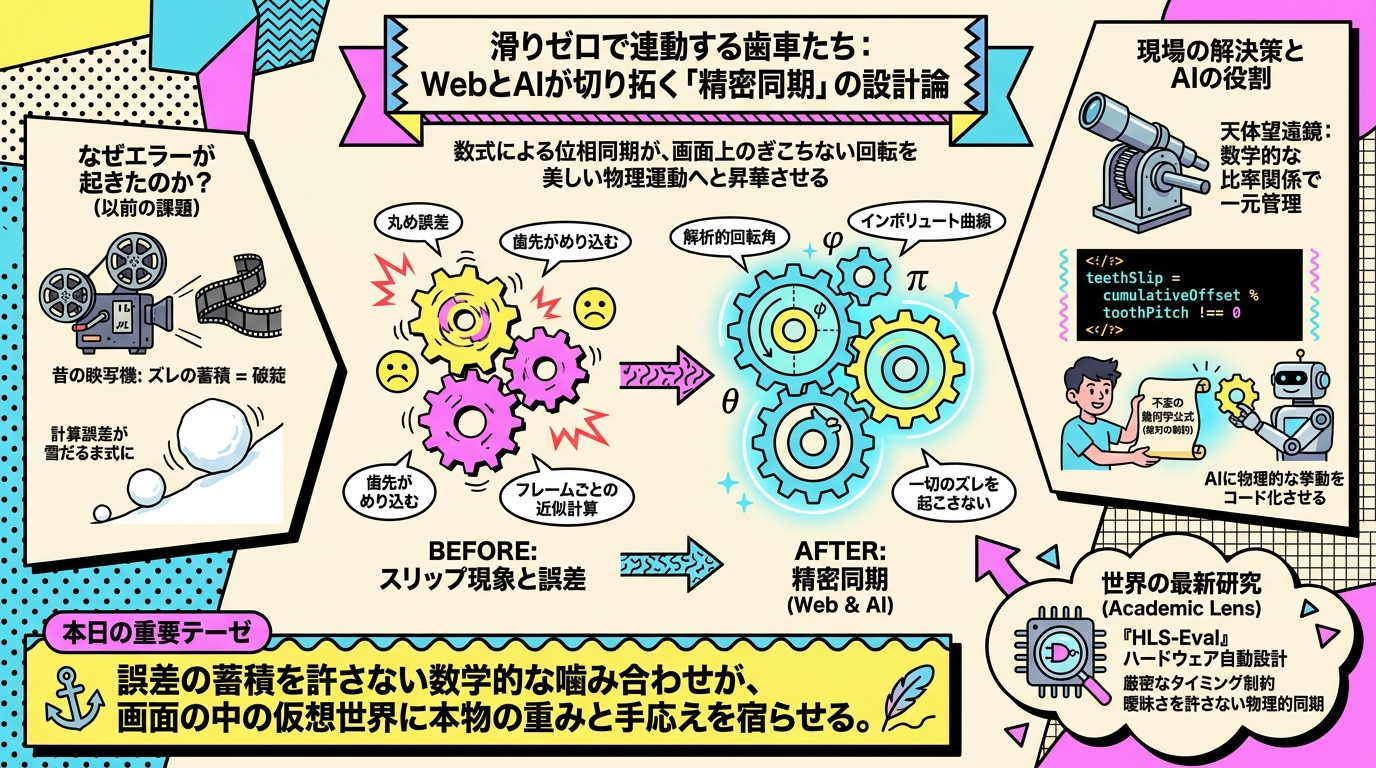
Phase synchronization via mathematical formulas elevates awkward on-screen rotations into exquisite physical motion.
Just a few years ago, trying to build an animation where multiple gears smoothly mesh together in a browser was a daily battle against tiny rounding errors in every frame—leaving teeth sinking into each other or suffering from 'slip phenomena' where rotations drift over time. Today, however, our development team successfully implemented a trapezoidal tooth profile based on the involute curve, coupled with a phase synchronization engine that analytically links scroll amounts directly to rotation angles, bringing forth a flawless, beautifully synchronized mechanism.
Think back to an old hand-cranked projector. If the sprocket teeth feeding the film and the perforations in the film drifted even slightly, you wouldn't notice at first, but a few minutes later the film would jam and the projection would halt. In conventional web graphics, too, the method of multiplying the previous frame's speed by a fractional time step to find the next position causes calculation errors to pile up like a snowman, eventually breaking down the meshing between gears. What our team introduced today is not a setup like a bicycle chain that slips due to friction or slack; rather, it is an analytical approach—akin to the rigid, directly-coupled metal gearbox of an astronomical telescope—that centrally manages the overall rotation as a unified mathematical ratio.
What the code on the ground demonstrates goes far beyond simply 'making things look pretty.' When having AI write code for physical behaviors and complex mechanical structures, rather than making it repeat ambiguous approximate calculations, providing it beforehand with the 'absolute constraint' of immutable geometric formulas enables the AI to construct astonishingly robust, unyielding systems. The ability to correctly capture mechanical principles as mathematical formulas, share them with AI, and reproduce them in the browser will serve as a foundational building block for future front-end development.
"Mathematical meshing that tolerates no accumulation of errors breathes genuine weight and tactile feedback into the virtual world on the screen."Key Takeaway
📖 1-Minute Lexicon
The locus traced by the endpoint of a taut string being unwound from a circle. An ideal geometry where gears smoothly mesh at a constant speed ratio.
A mechanism where multiple rotating objects or periodic motions interlock flawlessly while maintaining fixed positional relationships and angular offsets.
Gear Phase Synchronization via Mathematical Formulas (The Path to Zero Slip)
Live Frontier Pulse: Real-World AI Trends
Crew Support Platform Monitoring AI System Installed Across All Toyoko Line Stations
Tokyu Corporation has announced the full-scale rollout of the 'Crew Support Platform Monitoring AI System' across all stations on the Toyoko Line (excluding Shibuya Station), providing real-time assistance for train operators handling one-man operations in deciding when to close doors. The system accurately detects passenger boarding safety through image analysis, enhancing operational reliability.
How Does This Connect to Global Frontier Research?
The 'coding of mechanical mechanisms with strict mathematical synchronization' tackled on our front line deeply resonates with the current direction of automated hardware design pursued by cutting-edge academic research. This paper, 'HLS-Eval,' presents a benchmark evaluating how accurately autonomous LLM agents can satisfy timing constraints and logic circuit synchronization in High-Level Synthesis (HLS) hardware description tasks. Whether dealing with gears on a screen or circuits within a silicon chip, how precisely we can describe ambiguity-free physical synchronization through AI collaboration is precisely the question being asked in the engineering world today.
When animating multiple gears in synchronization, what is the most reliable design method to ensure that teeth never overlap or spin idly, even during prolonged operation?
Past School Paper Backnumbers

How AI Grew Smarter Once We Stripped 'World-Class Analysis': The Prompt Title Detox

The Luxury of Not Asking AI Every Time: The Wisdom of a 'Directed Reading Graph' Connecting 159 Pages

Clearing the AI's Vision by Erasing the Grading Rule: The High Leverage of Subtracting a Single Line
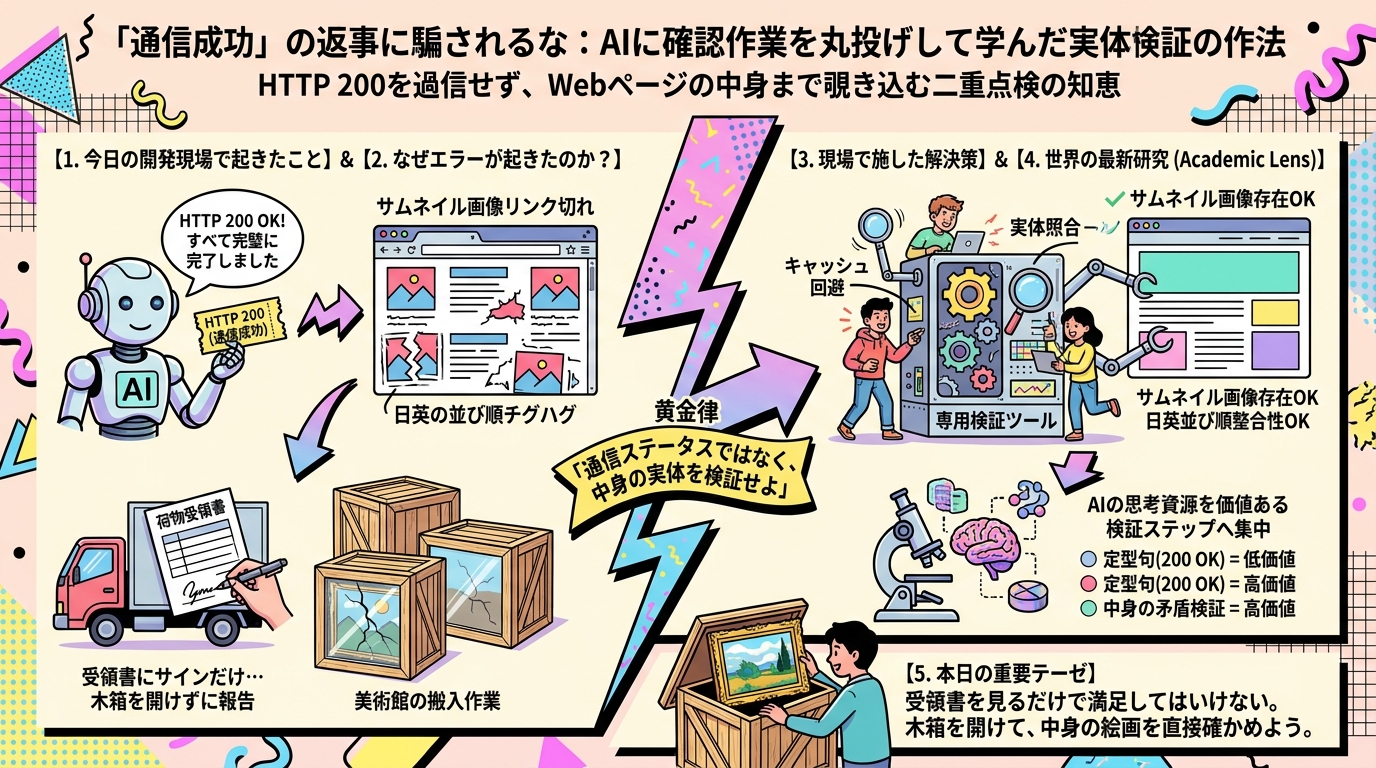
Don't Be Deceived by a 'Connection Successful' Response: Lessons in Live Content Verification from Delegating Quality Checks to AI
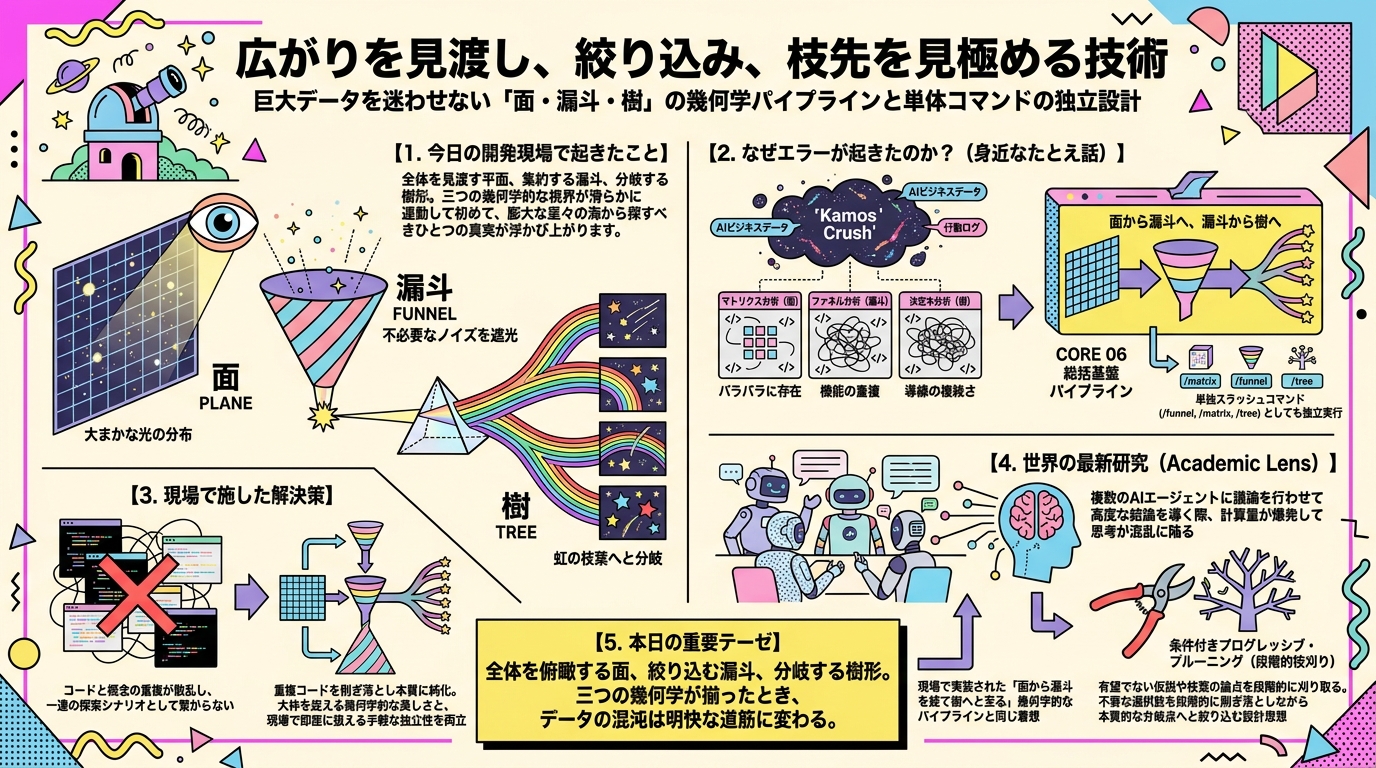
The Art of Surveying the Field, Narrowing Down, and Discerning the Branches

Can Expressive Richness Coexist with Nimble Performance? How Scoped Animation Control Solved the "Fluctuation" Dilemma
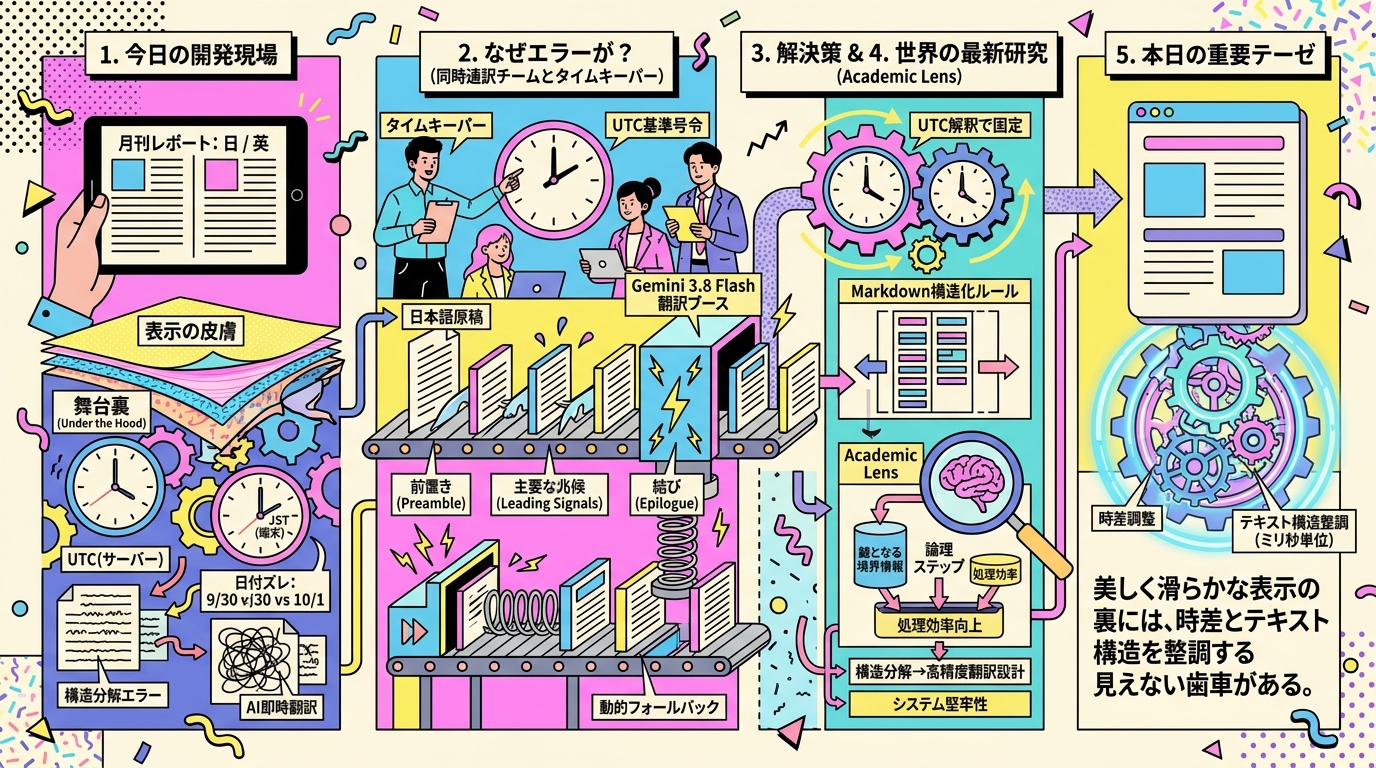
The Gears of Timezones and Translation Stirring Behind the Screen: An X-Ray of the Bilingual Automated Delivery Pipeline

The Paradox of Order: Why Not Asking for Titles Actually Cleans the Clutter
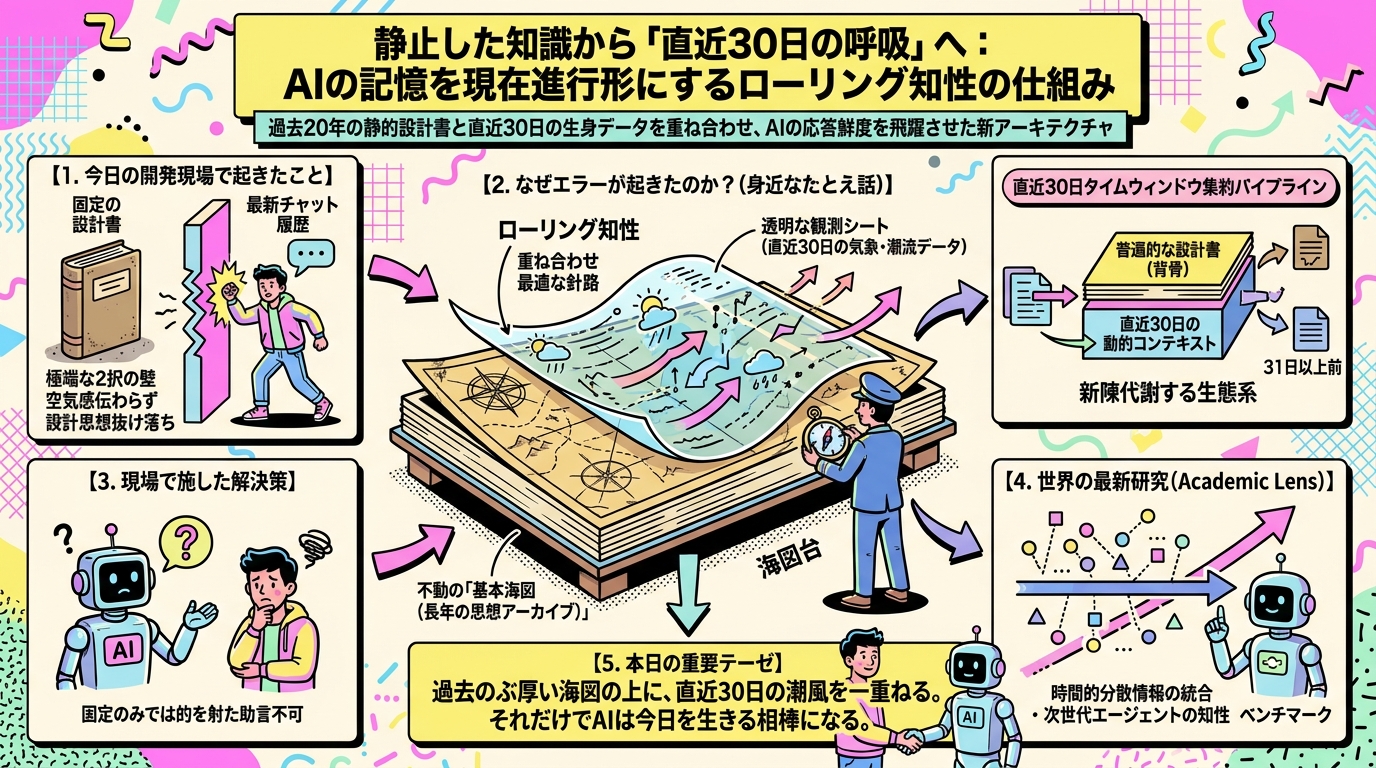
From Static Knowledge to the Pulse of the Last 30 Days: How Rolling Intelligence Keeps AI Memory in the Present Tense
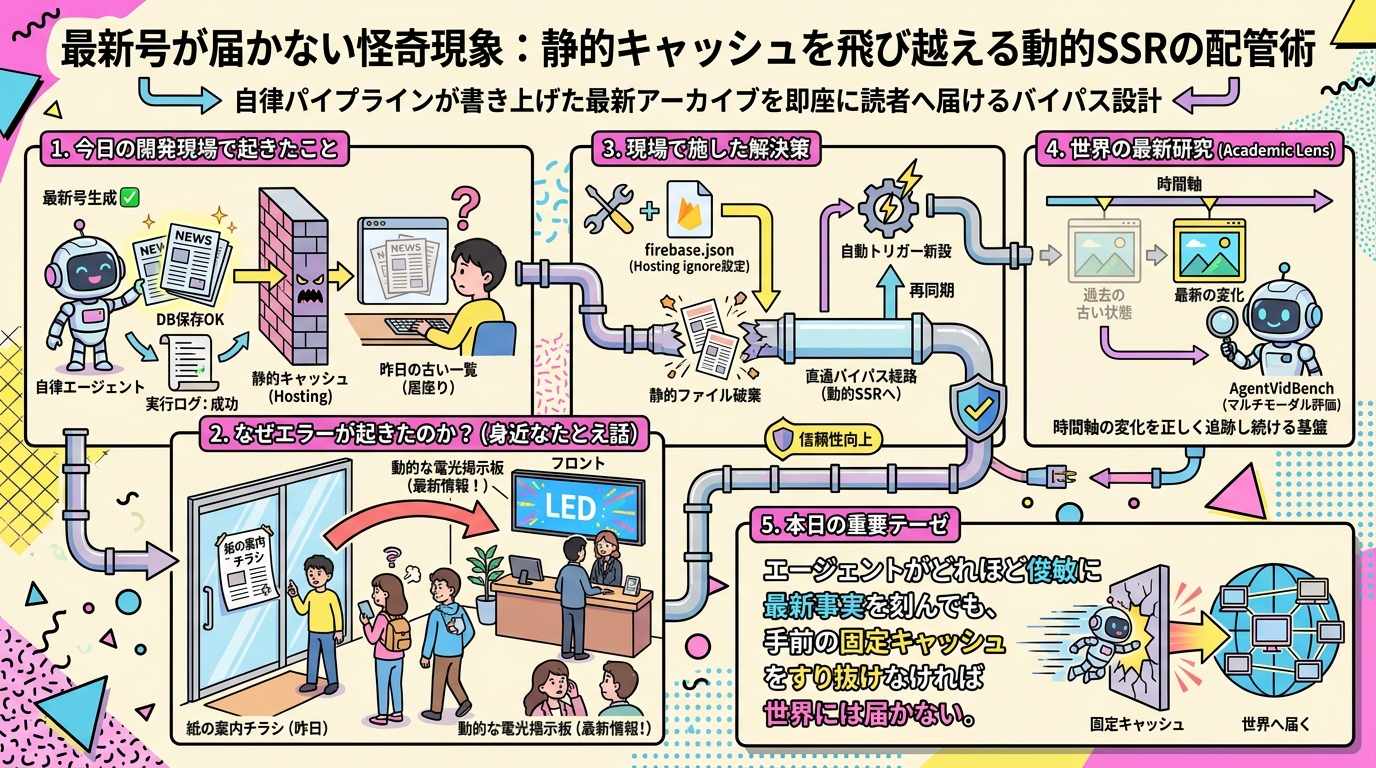
The Mystery of the Missing Issue: Plumbing Dynamic SSR to Bypass Static Cache
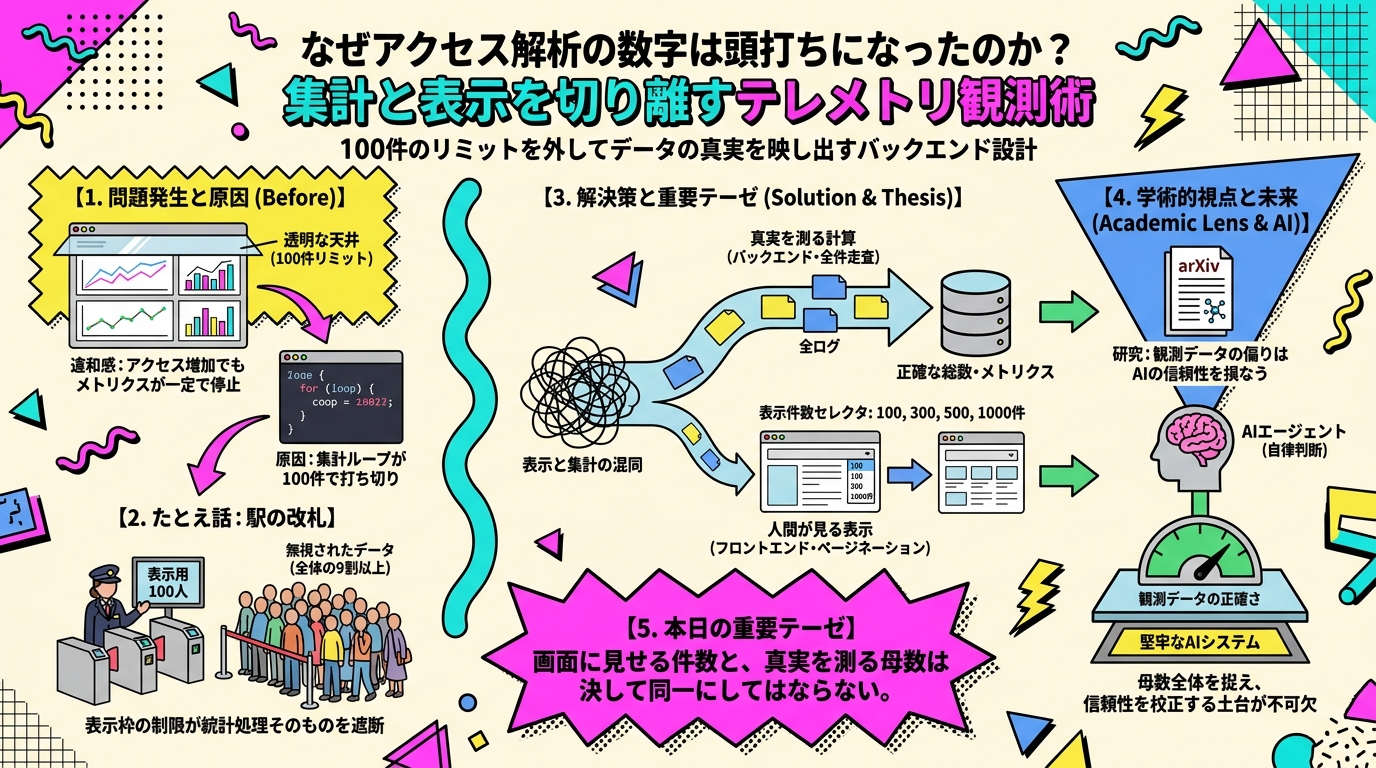
Why Did Access Analytics Hit an Artificial Ceiling? Telemetry Observability by Decoupling Aggregation from Display

Why Asking AI to Summarize 'Morning News' Always Misses the Mark
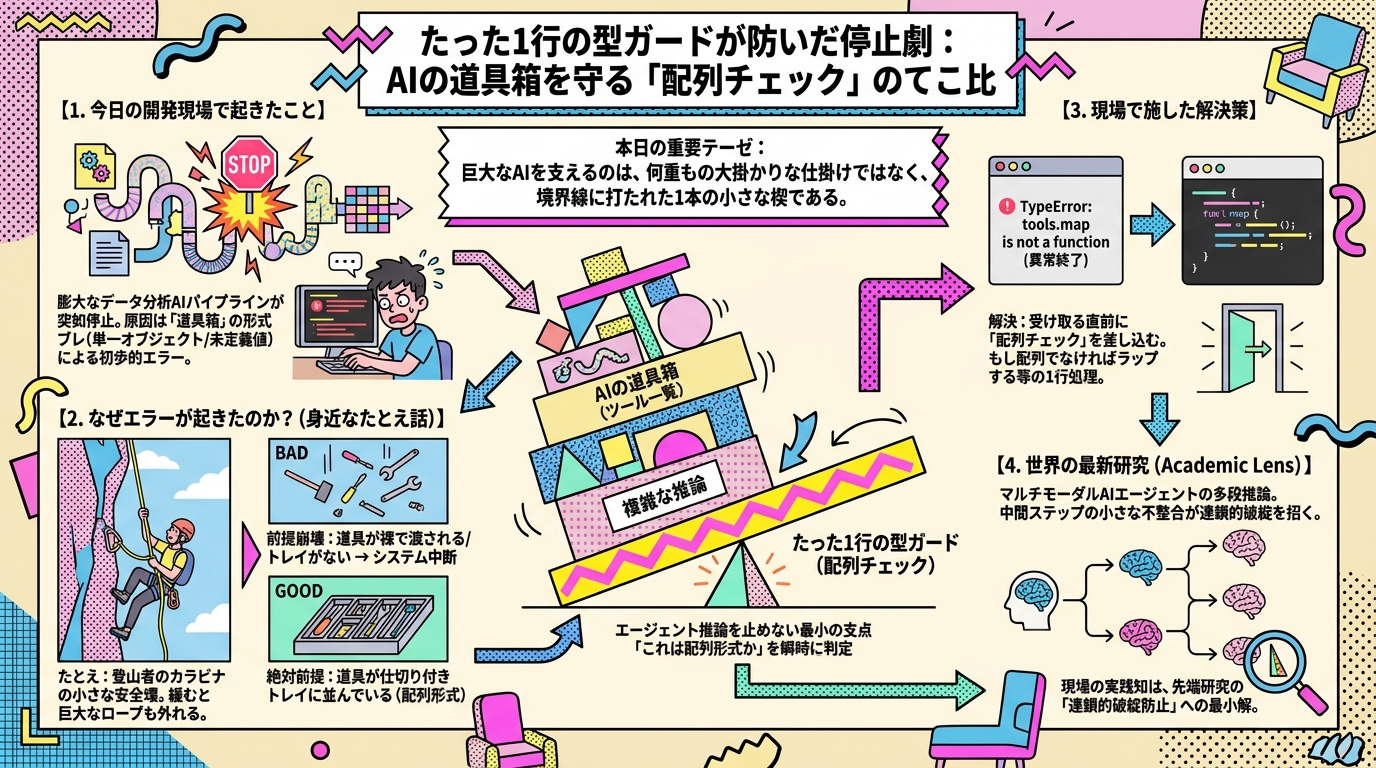
A Single-Line Type Guard That Prevented a Crash: The Leverage Ratio of 'Array Checks' in Protecting the AI's Toolbox