THE SCHOOL OF KAMOS
Connecting Real-world Dev & Academic Intelligence with Intuitive Metaphors
The White Fracture Across the 3D Polyhedron: Solving Zero-Gap Geometry with Equilateral UV Mapping
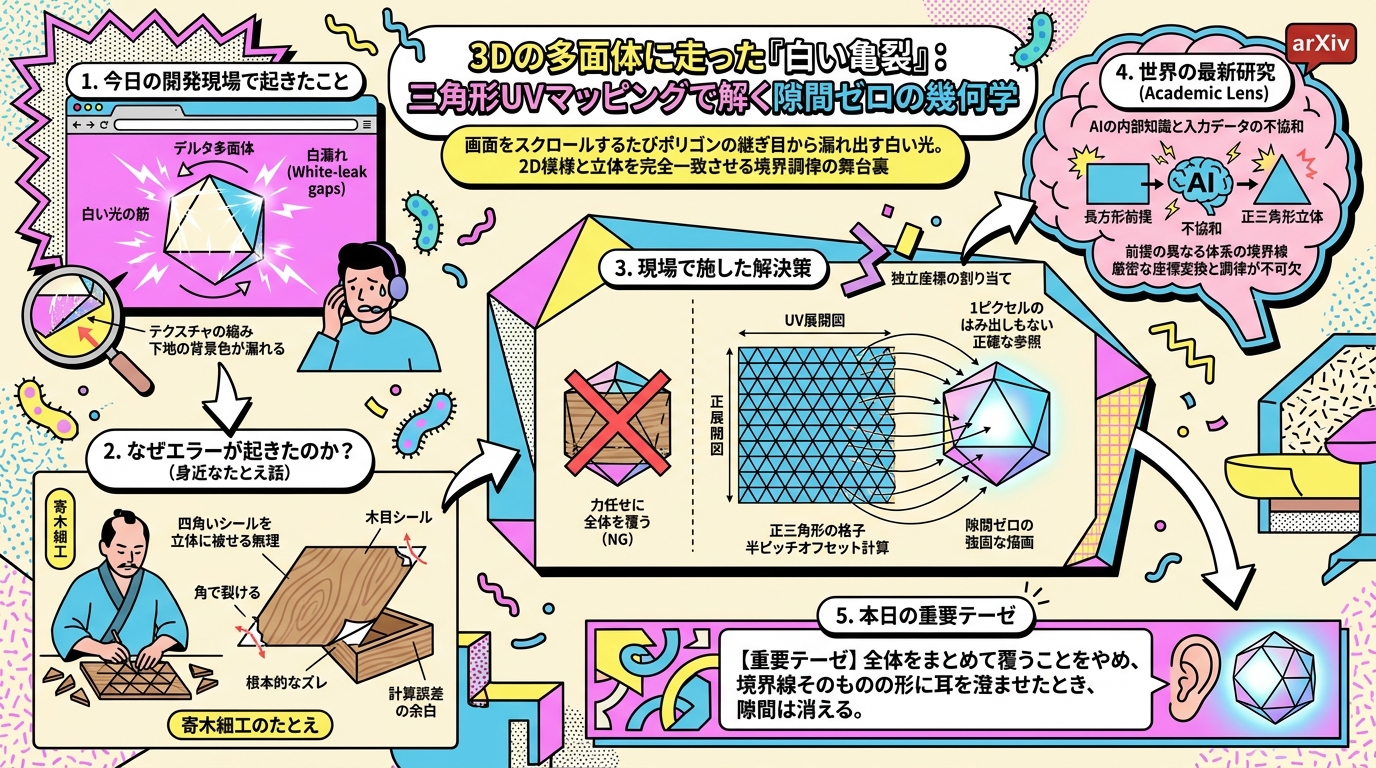
Every time the screen scrolls, white light leaks from the polygon seams. Behind the scenes of boundary tuning that perfectly aligns 2D patterns and 3D solids.
It happened while we were testing a smooth-rotating delta polyhedron composed entirely of equilateral triangle faces on a new landing page. The moment the user scrolled and the solid changed angles, countless needle-like streaks of white light began flickering across the polygon's corners and edges. Upon closer inspection, the geometric texture covering the solid was shrinking slightly at the seams, causing a 'white-leak' where the underlying background color bled through the gaps.
Behind this phenomenon lay a fundamental misalignment when wrapping flat artwork onto a three-dimensional object. Think of traditional wooden parquetry. When a craftsperson joins numerous equilateral wooden pieces to build a three-dimensional box, what happens if they simply wrap a square, sheet-printed wood-grain sticker over the entire thing? At the corners and valley folds, the sticker stretches and tears, and the underlying white adhesive peeks through the cross-sections of the seams. Exactly the same thing happens in computer 3D graphics: when a square texture image is automatically assigned to equilateral triangle faces, sub-pixel coordinate calculation errors at the edges create invisible margins between the faces.
To counter this, the team abandoned blanket texture-wrapping and instead assigned independent coordinates to each individual equilateral triangle face. We laid out an equilateral triangle grid regularly within a rectangular image space, calculating a half-pitch offset that shifted the positions of odd and even rows by exactly fifty percent. By redefining the UV coordinates so that each polygon on the solid precisely references its corresponding texture triangle region without even a single pixel of overflow, we eliminated gaps. Rather than forcing a brute-force blanket coverage, translating the geometric properties of the boundaries directly into the coordinate system achieved robust rendering where no white gaps appeared, no matter how violently the solid rotated.
"When you stop trying to blanket-cover everything and instead listen to the shape of the boundary lines themselves, the gaps disappear."Key Takeaway
📖 1-Minute Lexicon
A technique that maps 2D texture images drawn on a plane (U and V axes) onto the surface of 3D polygons.
A polyhedron in which all faces are congruent equilateral triangles. Includes regular tetrahedrons, octahedrons, and icosahedrons.
Eliminating Boundary White-Leaks via Equilateral UV Mapping
Live Frontier Pulse: Real-World AI Trends
Announcement of 'AI for Science 2026 Open Symposium'
The Japan Science and Technology Agency (JST) has announced the 'AI for Science 2026' open symposium, sharing initiatives that accelerate frontier challenges in natural and mathematical sciences using AI.
How Does This Connect to Global Frontier Research?
Published on arXiv, this research examines the phenomenon where Large Language Models fail to maintain boundary consistency and suffer drops in reasoning accuracy when given input data that contradicts their internal knowledge (beliefs). The 3D white-leak on the front line was similarly a dissonance occurring at the boundary between two systems with differing premises: a 'texture space predicated on rectangles' and a 'solid space composed of equilateral triangles'. It demonstrates both academically and practically that when connecting information sources with distinct premises—whether in AI agent reasoning or 3D graphics—strict coordinate transformation and boundary tuning are indispensable.
What is the primary cause of white lines (texture gaps) appearing at the boundaries of 3D polygons?
Past School Paper Backnumbers

How AI Grew Smarter Once We Stripped 'World-Class Analysis': The Prompt Title Detox

The Luxury of Not Asking AI Every Time: The Wisdom of a 'Directed Reading Graph' Connecting 159 Pages

Clearing the AI's Vision by Erasing the Grading Rule: The High Leverage of Subtracting a Single Line

Don't Be Deceived by a 'Connection Successful' Response: Lessons in Live Content Verification from Delegating Quality Checks to AI

The Art of Surveying the Field, Narrowing Down, and Discerning the Branches

Can Expressive Richness Coexist with Nimble Performance? How Scoped Animation Control Solved the "Fluctuation" Dilemma

The Gears of Timezones and Translation Stirring Behind the Screen: An X-Ray of the Bilingual Automated Delivery Pipeline

The Paradox of Order: Why Not Asking for Titles Actually Cleans the Clutter

From Static Knowledge to the Pulse of the Last 30 Days: How Rolling Intelligence Keeps AI Memory in the Present Tense

The Mystery of the Missing Issue: Plumbing Dynamic SSR to Bypass Static Cache

Why Did Access Analytics Hit an Artificial Ceiling? Telemetry Observability by Decoupling Aggregation from Display

Why Asking AI to Summarize 'Morning News' Always Misses the Mark

A Single-Line Type Guard That Prevented a Crash: The Leverage Ratio of 'Array Checks' in Protecting the AI's Toolbox