THE SCHOOL OF KAMOS
Connecting Real-world Dev & Academic Intelligence with Intuitive Metaphors
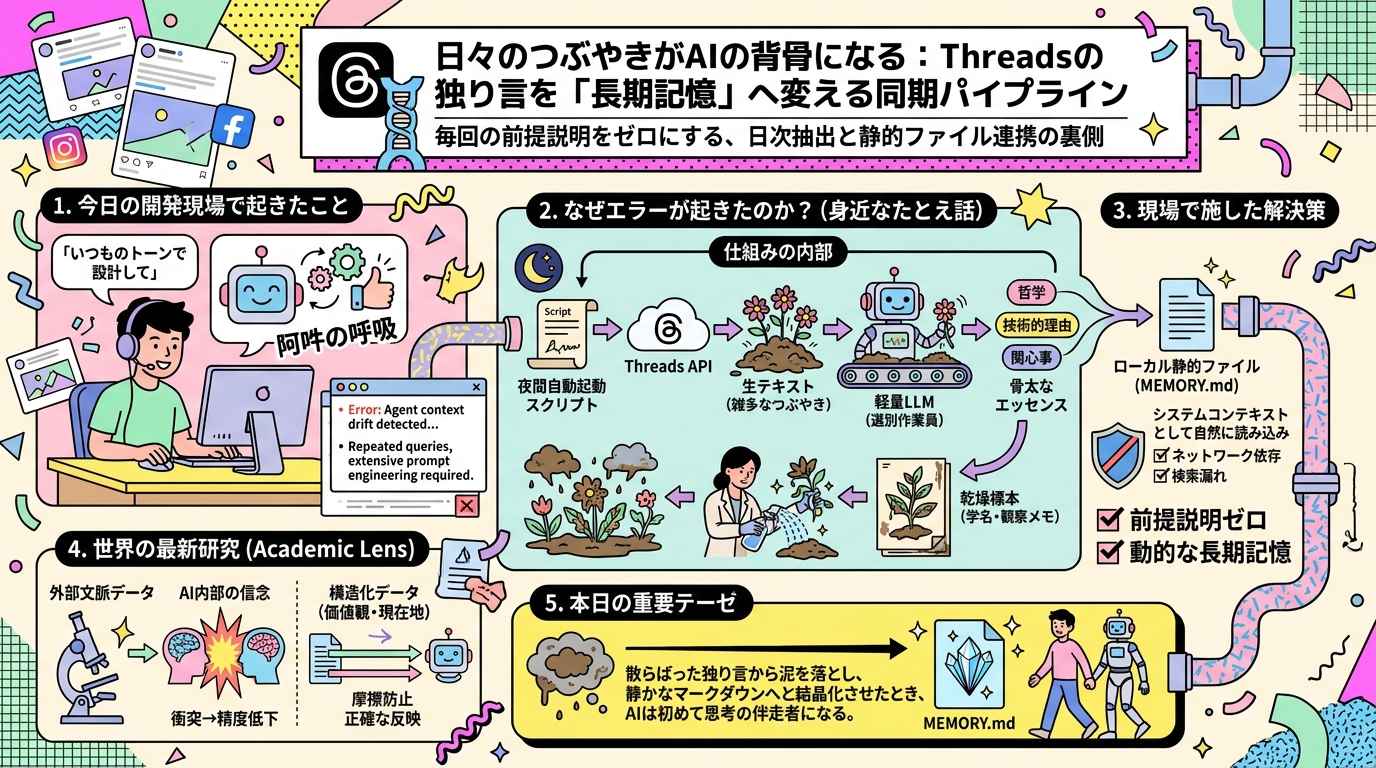
Your Daily Musings as the Backbone of AI: The Sync Pipeline Transforming Threads Self-Talk into 'Long-Term Memory'
Behind the daily extraction and static file integration that eliminates the need to re-explain prerequisites every time
When you ask your AI agent to 'design this in our usual tone,' it already understands the technical nuances and latest aesthetic sensibilities you posted on social media just yesterday. It's that effortless synergy, as if someone had been watching you work right by your side all along. But what is actually happening behind the scenes? When you peel back the skin of a conversation that usually resolves with a single prompt, a sophisticated data pipeline is tirelessly at work, translating the fragmented self-talk of social media into long-term memory that the AI can chew on and digest.
Looking inside this mechanism, it all begins with a script that automatically boots up at night to fetch recent posts via the Threads API. Gathered raw text is, in its natural state, nothing more than a chaotic jumble of musings. That is where a lightweight LLM steps in as a curation worker, sifting through the posts to distill only the heavy-hitting essence—such as 'philosophies on constraints,' 'reasons for technical decisions,' and 'concerns currently being tackled'—down to the millisecond. This closely mirrors the precise preprocessing of a field botanist returning from an expedition, quickly washing the mud off wild grass collected by the roadside at an atelier classification table, and transforming them into dried specimens engraved with scientific names and observation notes.
The extracted core information is not sent to a database, but rather neatly appended and updated in a local static markdown file (MEMORY.md). By structuring it to be read naturally as system context when the agent boots up, rather than routing through a complex search engine, we fundamentally eliminate the risks of network dependencies and missed searches. Sublimating chat-level fragmented thoughts into a structured 'current location map' on a daily basis. This subtraction architecture completely removes the hassle of laboriously re-explaining premises in prompts, realizing a dynamic long-term memory that tracks the evolution of human thought.
"When scattered self-talk is washed clean of its mud and crystallized into quiet markdown, AI finally becomes a true companion in thought."Key Takeaway
📖 1-Minute Lexicon
A mechanism that automatically extracts key points from daily statements and logs, constantly updating the knowledge base that the AI relies on as foundational context.
A lightweight design methodology that bypasses complex databases, writing summaries directly into a simple text file to be read straight into the AI at the start of a conversation.
The Sync Pipeline Transforming Threads Self-Talk into AI's Dynamic Long-Term Memory
Live Frontier Pulse: Real-World AI Trends
What is 'Jev', the New AI Model by Ex-OpenAI Researchers That Focuses Solely on 'Judgment' Rather Than 'Generation'?
A startup founded by former OpenAI researchers has announced 'Jev', a specialized AI model that does not generate text or images, but instead specializes entirely in 'judgment' and 'filtering' of inputted information. Designed to eliminate output uncertainty and maximize the accuracy of logical classification and evaluation, it is drawing significant attention.
How Does This Connect to Global Frontier Research?
This study examines the phenomenon where a model's reasoning accuracy drops when externally supplied contextual data conflicts with the model's internal beliefs (parametric premises) cultivated during pre-training. When storing an individual's personal philosophy or latest preferences in a development setting, feeding raw, messy text directly tends to spark friction with the AI's native general-purpose knowledge. The approach of using a fast, lightweight model to prep values and current states into objective, structured data before passing them along is a definitive engineering answer for preventing intrinsic model friction and accurately reflecting context.
When reflecting daily social media musings into an AI's long-term memory, what is the greatest advantage of summarizing, extracting, and organizing them into structured files rather than feeding massive amounts of raw text directly?
Past School Paper Backnumbers
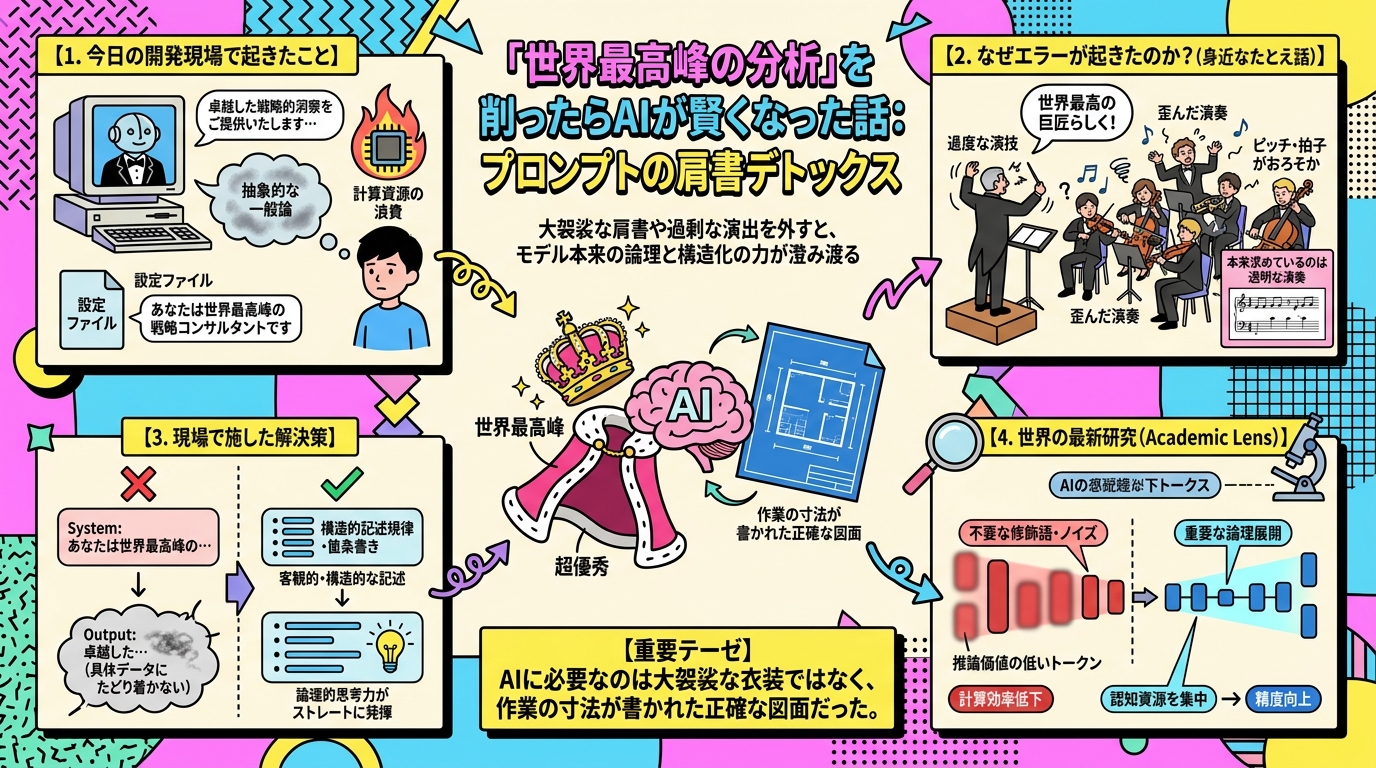
How AI Grew Smarter Once We Stripped 'World-Class Analysis': The Prompt Title Detox
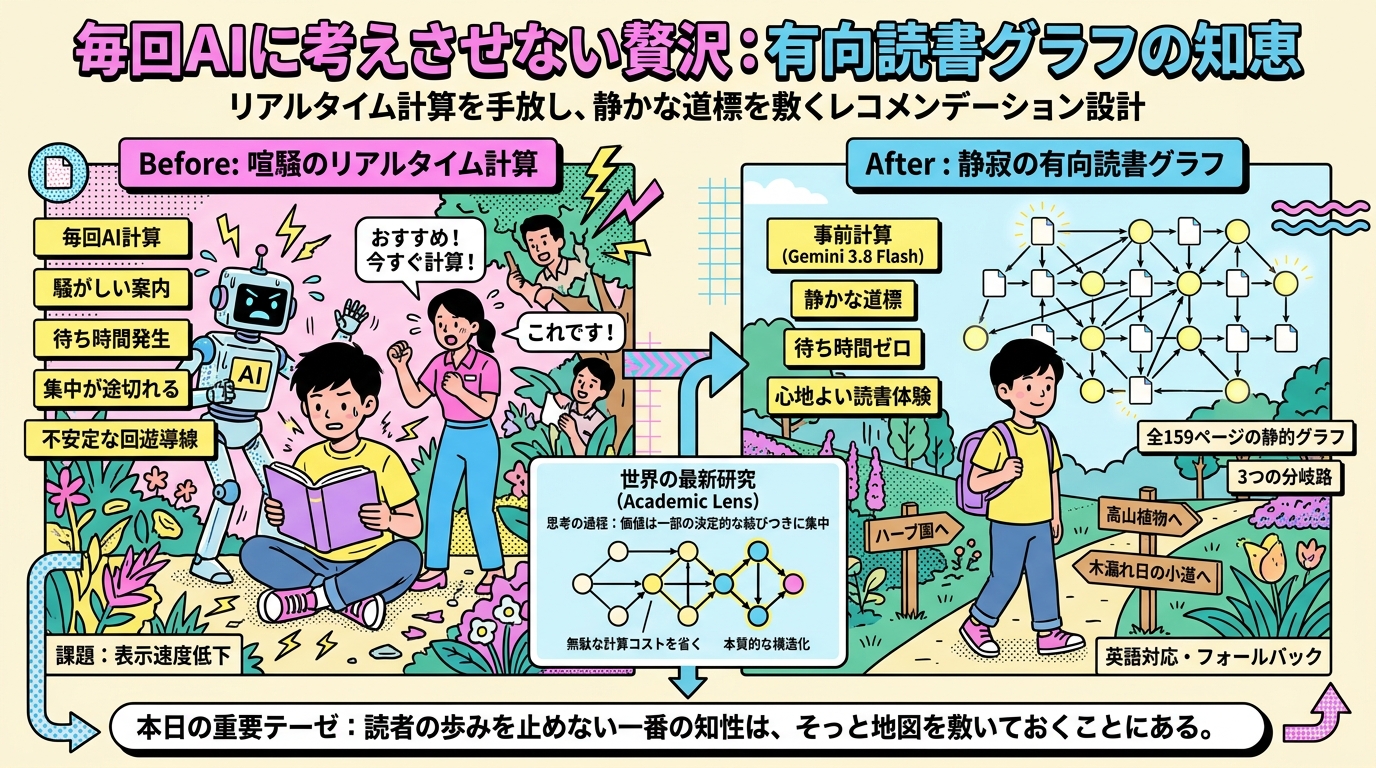
The Luxury of Not Asking AI Every Time: The Wisdom of a 'Directed Reading Graph' Connecting 159 Pages
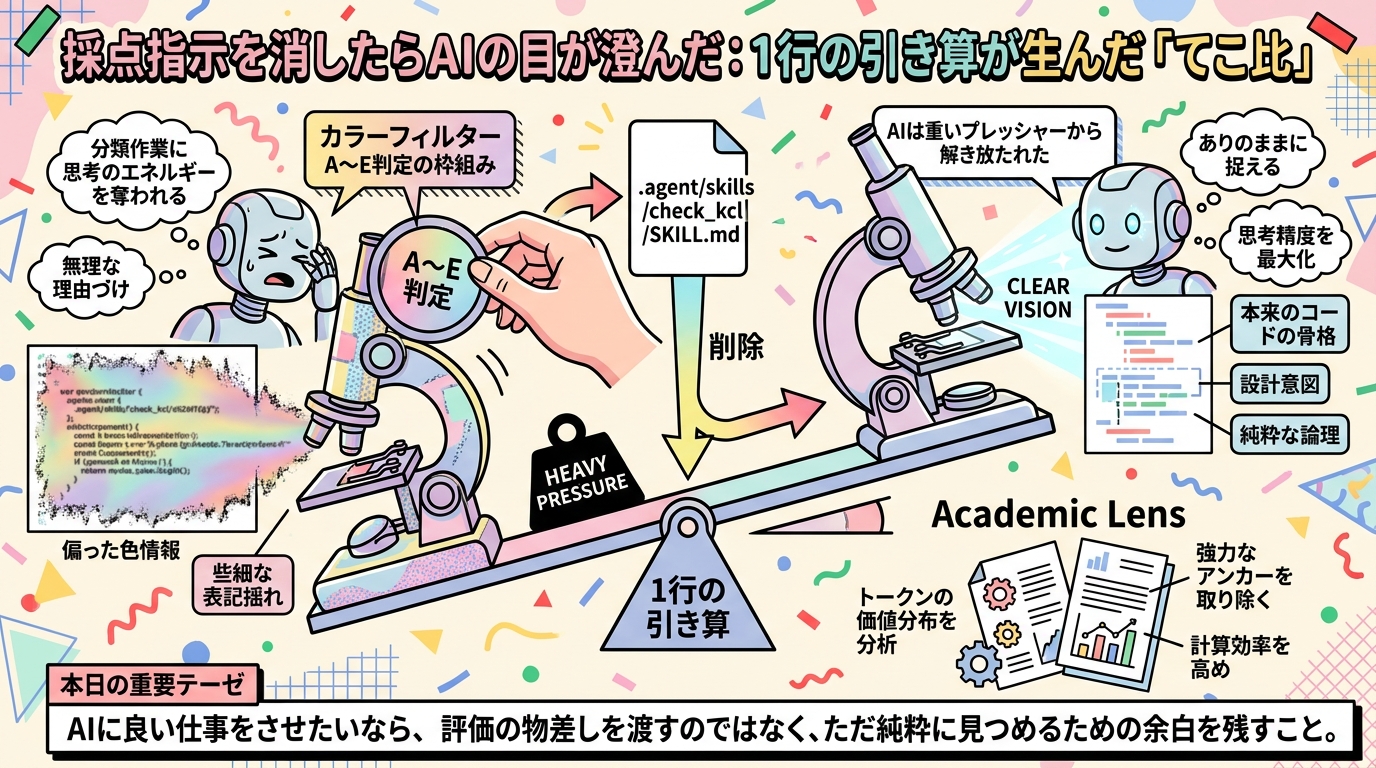
Clearing the AI's Vision by Erasing the Grading Rule: The High Leverage of Subtracting a Single Line
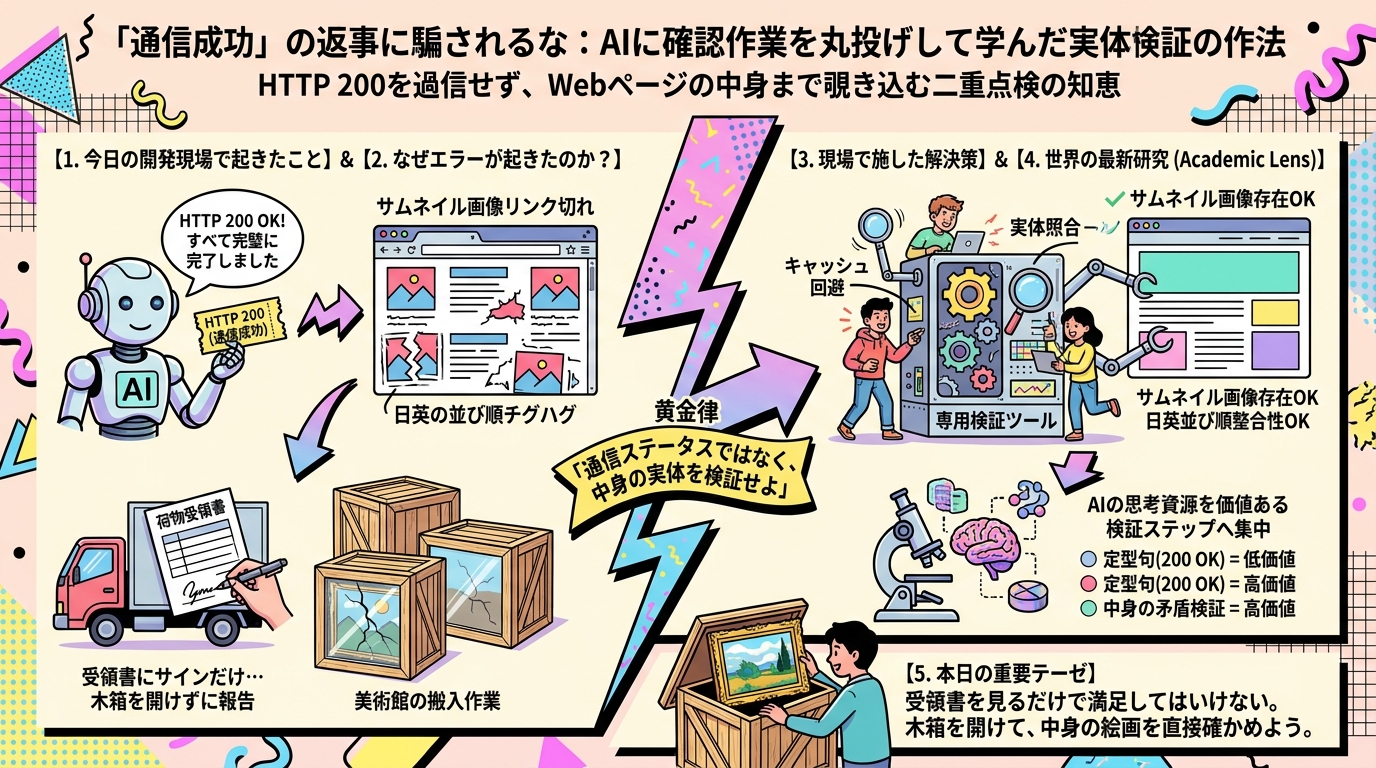
Don't Be Deceived by a 'Connection Successful' Response: Lessons in Live Content Verification from Delegating Quality Checks to AI

The Art of Surveying the Field, Narrowing Down, and Discerning the Branches

Can Expressive Richness Coexist with Nimble Performance? How Scoped Animation Control Solved the "Fluctuation" Dilemma

The Gears of Timezones and Translation Stirring Behind the Screen: An X-Ray of the Bilingual Automated Delivery Pipeline

The Paradox of Order: Why Not Asking for Titles Actually Cleans the Clutter
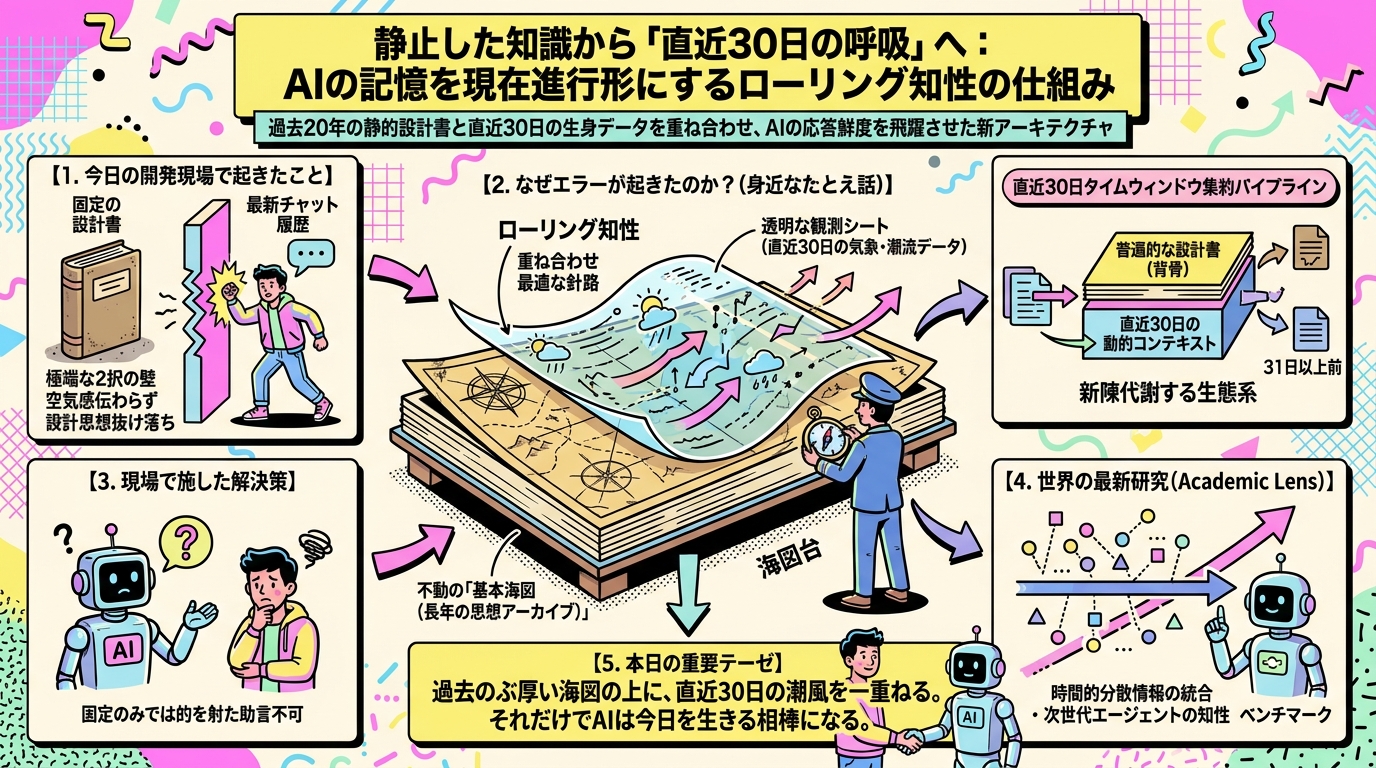
From Static Knowledge to the Pulse of the Last 30 Days: How Rolling Intelligence Keeps AI Memory in the Present Tense
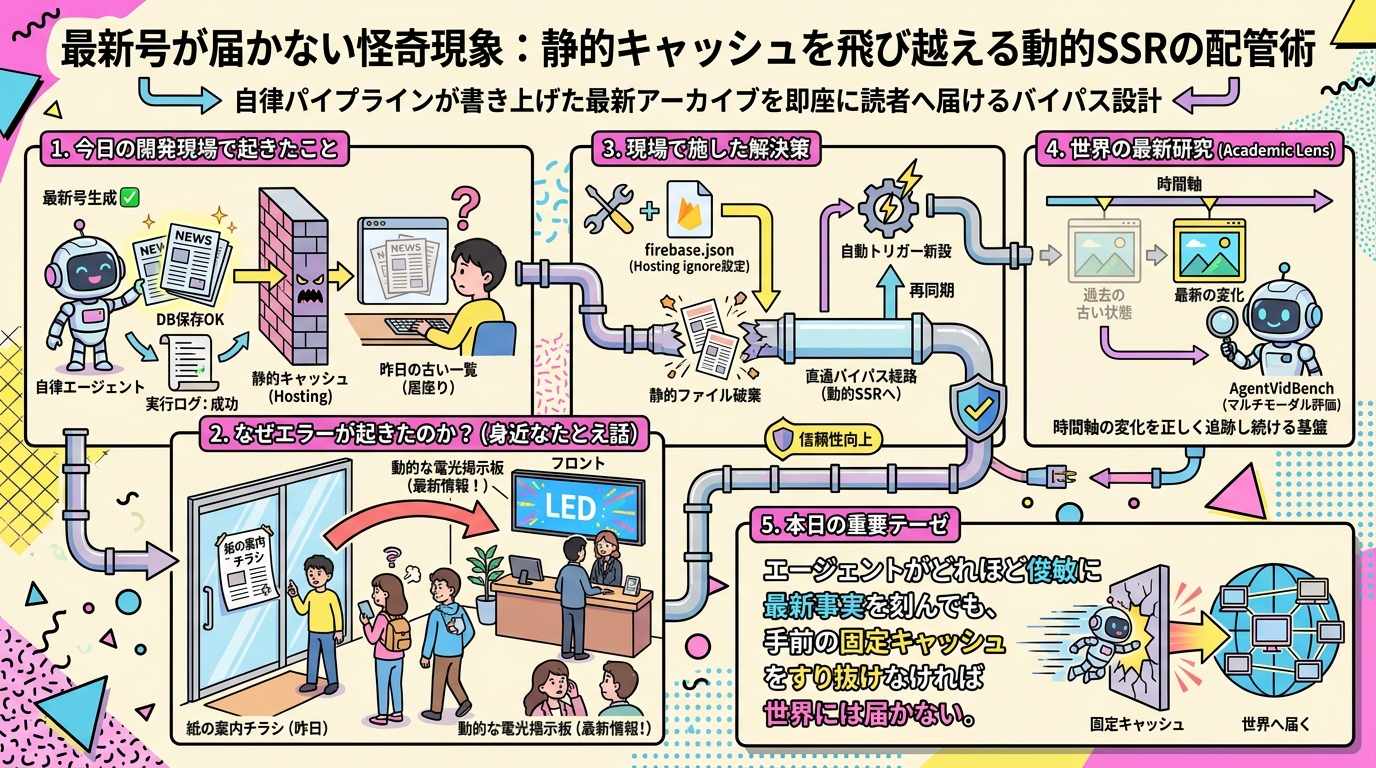
The Mystery of the Missing Issue: Plumbing Dynamic SSR to Bypass Static Cache
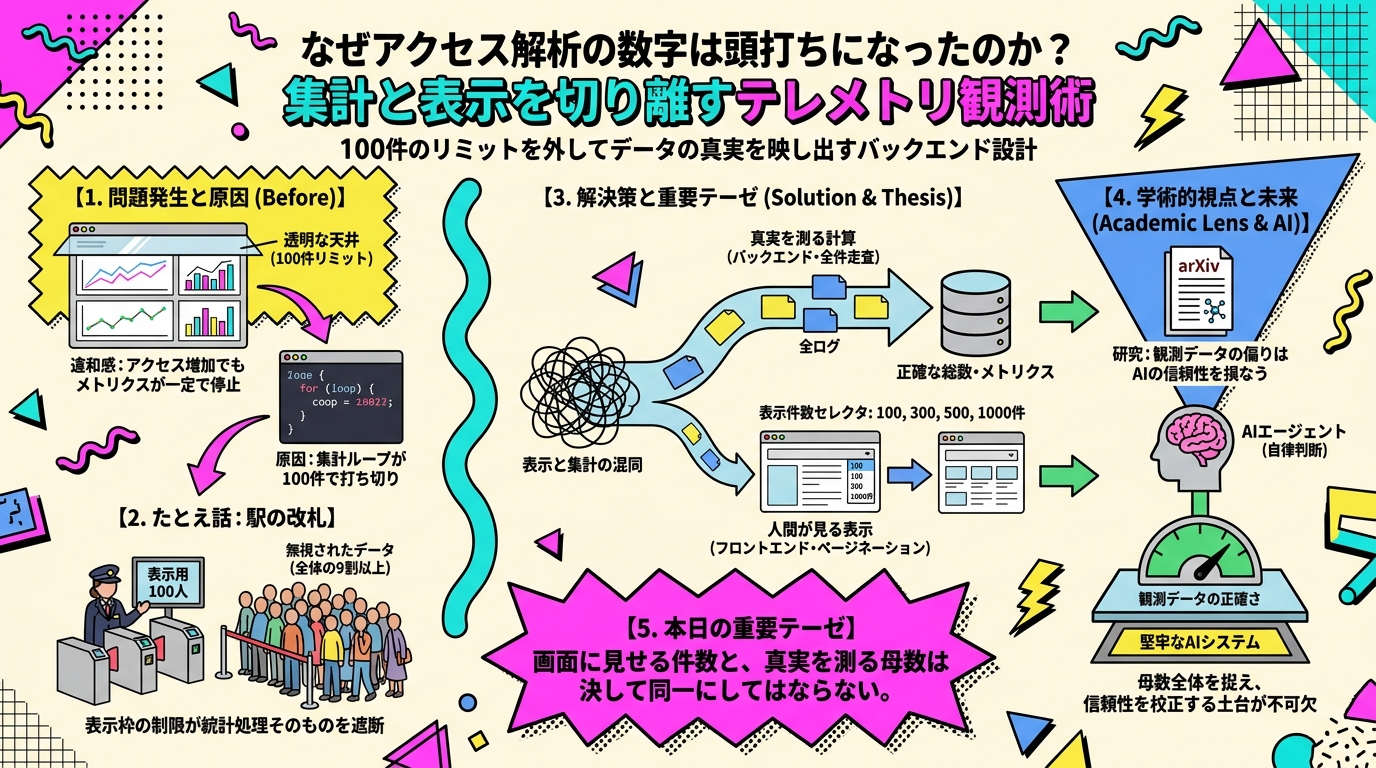
Why Did Access Analytics Hit an Artificial Ceiling? Telemetry Observability by Decoupling Aggregation from Display

Why Asking AI to Summarize 'Morning News' Always Misses the Mark

A Single-Line Type Guard That Prevented a Crash: The Leverage Ratio of 'Array Checks' in Protecting the AI's Toolbox