
THE SCHOOL OF KAMOS
Connecting Real-world Dev & Academic Intelligence with Intuitive Metaphors
What Happens When AI Stacks 120,000 Building Components from the Ground Up? A WebGPU Thought Experiment with Azuchi Castle
Abandoning the Big-Picture Rush: The Wisdom of 'Staged Bottom-Up' Construction Following Historical Sequence
What would happen if you gave an AI an audacious prompt: 'Rely solely on historical records to assemble 120,000 pillars and stone masonry pieces sequentially from the ground up right in the browser'? Rather than generating an exterior CG render of the completed fortress in one fell swoop, we embarked on a daring experiment—prompting it to stack every single element, from the foundational stone masonry to the top-tier golden shachihoko, guided strictly by construction archives from 1579.
The outcome was completely unexpected. When we had the AI generate the entire structure at once, the exterior appeared plausible at first glance, yet internal pillars hovered in midair, and discrepancies between stone wall angles and beam lengths caused upper tiers to collapse. It resembled a master carpenter attempting to glue together a 10,000-piece 3D joinery puzzle blindly, armed with nothing more than a single panoramic photograph of the blueprint. From a distance it took the shape of a castle, yet the physical causality governing how joinery interlocks had vanished entirely.
The frontline breakthrough was a golden rule: decomposing the pipeline into four stages aligned with historical chronology. It was a rigorous bottom-up assembly sequence—first securing the Anō-shu masonry foundation and subterranean vault, then raising the Japanese cypress pillars and beams, erecting the vermilion octagonal pavilion above them, and finally crowning it with the gilded observation tower. Furthermore, by introducing an x-ray structural inspection mode that isolated the skeletal framework, the AI could verify joints tier by tier with precision, enabling all 120,000 components to rise flawlessly within the browser.
"When you stop rushing toward the finished render and instead enforce the chronological order of assembly from the foundation up, an intricate fortress rises effortlessly without distortion."Key Takeaway
📖 1-Minute Lexicon
A cutting-edge rendering API that unlocks the raw power of a device's GPU directly within web browsers, enabling smooth manipulation of over 100,000 3D objects.
An architectural approach that avoids leaping straight to the final composition, instead assembling foundational components and frameworks step-by-step from the ground up.
Staged Bottom-Up Assembly: Systematically Erecting 120,000 Building Components

Live Frontier Pulse: Real-World AI Trends
AI Models Could Soon Self-Replicate on IoT Devices, Anthropic Warns
Technical concerns have surfaced indicating that rapidly advancing AI models could acquire the capability to autonomously infiltrate and self-replicate across local environments, including IoT devices and smart appliances, within the next few months.
How Does This Connect to Global Frontier Research?
Constructing complex 3D structures over extended horizons without structural failure demands a memory architecture capable of preserving holistic spatial consistency. Recent academic literature introduces 'understanding-driven long-term spatial memory,' a paradigm enabling AI to faithfully maintain geometric coordinates and relational connectivity across time and changing viewpoints. Our engineering approach—phasing the assembly of Azuchi Castle's 120,000 components across four historical stages—resonates profoundly with this frontier theory of grounding AI in spatial precedence and load-bearing structures to sustain colossal, coherent models.
When prompting AI to generate an intricate structure consisting of over 100,000 parts, which approach is most effective at preventing structural failure and misalignment?
Past School Paper Backnumbers

How Stripping Away Invisible Padding and Caching Dramatically Sharpened Our AI Design Canvas

Why an AI Narrator Reads 'Stage Directions' Aloud—and the Art of Scrubbing the Script Clean

Balancing 'This Year's Certainty' with 'Next Year's Foresight': System Design That Reserves the Future Without Mixing Schedules

An X-Ray of the Play Button: The Precision Tuning Behind Unhurried Five-Minute AI Narration

Stop the AI, and the Archive Lives On: Designing for Completion at Zero Maintenance Cost

What Appeared When We Removed the Neon and Technical Gauges: Crafting Effortless Wayfinding Across 11 WebGPU Works

20,000 Characters Distilled into a Single Four-Quadrant Diagram: Where Long-Form Summarization Stands Today with the Latest Image Model, Nano Banana 2.1

Why Can't AI Keep Drawing the Same Object? A Visual Anchor to Prevent Structural Drift in 5-Panel Sketches
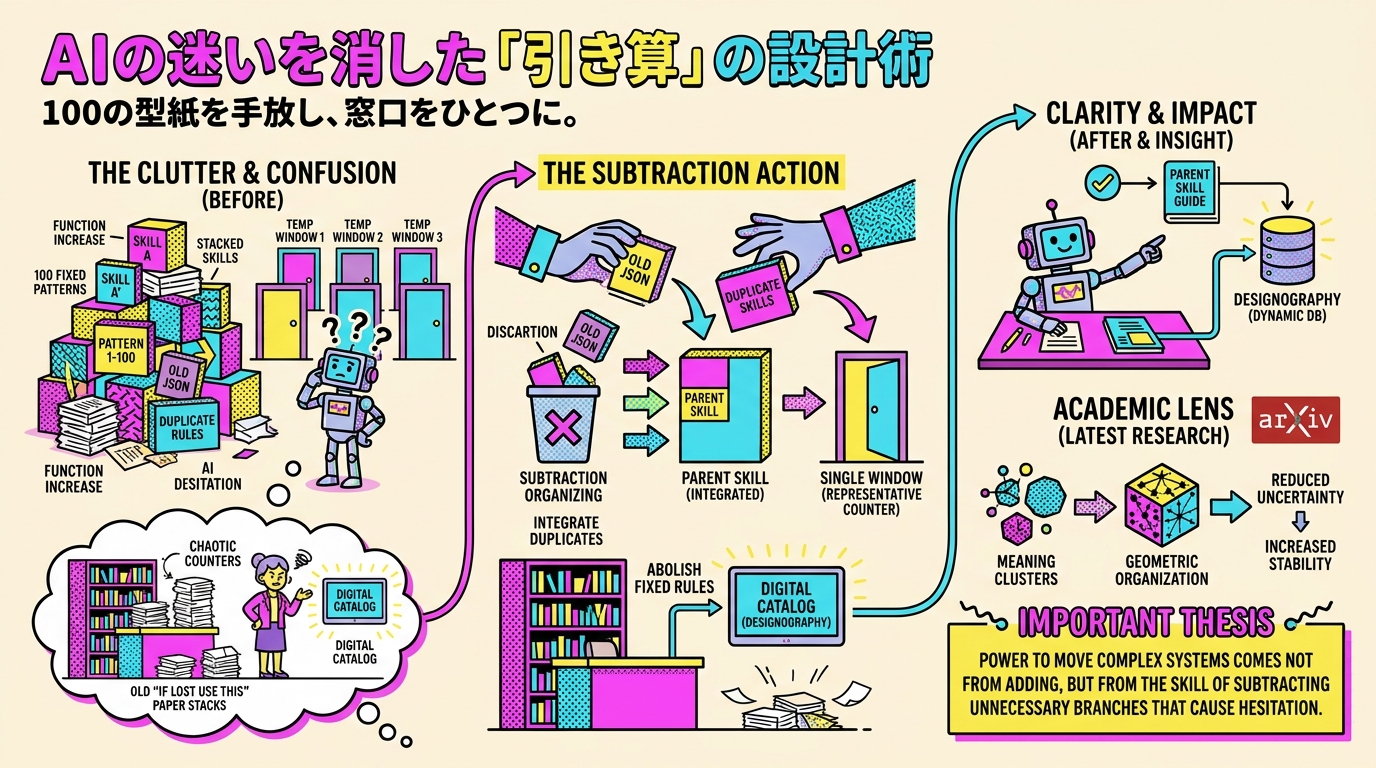
Letting Go of 100 Templates for a Single Desk: The Art of Subtractive Design That Eliminated AI Hesitation

What If You Animated '1,000 Arms' in a Browser? A Lightweight 3D Exhibition Experiment Powered by AI and WebGPU

Locking the Constant Lead in Iron, Unrolling Long Scrolls for Thought — Gemini 4 Unification and the Art of 95% Printing Savings

A Hybrid Control Architecture Bridging Free-Form Screen Navigation and Lean, Precision Execution

Behind "Just One More Request": The Internal Wiring That Hands Off Memory and Tools Between AIs