THE SCHOOL OF KAMOS
Connecting Real-world Dev & Academic Intelligence with Intuitive Metaphors
Why Do AIs and Automated Reports Suddenly Collapse When Consolidating Multiple Data Sources?
The Art of Streamlining Cross-Aggregation Pipelines to Bundle Disparate Data Sources Without Failure
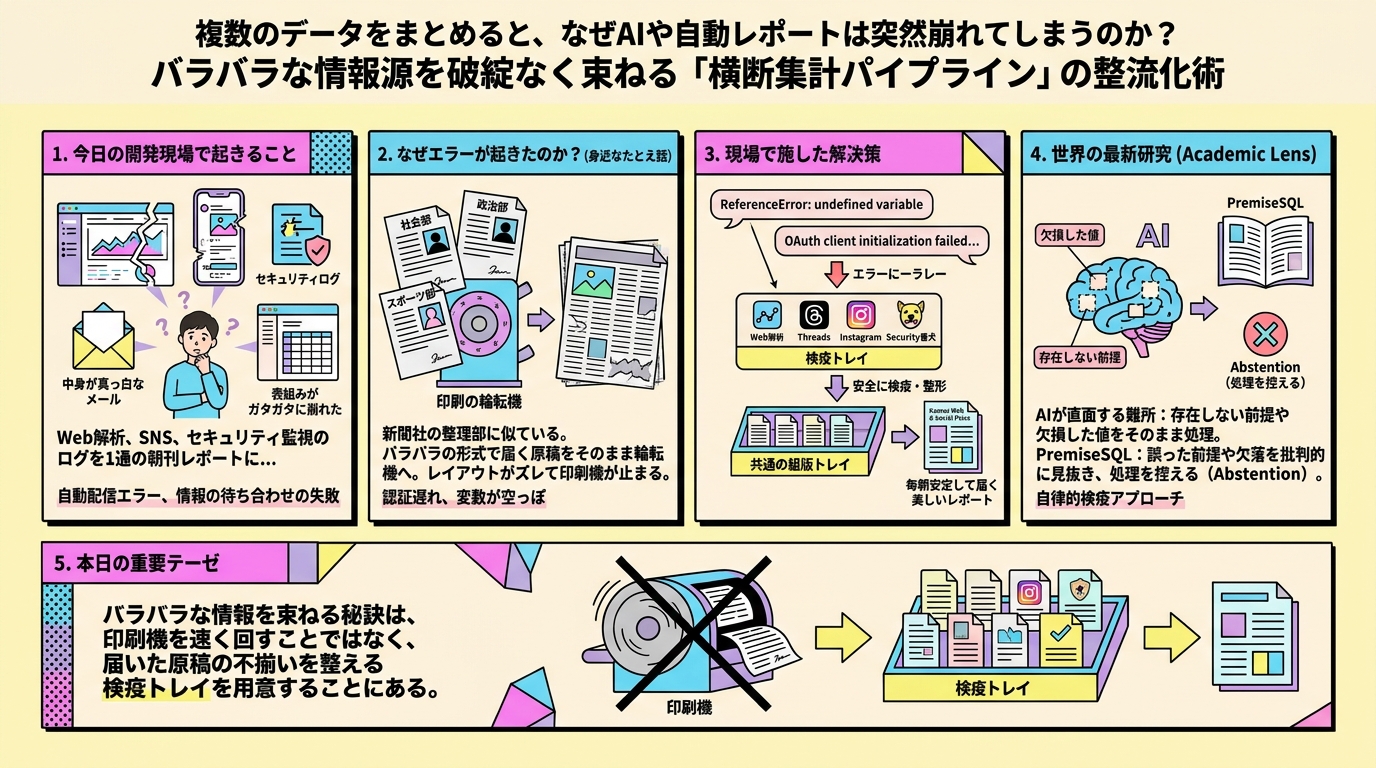
"We want to bundle Web analytics, social media, and security monitoring logs into a single morning digest report." Driven by this ambition, we activated automated delivery—only to face broken table layouts mid-stream and entirely blank emails landing in inboxes. Why do automated pipelines suddenly turn brittle when attempting to unify disparate sources? Investigating the delivery failures on the frontline revealed the true culprit: rendezvous failures that arise when synchronizing across multiple integration endpoints simultaneously.
This phenomenon closely mirrors the copy desk of a newspaper office right before morning print. Imagine feeding manuscripts arriving in mismatched formats from city news, politics, and sports desks straight into the rotary press without pre-flight checks. If a single draft lacks an attached photograph or leaves the reporter's byline blank, the entire newspaper's page layout distorts, grinding the press to a halt. Automated digest reports suffer from the exact same vulnerability: an authentication timeout from a single upstream provider or an empty variable arrival breaks the typesetting of the entire document.
To remedy this, rather than passively awaiting incoming updates from each channel, the engineering team introduced a normalization mechanism at the intake gateway to verify required fields, ensuring that even if one transmission lags, the overall page integrity remains intact. Specifically, we redesigned the pipeline into 'Kamos Web & Social Pulse'—a system that securely quarantines and normalizes data collected over the past seven days across four disparate sources: Web analytics (GA4 and trace logs), Threads, Instagram, and our security watchdog (Blue Impulse), extracting the top five insights. By retiring legacy delivery routes and introducing a unified typesetting tray impervious to undefined variables, we achieved a flawlessly formatted report delivered reliably every morning.
"The secret to unifying scattered information is not spinning the printing press faster, but providing a quarantine tray to reconcile incoming discrepancies before they go to print."Key Takeaway
📖 1-Minute Lexicon
A state in code where a variable name is referenced, but holds no assigned value or content.
An automated mechanism that collects and measures usage metrics and operational data remotely from websites and social media platforms.
Architecture of Cross-Platform Pulse Aggregation for Safely Unifying Multiple Data Sources
Live Frontier Pulse: Real-World AI Trends
PremiseSQL Released: A New Benchmark Evaluating Premise Critique and Abstention in LLM-Based Text-to-SQL Systems
The PremiseSQL benchmark has been unveiled to assess an LLM's capacity to correctly detect flawed user premises or non-existent data conditions and abstain from generating invalid queries. It emphasizes systemic robustness: returning silence or explicit warnings when confronted with incomplete data sources.
How Does This Connect to Global Frontier Research?
When pulling and consolidating information across multiple data sources, the greatest obstacle AI faces is naively processing non-existent premises or missing values, yielding erroneous outputs. The latest research published on arXiv, 'PremiseSQL', introduces an evaluation framework for Text-to-SQL AI systems to assess their ability to critically identify flawed premises or missing variables in queries and deliberately abstain from generating fabricated responses. Our engineering approach—designing a sanitized pipeline that detects gaps and prevents crashes triggered by undefined variables—deeply resonates with this autonomous quarantine methodology essential for maintaining the robustness of modern AI systems.
When compiling automated reports from multiple web services and social platforms, which measure is most effective in preventing layout collapses?
Past School Paper Backnumbers

How Stripping Away Invisible Padding and Caching Dramatically Sharpened Our AI Design Canvas

Why an AI Narrator Reads 'Stage Directions' Aloud—and the Art of Scrubbing the Script Clean

Balancing 'This Year's Certainty' with 'Next Year's Foresight': System Design That Reserves the Future Without Mixing Schedules

An X-Ray of the Play Button: The Precision Tuning Behind Unhurried Five-Minute AI Narration

Stop the AI, and the Archive Lives On: Designing for Completion at Zero Maintenance Cost

What Appeared When We Removed the Neon and Technical Gauges: Crafting Effortless Wayfinding Across 11 WebGPU Works

20,000 Characters Distilled into a Single Four-Quadrant Diagram: Where Long-Form Summarization Stands Today with the Latest Image Model, Nano Banana 2.1

Why Can't AI Keep Drawing the Same Object? A Visual Anchor to Prevent Structural Drift in 5-Panel Sketches
Letting Go of 100 Templates for a Single Desk: The Art of Subtractive Design That Eliminated AI Hesitation

What If You Animated '1,000 Arms' in a Browser? A Lightweight 3D Exhibition Experiment Powered by AI and WebGPU
Locking the Constant Lead in Iron, Unrolling Long Scrolls for Thought — Gemini 4 Unification and the Art of 95% Printing Savings
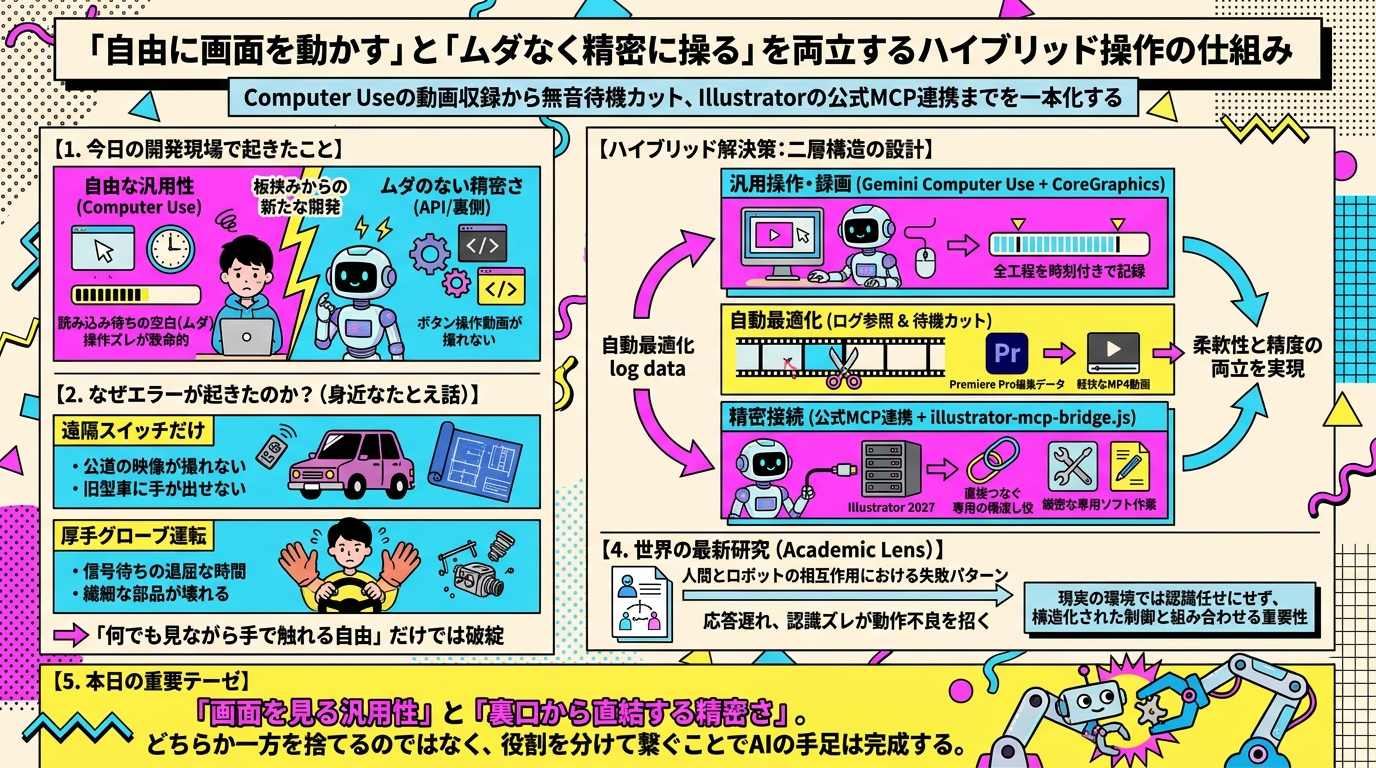
A Hybrid Control Architecture Bridging Free-Form Screen Navigation and Lean, Precision Execution
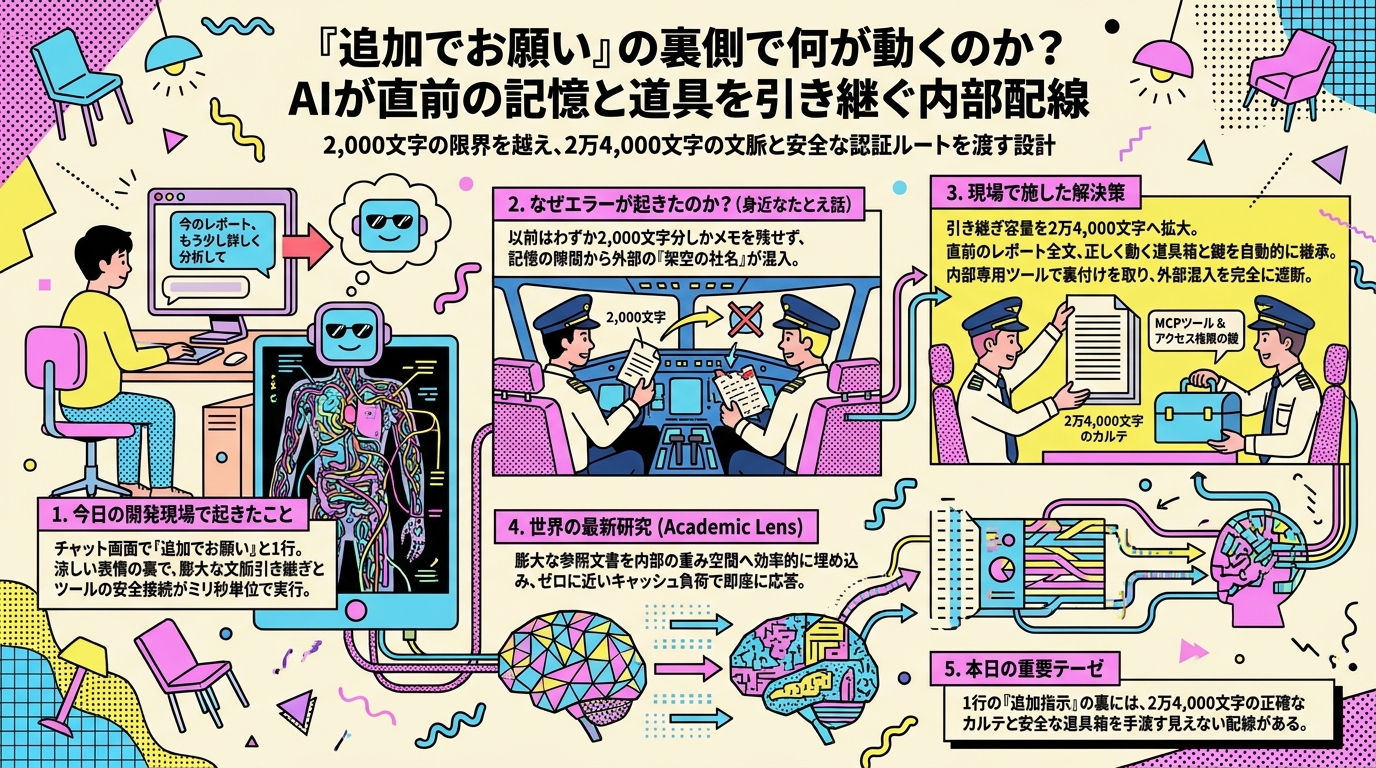
Behind "Just One More Request": The Internal Wiring That Hands Off Memory and Tools Between AIs