THE SCHOOL OF KAMOS
Connecting Real-world Dev & Academic Intelligence with Intuitive Metaphors
From Blanket Search to Two-Tier Grounding: Engineering Life-Saving AI Information Networks in Disasters
Decoupling wide-area sensors from precision investigation agents to capture the critical first 72 hours minute by minute
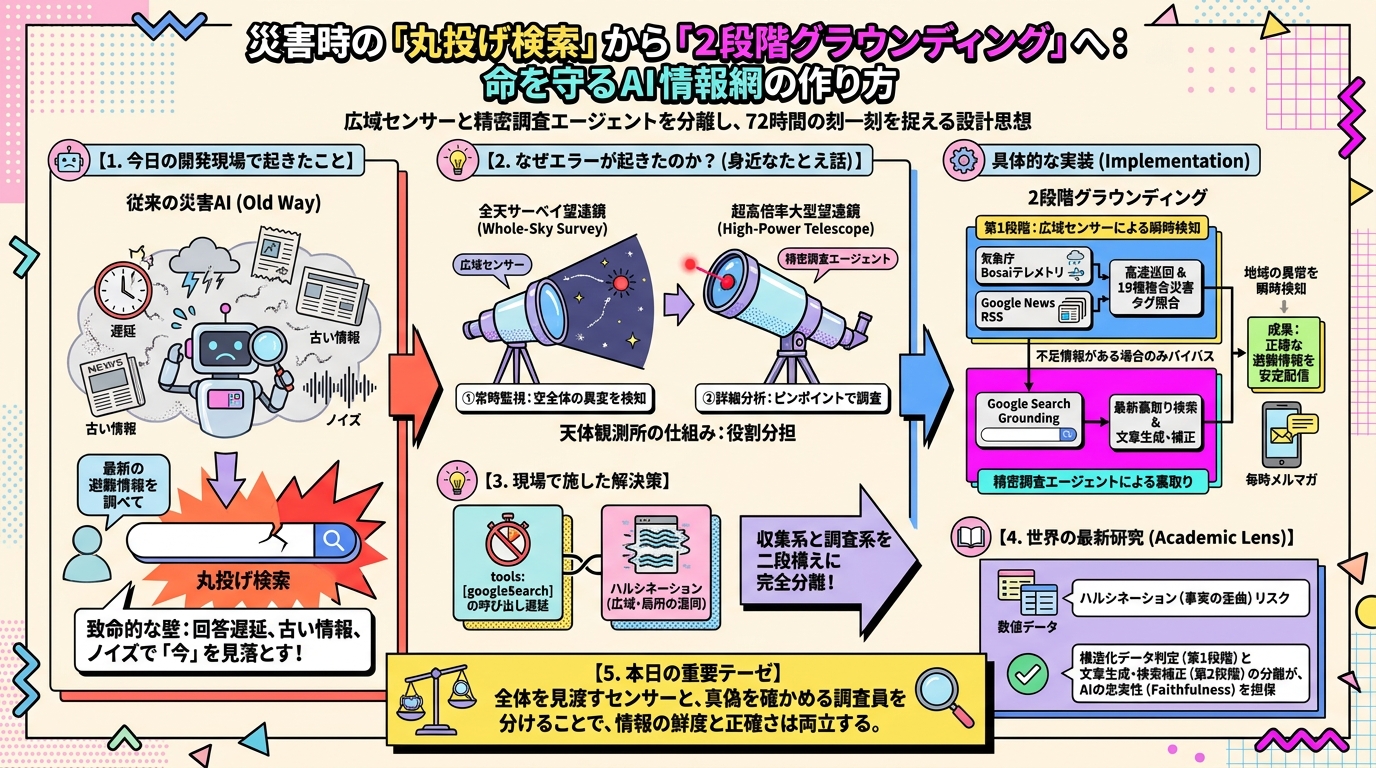
Historically, disaster-response AI relied on prompts like "Check the latest evacuation information," leaving the AI to scour the vast expanse of the open web unaided. However, this blanket approach hit a fatal wall. Not only did search latency delay responses by dozens of critical seconds, but the model frequently retrieved stale reports from days prior or irrelevant noise—fatally overlooking the most vital question: "What danger is unfolding right here, right now?"
To overcome this bottleneck, the engineering team drew inspiration from astronomical observatories. When searching for cosmic anomalies, no astronomer blindly scans the entire sky using a single high-magnification telescope. Instead, a wide-angle "all-sky survey telescope" continuously monitors broad shifts in brightness across the heavens, and only when an anomaly is flagged does a "massive ultra-high-magnification telescope" pivot to those exact coordinates for deep analysis. Applying this division of labor to disaster agents, we decoupled data harvesting from targeted investigation into a clean two-tier architecture.
In our concrete implementation, Tier 1 executes rapid, parallel sweeps across the Japan Meteorological Agency's Bosai telemetry and Google News RSS feeds, matching real-time data against 19 compound disaster tags to detect local anomalies instantaneously. Tier 2 then triggers only when field notes lack granular specifics, automatically bypassing queries to an investigative agent equipped with Google Search Grounding to execute targeted fact-checking. This two-tier pipeline eliminates idle latency while ensuring the reliable, hourly delivery of accurate evacuation intelligence via newsletters.
"Decoupling wide-angle monitoring sensors from precision investigators is how freshness and factual accuracy coexist."Key Takeaway
📖 1-Minute Lexicon
A technique that anchors AI outputs to trusted external data or live search results rather than relying solely on parametric memory, ensuring factual accuracy.
Automated numeric and state data transmitted from remote sensors, measurement devices, and field instruments.
Architecture of the Dual-Tier Crisis Pipeline
Live Frontier Pulse: Real-World AI Trends
Agentic Optimization of Scheduling Policies for Satellite-Cellular Edge Services
In extreme environments where satellite communications and terrestrial cellular networks converge, researchers have introduced "SatCraft," a framework where LLM agents autonomously and iteratively optimize scheduling policies for communication code.
How Does This Connect to Global Frontier Research?
When synthesizing evacuation instructions for residents from structured inputs like meteorological telemetry and disaster tags, AI hallucinations—such as fabricating figures—pose a life-threatening risk. This paper diagnoses and investigates at which stages tabular-to-text generation models deviate from factual source data. Our production architecture—decoupling structured tag evaluation (Tier 1) from text generation and targeted search verification (Tier 2)—closely aligns with academic guidelines for guaranteeing faithfulness in generative AI.
When every second counts during a disaster, what is the single greatest flaw of having an AI perform an unconstrained, blanket web search?
Past School Paper Backnumbers
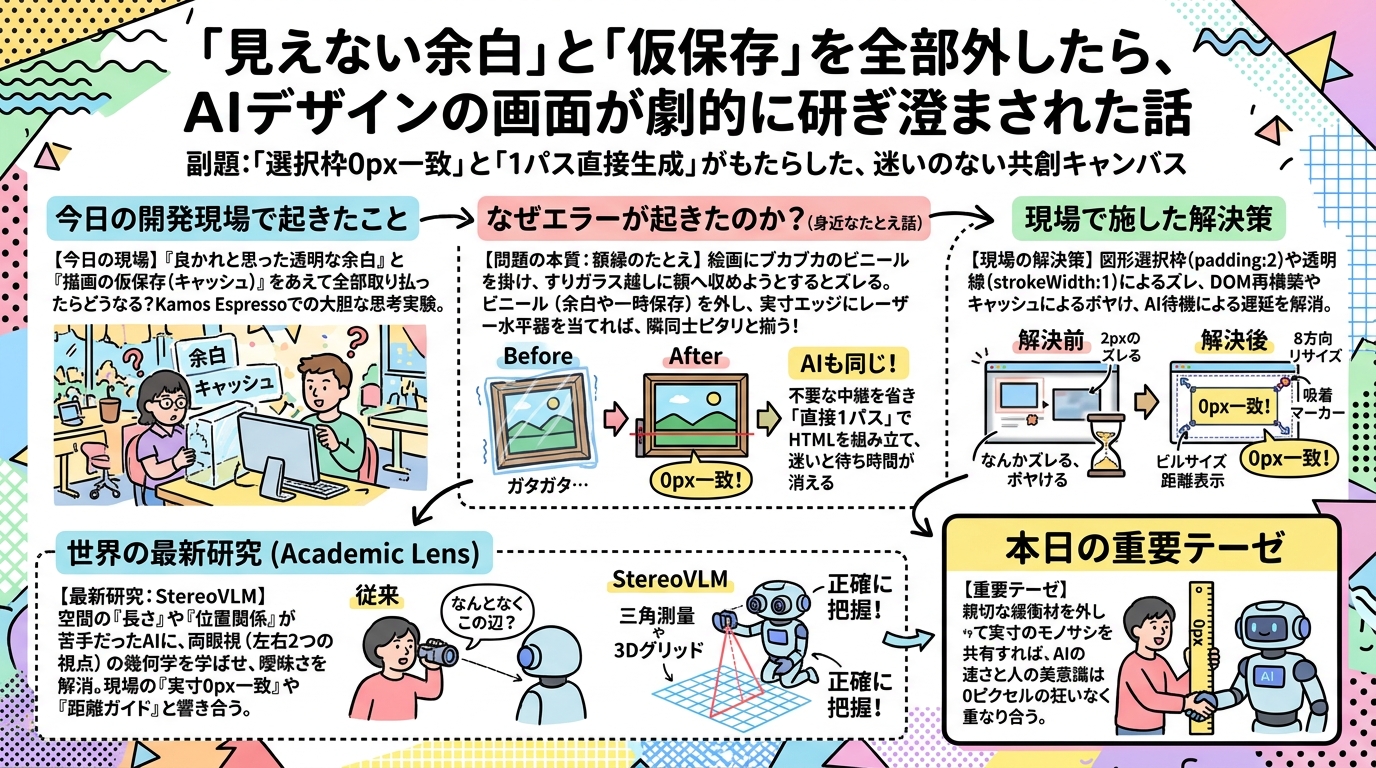
How Stripping Away Invisible Padding and Caching Dramatically Sharpened Our AI Design Canvas
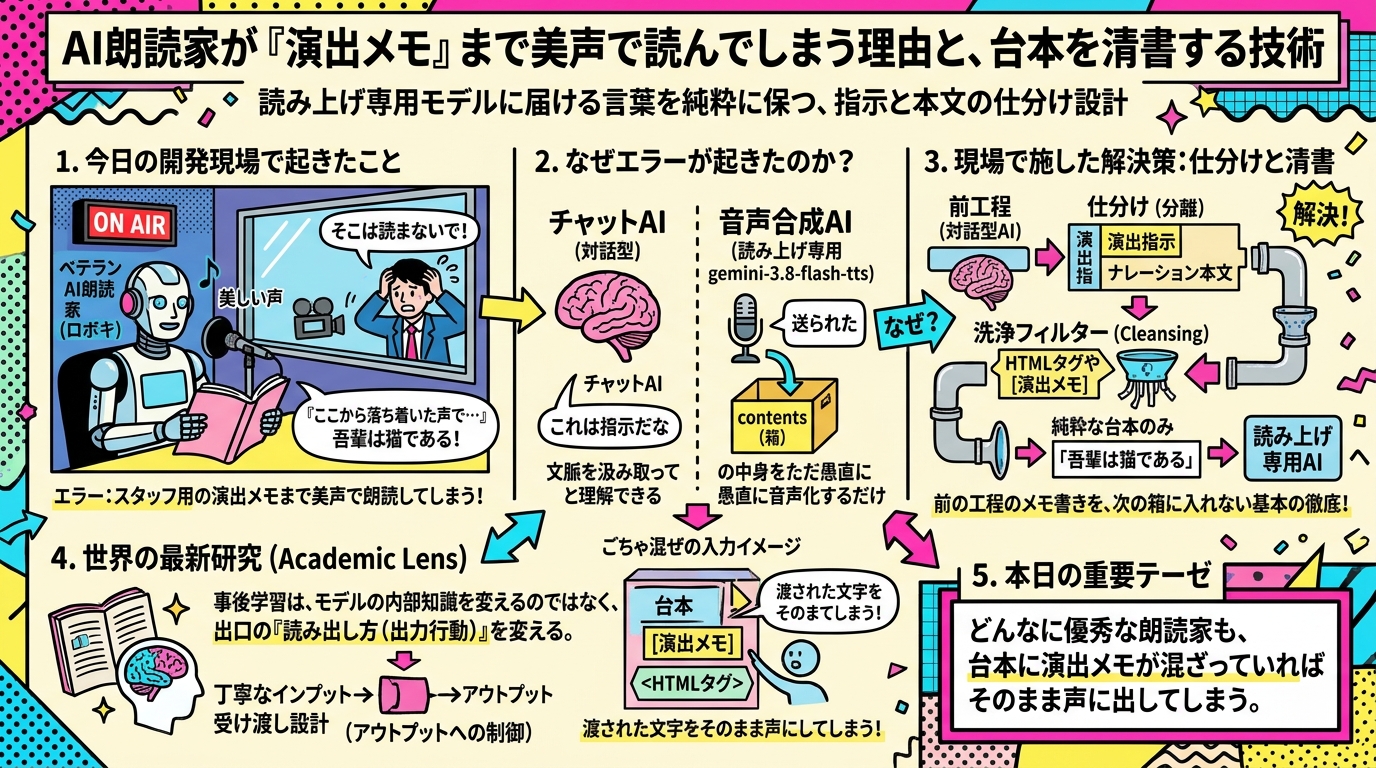
Why an AI Narrator Reads 'Stage Directions' Aloud—and the Art of Scrubbing the Script Clean
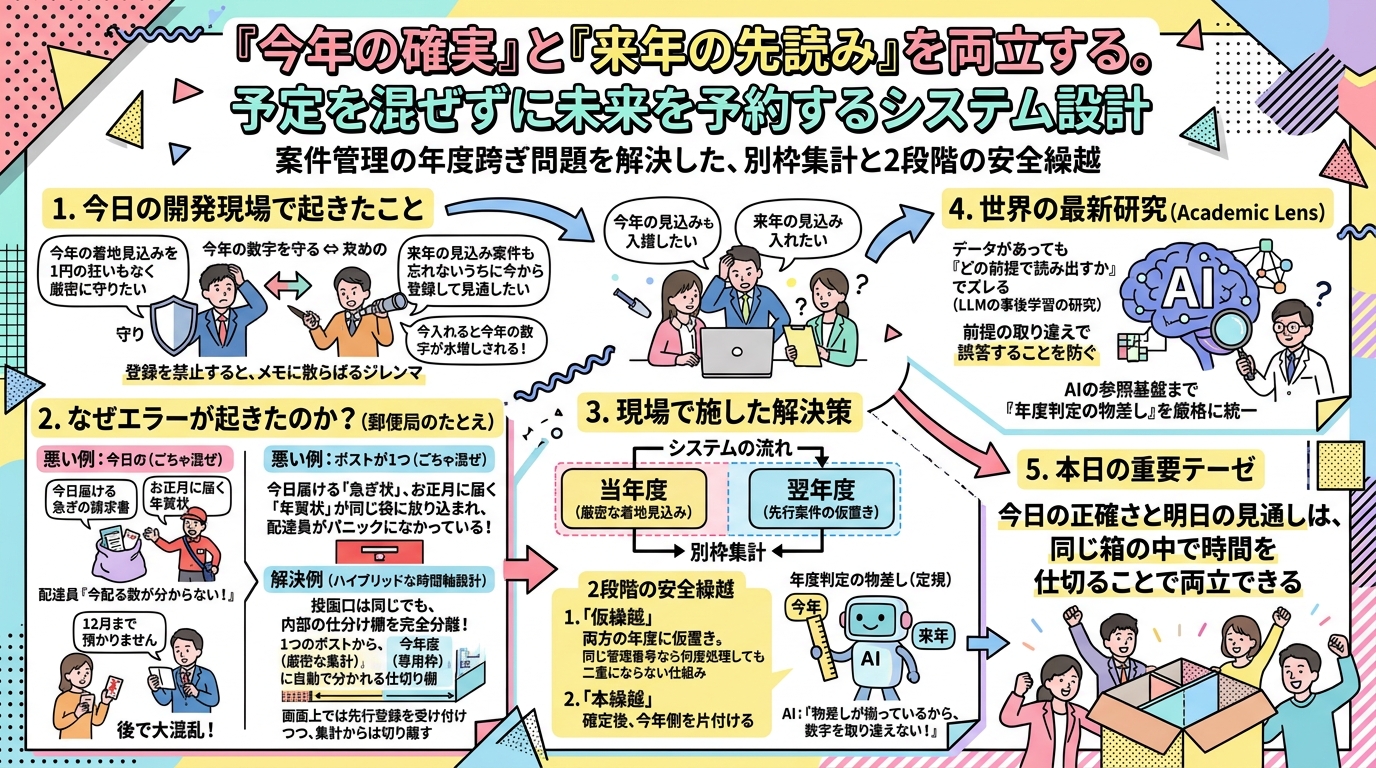
Balancing 'This Year's Certainty' with 'Next Year's Foresight': System Design That Reserves the Future Without Mixing Schedules
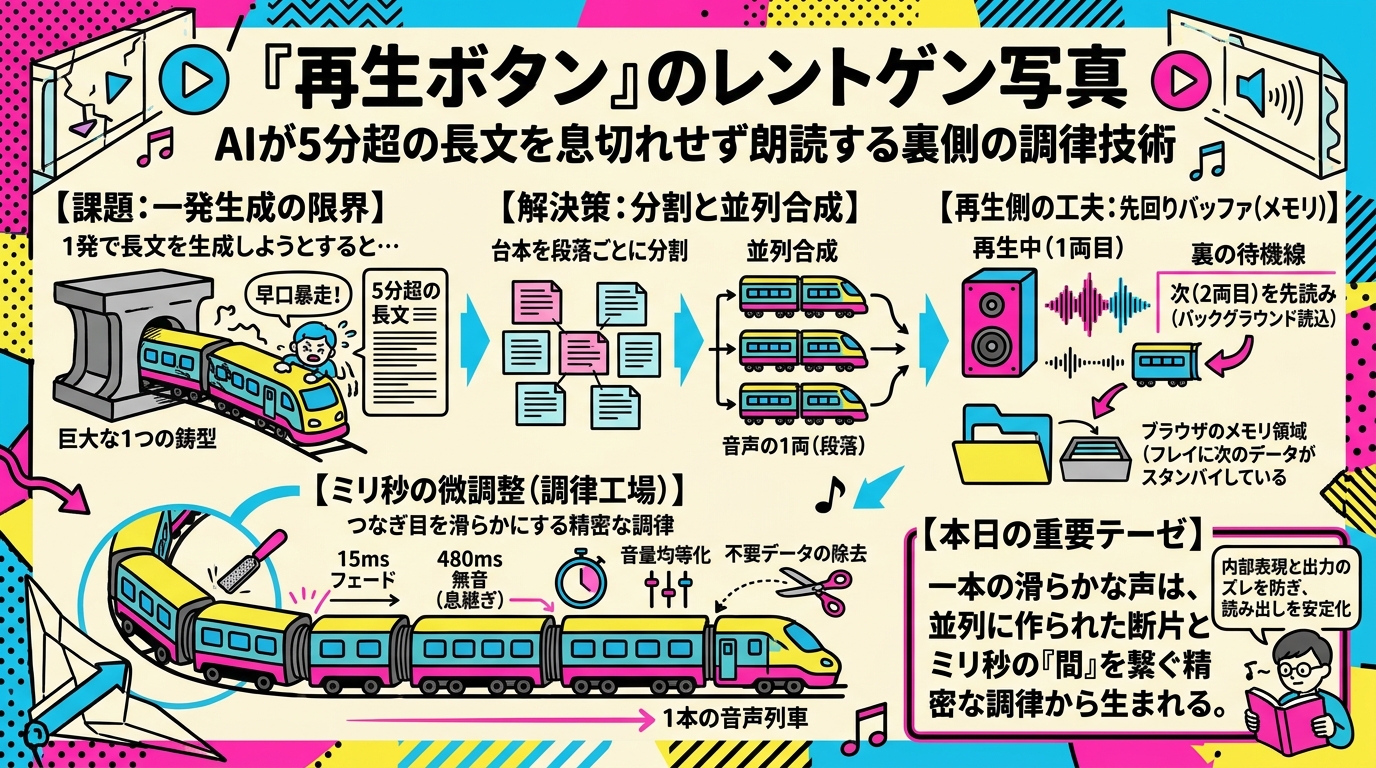
An X-Ray of the Play Button: The Precision Tuning Behind Unhurried Five-Minute AI Narration
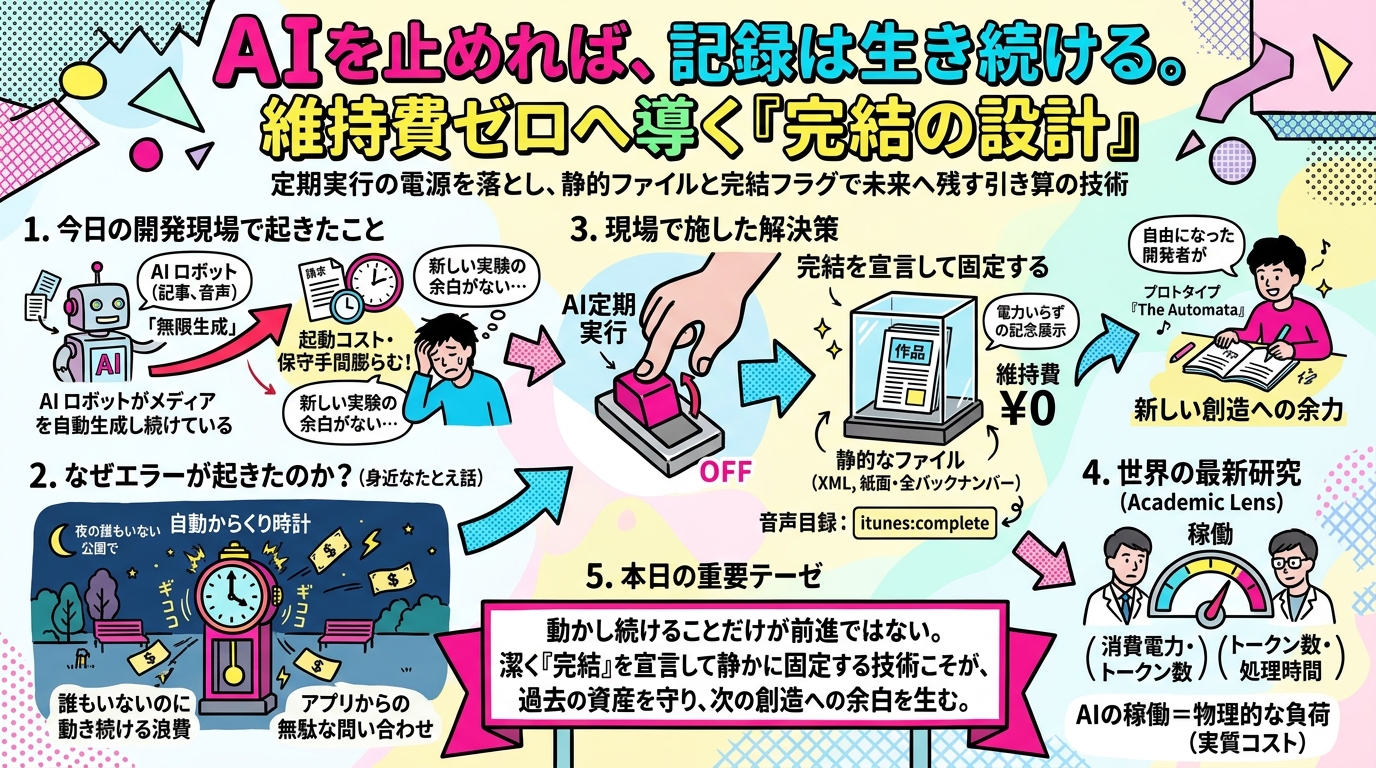
Stop the AI, and the Archive Lives On: Designing for Completion at Zero Maintenance Cost
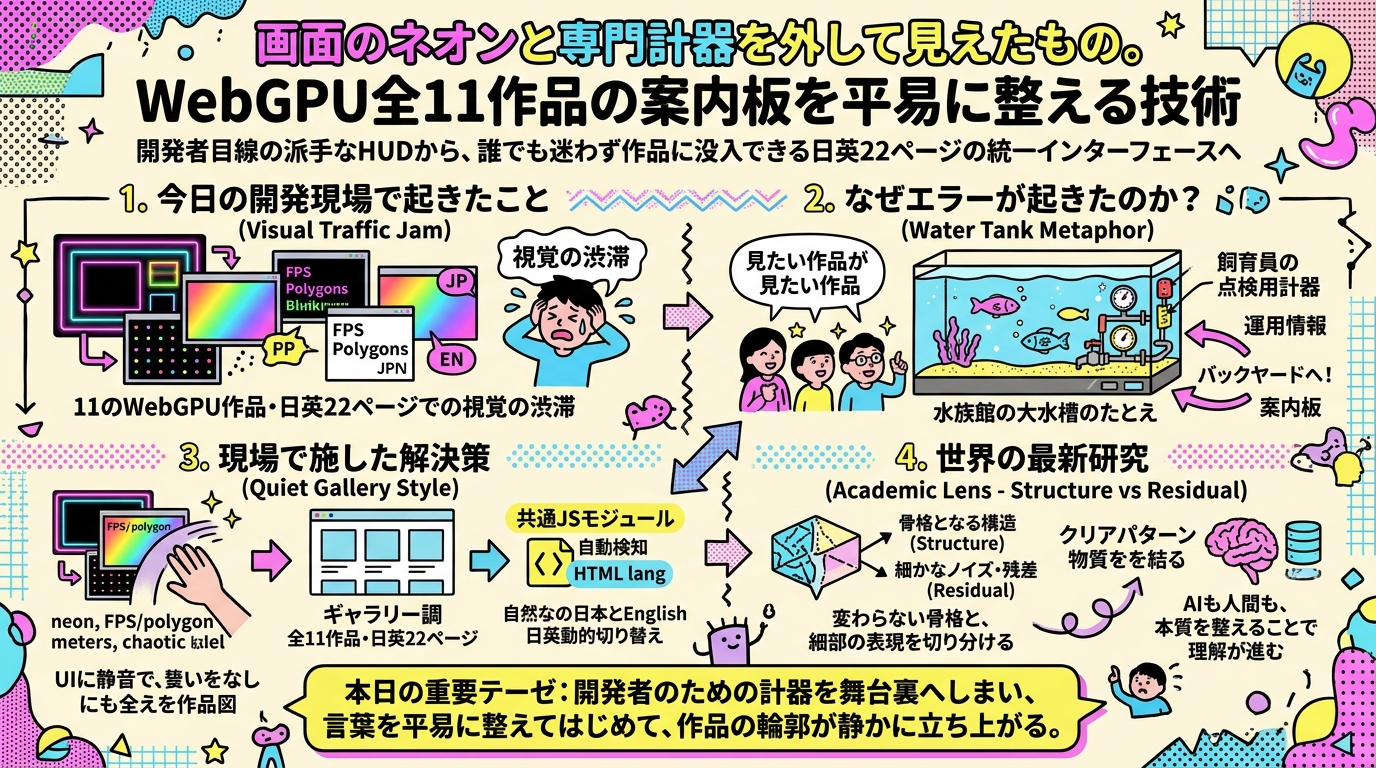
What Appeared When We Removed the Neon and Technical Gauges: Crafting Effortless Wayfinding Across 11 WebGPU Works
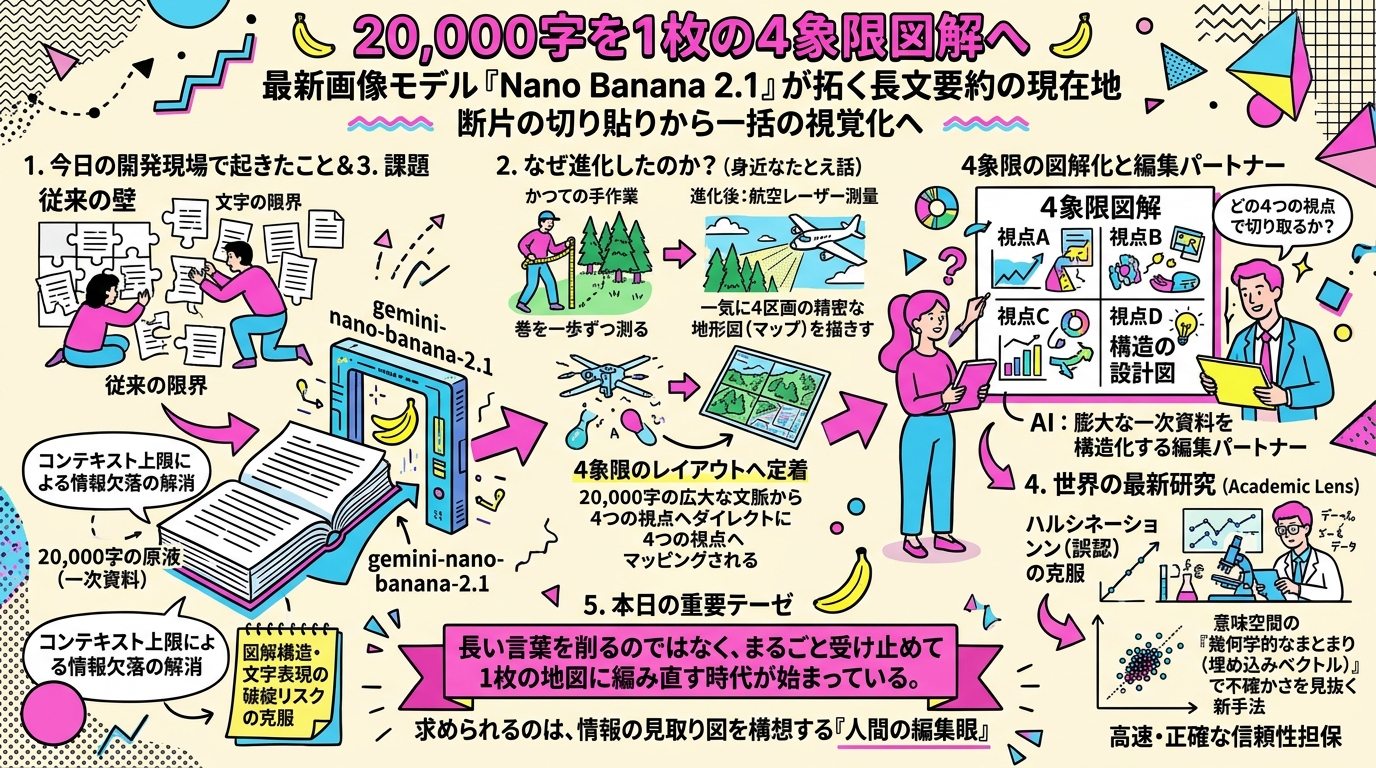
20,000 Characters Distilled into a Single Four-Quadrant Diagram: Where Long-Form Summarization Stands Today with the Latest Image Model, Nano Banana 2.1
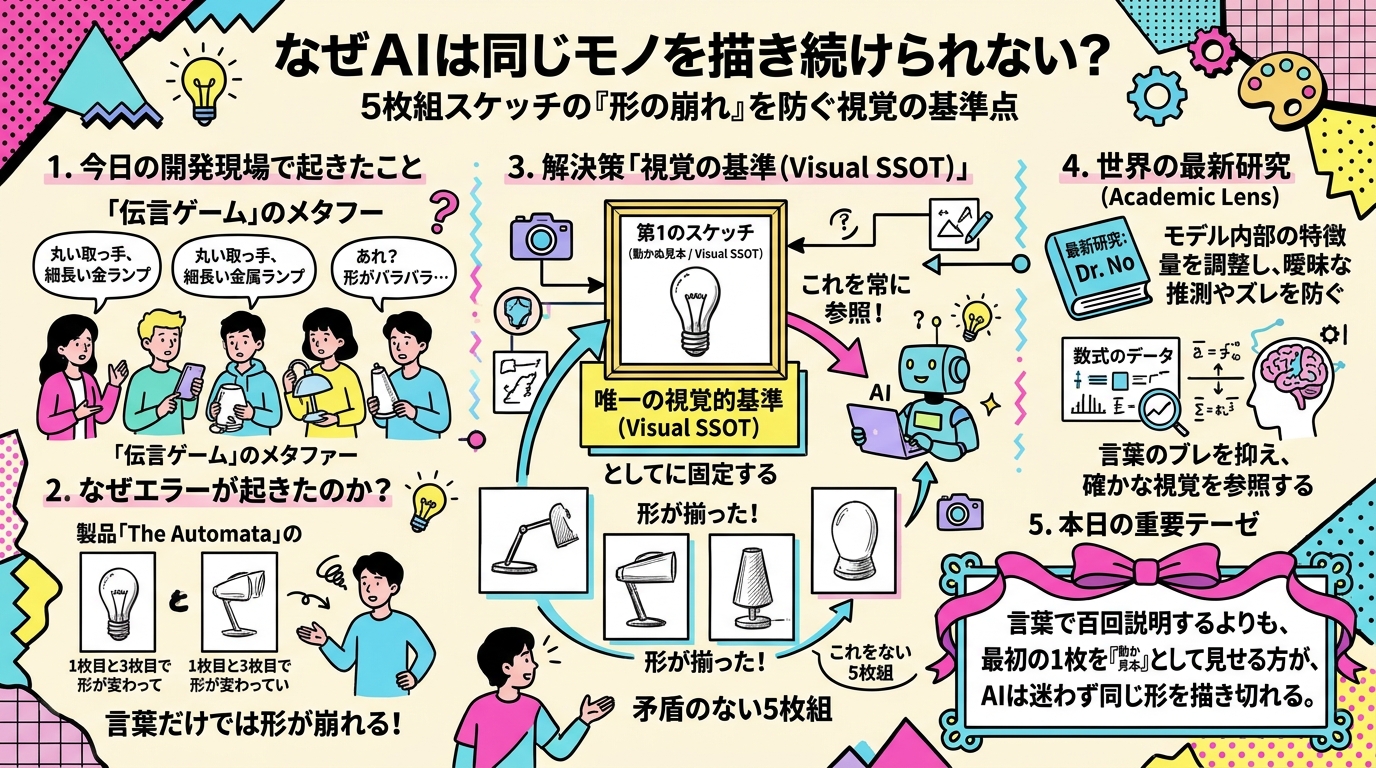
Why Can't AI Keep Drawing the Same Object? A Visual Anchor to Prevent Structural Drift in 5-Panel Sketches
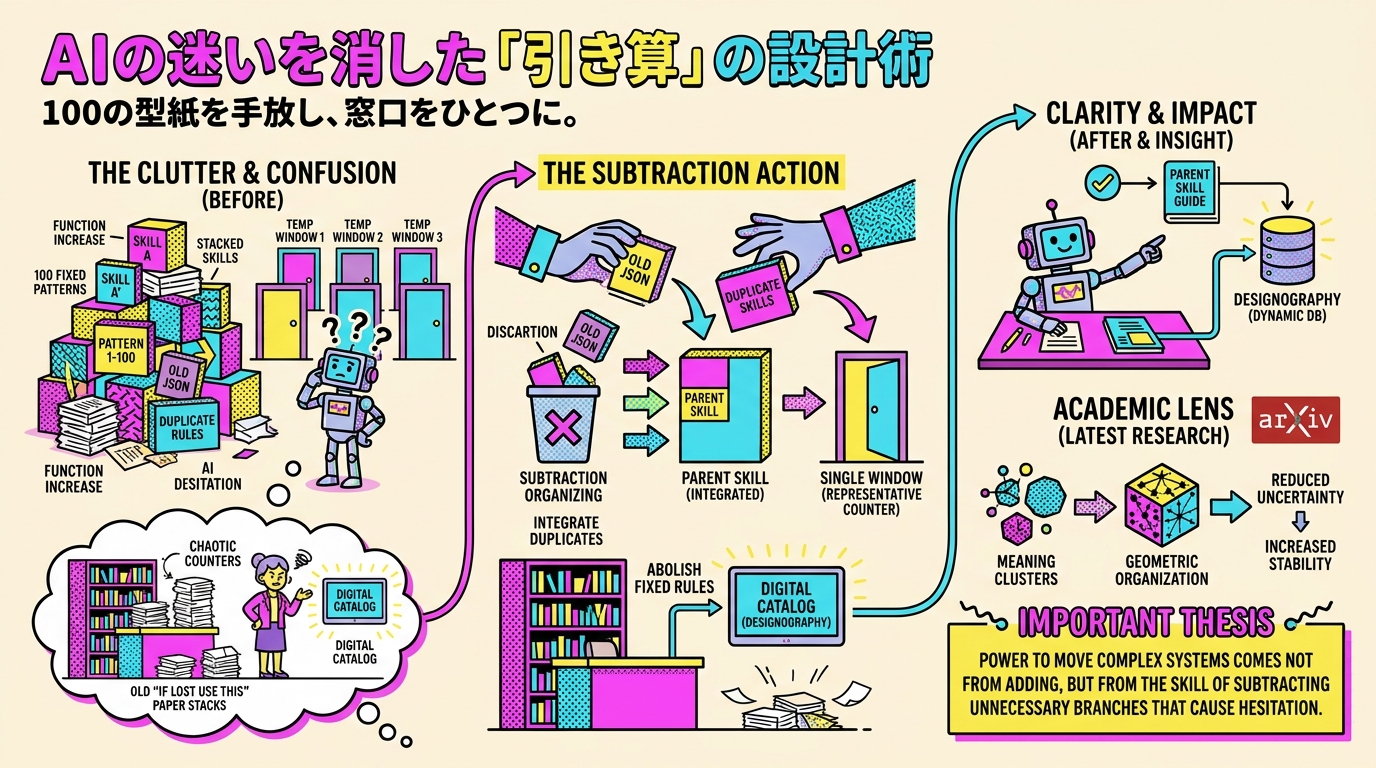
Letting Go of 100 Templates for a Single Desk: The Art of Subtractive Design That Eliminated AI Hesitation
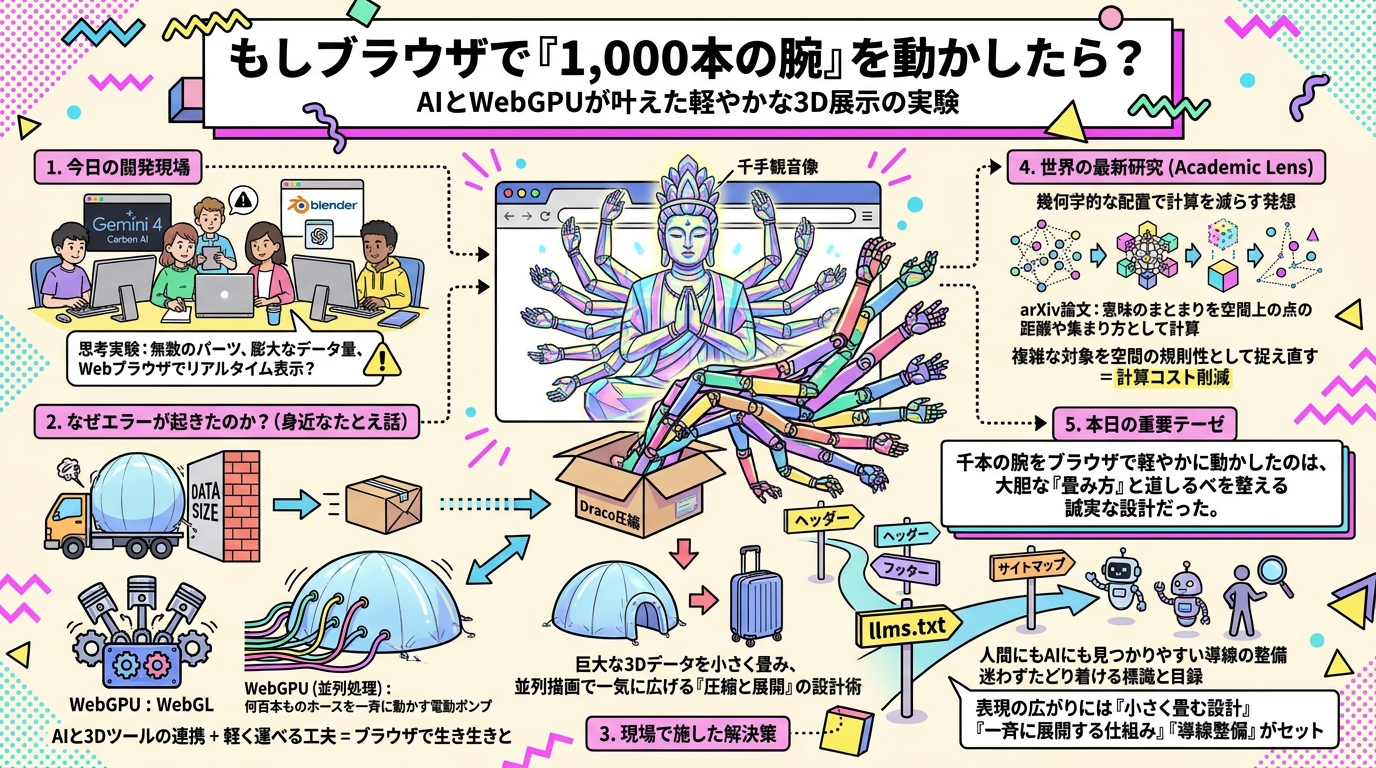
What If You Animated '1,000 Arms' in a Browser? A Lightweight 3D Exhibition Experiment Powered by AI and WebGPU
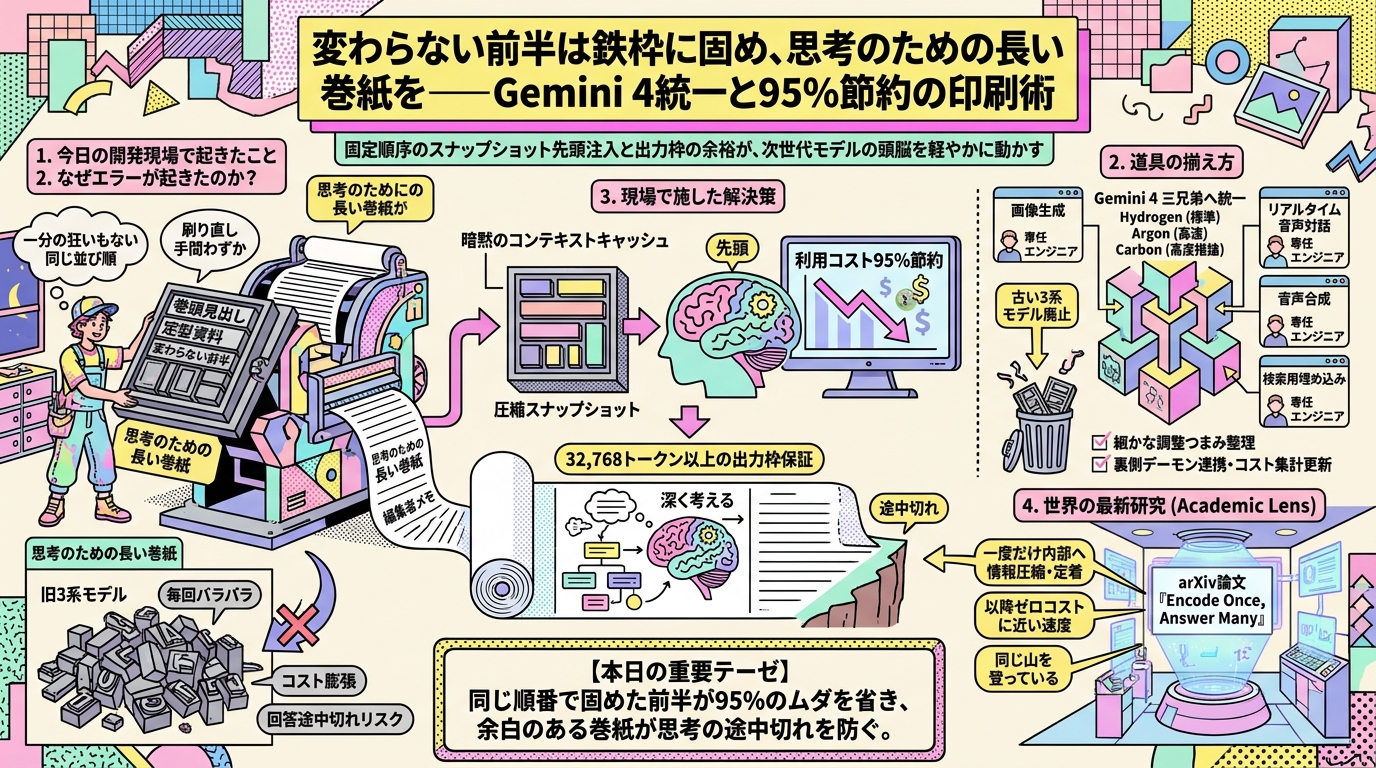
Locking the Constant Lead in Iron, Unrolling Long Scrolls for Thought — Gemini 4 Unification and the Art of 95% Printing Savings
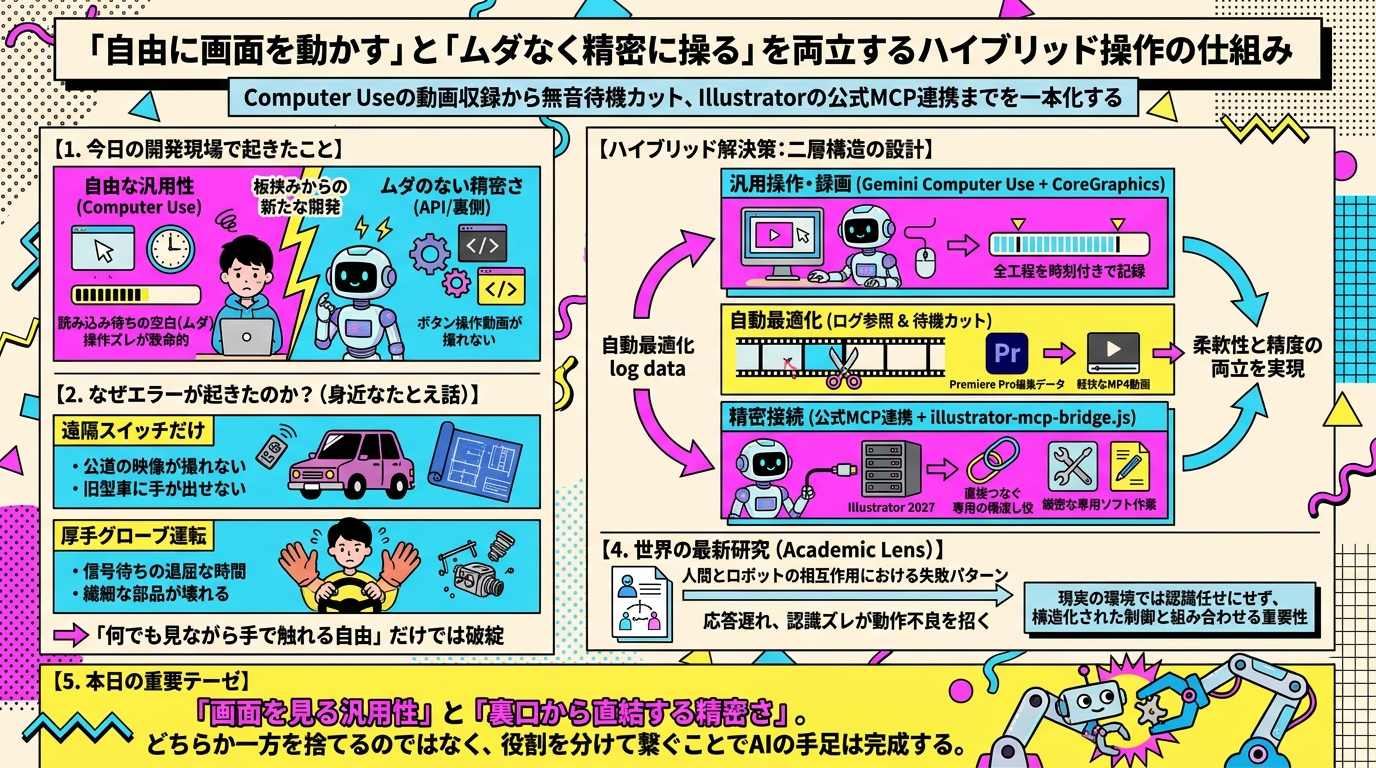
A Hybrid Control Architecture Bridging Free-Form Screen Navigation and Lean, Precision Execution
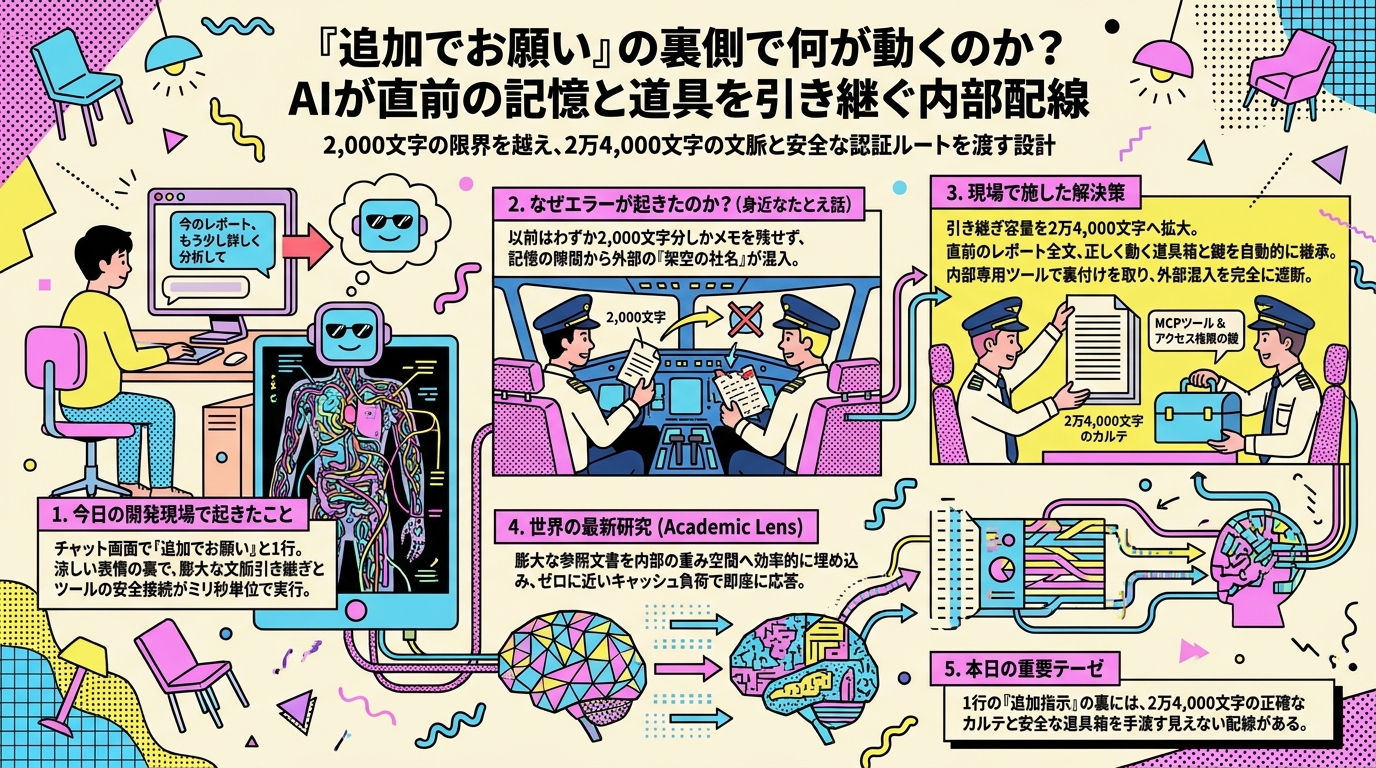
Behind "Just One More Request": The Internal Wiring That Hands Off Memory and Tools Between AIs